91- 6303239042
What is the sum of the following series?
-64, -66, -68,............., -100
Sign in
Please select an account to continue using cracku.in
↓ →
What is the sum of the following series?
-64, -66, -68,............., -100
The series is an A.P. with common difference, $$d = -66 - (-64) = -2$$
First term, $$a = -64$$ and last term $$a_n = -100$$
nth term of the series, $$a_n = a + (n - 1) d$$
=> $$-100 = -64 + (n - 1) (-2)$$
=> $$n - 1 = \frac{-36}{-2} = 18$$
=> $$n = 18 + 1 = 19$$
$$\therefore$$ Sum = $$\frac{n}{2} (a + a_n)$$
= $$\frac{19}{2} \times (-64 -100) = \frac{19}{2} \times (-164)$$
= $$19 \times (-82) = -1558$$
A solid metal cylinder of 10 cm height and 14 cm diameter is melted and re - cast into two cones in the proportion of 3 : 4 (volume), keeping the height 10 cm. What would be the percentage change in the flat surface area before and after?
Volume of Cylinder = $$\pi r^2 h = \pi \times 7^2 \times 10 = 490\pi$$
Now, The solid metal cylinder is re-cast into two cones in the proportion 3 : 4 i.e. the volumes of cone 1 and cone 2 is
$$210 \pi$$ and $$280 \pi$$ respectively.
So, flat Surface area of cylinder before melting = $$2 \pi r^2 = 2 \pi \times 7^2 = 98 \pi$$
Volume of cone 1 = $$\frac{1}{3} \pi r_1^2 h = 210 \pi$$
=> $$r_1^2 = \frac{210 \times 3}{10} = 63$$
Volume of cone 2 = $$\frac{1}{3} \pi r_2^2 h = 280 \pi$$
=> $$r_2^2 = \frac{280 \times 3}{10} = 84$$
Flat surface area of cones = $$\pi r_1^2 + \pi r_2^2$$
= $$\pi (63 + 84) = 147 \pi$$
$$\therefore$$ Percentage change in surface area = $$\frac{147 \pi - 98 \pi}{98 \pi} \times 100$$
= $$\frac{1}{2} \times 100 = 50 \%$$
The Maximum Retail Price (MRP) of a product is 55% above its manufacturing cost. The product is sold through a retailer, who earns 23% profit on his purchase price. What is the profit percentage (expressed in nearest integer) for the manufacturer who sells his product to the retailer? The retailer gives 10% discount on MRP.
Let Manufacturing Cost of the product = $$Rs. 100$$
=> Maximum Retail Price(MRP) = $$100 + \frac{55}{100} \times 100 = Rs. 155$$
Retailer gives 10% discount on MRP
=> Retailer's selling price = $$155 - \frac{10}{100} \times 155 = Rs. 139.5$$
It is given that the retailer earned 23% profit on his purchase price, say $$Rs. x$$
=> $$\frac{123 x}{100} = 139.5$$
=> $$x = \frac{13950}{123} = 113.41$$
Now, the purchase price of retailer = $$x$$ = selling price of Manufacturer
$$\therefore$$ Profit earned by Manufacturer = $$113.41 - 100 = 13.41$$
$$\approx 13 \%$$
Ramesh plans to order a birthday gift for his friend from an online retailer. However, the birthday coincides with the festival season during which there is a huge demand for buying online goods and hence deliveries are often delayed. He estimates that the probability of receiving the gift, in time, from the retailers A, B, C and D would be 0.6, 0.8, 0.9 and 0.5 respectively.
Playing safe, he orders from all four retailers simultaneously. What would be the probability that his friend would receive the gift in time?
The probability that his friend receives the gift in time will be when his friend receives even one gift.
That can be calculated as the probability of his friend receiving at least one gift.
The probability that none of the retailers sends in time = $$(1 - 0.6) \times (1 - 0.8) \times (1 - 0.9) \times (1 - 0.5)$$
= $$0.4 \times 0.2 \times 0.1 \times 0.5 = 0.004$$
$$\therefore$$ Probability of his receiving at least one gift = $$1 - 0.004 = 0.996$$
The figure below has been obtained by folding a rectangle. The total area of the figure (as visible) is 144 square meters. Had the rectangle not been folded, the current overlapping part would have been a square. What would have been the total area of the original unfolded rectangle?
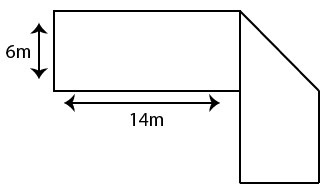

Area of given figure = 144 sq meter
It is given that BCE becomes square when we will unfold it, so to find the complete area of the figure shown as dotted after unfolding we need to add the area of triangle BCE.
Thus, BC = CE = 6 m
=> Area of $$\triangle$$ BCE = $$\frac{1}{2} \times 6 \times 6 = 18$$ sq meter
$$\therefore$$ Final area of whole figure = 144 + 18 = 162 square meter.
Find the equation of the graph shown below.

When x = -3, y = -10
This is satisfied only in option D.
Hence, option D is the correct answer.
Product M is produced by mixing chemical X and chemical Y in the ratio of 5 : 4. Chemical X is prepared by mixing two raw materials, A and B, in the ratio of 1 : 3. Chemical Y is prepared by mixing raw materials, B and C, in the ratio of 2 : 1. Then the final mixture is prepared by mixing 864 units of product M with water. If the concentration of the raw material B in the final mixture is 50%, how much water had been added to product M?
Let the quantities of the chemicals X and Y, mixed to produce product M be $$5c$$ and $$4c$$ respectively.
X is prepared by mixing A and B in the ratio = 1 : 3
=> Quantity of B in X = $$\frac{3}{4} \times 5c = \frac{15 c}{4}$$
Y is prepared by mixing B and C in the ratio = 2 : 1
Quantity of B in Y = $$\frac{2}{3} \times 4c = \frac{8 c}{3}$$
Quantity of B in M = $$\frac{15 c}{4} + \frac{8 c}{3} = \frac{77 c}{12}$$
Now, 864 units of M was mixed with water to prepare the final mixture.
=> Total quantity of M = $$9c = 864$$ => $$c = \frac{864}{9} = 96$$
Concentration of raw material B in the final mixture is 50 %
=> Quantity of final mixture = $$\frac{100}{50} \times \frac{77}{12} \times 96 = 1232$$
$$\therefore$$ Quantity of water added to M = $$1232 - 864 = 368$$ units
A circular road is constructed outside a square field. The perimeter of the square field is 200 ft. If the width of the road is 7√2 ft. and cost of construction is Rs. 100 per sq.ft. Find the lowest possible cost to construct 50% of the total road.

Perimeter of square ABCD = 200 ft
=> AB = $$\frac{200}{4} = 50$$ ft
=> $$DB = \sqrt{50^2 + 50^2} = 50 \sqrt{2}$$ ft
=> $$BO = r = \frac{50 \sqrt{2}}{2} = 25 \sqrt{2}$$ ft
Width of the road = BX = $$7 \sqrt{2}$$ ft
=> $$BX = R = 25 \sqrt{2} + 7 \sqrt{2} = 32 \sqrt{2}$$
Area of bigger circle = $$\pi R^2 = \pi (32 \sqrt{2})^2 = 2048 \pi$$ sq. ft
Area of smaller circle = $$\pi r^2 = \pi (25 \sqrt{2})^2 = 1250 \pi$$ sq. ft
=> Area of road = $$2048 \pi - 1250 \pi = 798 \times \frac{22}{7} = 2508$$ sq. ft
But we have to calculate cost of construction of 50% road.
Required Construction = $$\frac{2508}{2} = 1254$$ sq. ft
$$\therefore$$ Cost of 1254 ft = $$1254 \times 100 = Rs. 1,25,400$$
In the diagram below, CD = BF = 10 units and ∠CED = ∠BAF = 30°. What would be the area of triangle AED? (Note: Diagram below may not be proportional to scale.)


In $$\triangle$$ ABF
=> $$tan 30 = \frac{BF}{AB}$$
=> $$\frac{1}{\sqrt{3}} = \frac{10}{AB}$$
=> $$AB = 10 \sqrt{3}$$
Similarly, $$ED = 10 \sqrt{3}$$
Also, $$\angle ECD = \angle BCF = 60$$ (Vertically opposite angles)
In $$\triangle$$ BCF
=> $$tan 60 = \frac{BF}{BC}$$
=> $$\sqrt{3} = \frac{10}{BC}$$
=> $$BC = \frac{10}{\sqrt{3}}$$
=> Height = $$AD = AB + BC + CD = 10 \sqrt{3} + \frac{10}{\sqrt{3}} + 10 = \frac{40 + 10 \sqrt{3}}{\sqrt{3}}$$
$$\therefore area (\triangle AED) = \frac{1}{2} \times AD \times ED$$
= $$\frac{1}{2} \times \frac{40 + 10 \sqrt{3}}{\sqrt{3}} \times 10 \sqrt{3}$$
= $$50 (\sqrt{3} + 4)$$
Two diagonals of a parallelogram intersect each other at coordinates (17.5, 23.5). Two adjacent points of the parallelogram are (5.5, 7.5) and (13.5, 16). Find the lengths of the diagonals.

Using distance formula,
$$CX = \sqrt{(17.5 - 5.5)^2 + (23.5 - 7.5)^2} = \sqrt{12^2 + 16^2}$$
= $$\sqrt{144 + 256} = \sqrt{400} = 20$$
=> $$AC = 2 \times CX = 40$$
$$BX = \sqrt{(17.5 - 13.5)^2 + (23.5 - 16)^2} = \sqrt{4^2 + 7.5^2}$$
= $$\sqrt{16 + 56.25} = \sqrt{72.25} = 8.5$$
=> $$BD = 2 \times BX = 17$$
If $$f(x^2 - 1) = x^4 - 7x^2 + k_1$$ and $$f(x^3 - 2) = x^6 - 9x^3 +k_2$$ then the value of $$(k_2 - k_1)$$ is
$$f(x^2 - 1) = x^4 - 7x^2 + k_1$$
Put $$x^2 = 1$$ to make it 0
=> $$f(0) = (1)^2 - 7(1) + k_1 = k_1 - 6$$ --------(i)
Also, $$f(x^3 - 2) = x^6 - 9x^3 +k_2$$
Put $$x^3 = 2$$
=> $$f(0) = (2)^2 - 9(2) + k_2 = k_2 - 14$$ -----------(ii)
Equating (i) & (ii), we get :
=> $$k_1 - 6 = k_2 - 14$$
=> $$k_2 - k_1 = 14 - 6 = 8$$
In the beginning of the year 2004, a person invests some amount in a bank. In the beginning of 2007, the accumulated interest is Rs. 10,000 and in the beginning of 2010, the accumulated interest becomes Rs. 25,000. The interest rate is compounded annually and the annual interest rate is fixed. The principal amount is:
Let the principal amount = $$P$$ and rate of interest = $$r \%$$
Interest accumulated from 2004 to 2007 is Rs.10,000 and from 2004 to 2010 is Rs.25,000
Using, $$C.I. = P[(1 + \frac{R}{100})^T - 1]$$
=> $$P[(1 + \frac{r}{100})^3 - 1] = 10,000$$ ----------Eqn(I)
and $$P[(1 + \frac{r}{100})^6 - 1] = 25,000$$ -----------Eqn(II)
Dividing eqn(II) from (I), we get :
=> $$\frac{P[(1 + \frac{r}{100})^6 - 1]}{P[(1 + \frac{r}{100})^3 - 1]} = \frac{5}{2}$$
Let $$(1 + \frac{r}{100})^3 = x$$
=> $$\frac{x^2 - 1}{x - 1} = \frac{5}{2}$$
=> $$2x^2 - 5x + 3 = 0$$
=> $$(2x - 3) (x - 1) = 0$$
=> $$x = \frac{3}{2} , 1$$ $$(x \neq 1)$$ because then, r = 0
=> $$(1 + \frac{r}{100})^3 = \frac{3}{2}$$
Substituting it in eqn(I)
=> $$P[\frac{3}{2} - 1] = 10,000$$
=> $$P = 10,000 \times 2 = 20,000$$
The tax rates for various income slabs are given below.

There are 15 persons working in an organization. Out of them, 3 to 5 persons are falling in each of the income slabs mentioned above. Which of the following is the correct tax range of the 15 persons? (E.g. If one is earning Rs. 2000, the tax would be:
500 × 0 + 1500 ×0.05)
Minimum tax paid would be = (15*0)+(6*1500*0.05)+(3*3000*0.10)= 450+900 = 1350
Maximum tax paid will be = (15*0) + (12*1500*0.05) + (9*3000*0.10) +(5*5000*0.15) = 0+900+2700+3750 = 7350
Since we have approximate the value so the actual minimum tax will be greater than 1350 and actual maximum tax will be less than 7350
If a, b, c and d are four different positive integers selected from 1 to 25, then the highest possible value of ((a + b) + (c +d ))/((a + b) + (c - d)) would be:
Expression : $$\frac{a + b + c + d}{a + b + c - d}$$
To maximize the above expression, we have to minimize the denominator
Minimum value of the denominator = 1
So we can make $$a + b + c = 26$$ and $$d = 25$$ (as maximizing d will give denominator the least value).
So required maximum value = $$\frac{a + b + c + d}{a + b + c - d}$$
= $$\frac{26 + 25}{26 - 25} = 51$$
An ascending series of numbers satisfies the following conditions:
i. When divided by 3, 4, 5 or 6, the numbers leave a remainder of 2.
Ii. When divided by 11, the numbers leave no remainder.
The 6th number in this series will be:
L.C.M. of 3,4,5,6 = 60
Number is of the form = $$60 k_1 + 2$$ -------------(i)
When divided by 11, it leaves 0 remainder so number will also be of the form = $$11 k_2$$ ---------(ii)
Hence equating (i) and (ii), we get,
$$60k_1 + 2 = 11k_2$$
$$60k_1 - 11k_2 = -2$$ or $$11k_2 - 60k_1 = 2$$ -----------(iii)
It means $$60k_1$$ will leave remainder 9 when divide by 11.
Lets consider values for 60k1, if k1=1, 60k1=60, reminder is 60mod11=5
120mod11 will be 5+5=10, 180mod11 will be 5+5+5=15, since 15>11, reminder will be 15-11=4
240mod11 reminder will be 4+5=9
$$\therefore$$ By remainder root $$\frac{4 k_1}{11}$$ should leave remainder as 9 or -2
=> Possible values of $$K_1 = 4, 15, 26, 37, 48, 59$$ (As 11 and 60 are co-prime)
$$\therefore$$ Required value = $$60 \times 59 + 2 = 3540 + 2 = 3542$$
Alternatively,
L.C.M. of 3,4,5,6 = 60
As the number 60k+2 is divisible by 11, 60k leaves a reminder of 9
60mod11=5, 120mod11=10, 180mod11=4, 240mod11=9
Hence the first number where both conditions are satisfied as 242.
As 60 and 11 are co-prime, the next number where this is true is 242+60*11
Hence, the numbers are in the form 242+660k
For 6th number, k=5 => 3300+242=3542
In an examination, two types of questions are asked: one mark questions and two marks questions. For each wrong answer, of one mark question, the deduction is 1/4 of a mark and for each wrong answer, of two marks question, the deduction is 1/3 of a mark.
Moreover, 1/2 of a mark is deducted for any unanswered question. The question paper has 10 one mark questions and 10 two marks questions. In the examination, students got all possible marks between 25 and 30 and every student had different marks. What would be the rank of a student, who scores a total of 27.5 marks?
It is evident that, 1 wrong 2 marks question would result in 2.33 deduction from the total (As negative in 2 marks question is 1/3 of a mark)
1 wrong of 1 mark question lead to deduction of 1.25 marks
1 unattempted of 1 mark question lead to deduction of 1.5 marks
1 unattempted of 2 marks question lead to deduction of 3 marks

$$\therefore$$ Rank of student who scores 27.5 = 5
For a positive integer x, define f(x) such that f(x + a) = f(a × x), where a is an integer and f(1) = 4. If the value of f(1003) = k, then the value of ‘k’ will be:
Expression : $$f (x + a) = f (a \times x)$$
Also, $$f(1) = 4$$
Now, $$f(1003) = f(1002 + 1) = f(1002 \times 1) = f(1002)$$
Similarly, $$f(1002) = f(1001) = f(1000) = ......... = f(1) = 4$$
$$\therefore f(1003) = k = 4$$
Devanand’s house is 50 km West of Pradeep’s house. On Sunday morning, at 10 a.m., they leave their respective houses.
Under which of the following scenarios, the minimum distance between the two would be 40 km?
Scenario I: Devanand walks East at a constant speed of 3 km per hour and Pradeep walks South at a constant speed of 4 km per hour.
Scenario II: Devanand walks South at a constant speed of 3 km per hour and Pradeep walks East at a constant speed of 4 km per hour.
Scenario III: Devanand walks West at a constant speed of 4 km per hour and Pradeep walks East at a constant speed of 3 km per hour.
Scenario I : Devanand's position after $$t$$ hours is $$(50 - 3t)$$ km west of Pradeep's house, while Pradeep's position is $$4t$$ km south of his own house.
If $$d$$ is the distance between them, then
=> $$d^2 = (50 - 3t)^2 + (4t)^2$$
=> $$d^2 = 2500 - 300t + 25t^2$$
=> $$d^2 = 25 (t^2 - 12t + 36) + 1600$$
=> $$d^2 = 25 (t - 6)^2 + 1600$$
Thus, minimum distance is 40 km after 6 hours.
Thus, scenario I is possible
Scenario II & III are not possible as minimum distance in that case would be 50 km as after that distance will keep on increasing between the two.
The median of 11 different positive integers is 15 and seven of those 11 integers are 8, 12, 20, 6, 14, 22, and 13.
Statement I: The difference between the averages of four largest integers and four smallest integers is 13.25.
Statement II: The average of all the 11 integers is 16.
Which of the following statements would be sufficient to find the largest possible integer of these numbers?
Median of 11 integers is 15, => In ascending order 6th integer = 15
=> Numbers = 6,8,12,13,14,15,20,22
Statement I : Average of four smallest = 6 + 8 + 12 + 13
= $$\frac{39}{4} = 9.75$$
It is given that, avg of 4 largest - avg of 4 smallest = 13.25
=> Average of 4 largest = 13.25 + 9.75 = 23
=> Sum of 4 largest numbers = 23 * 4 = 92
So, we can easily allocate other three numbers different minimum values but more than 15 and maximize the remaining one value
Thus, statement I is sufficient.
Statement II : Sum of 11 integers = 11 * 16 = 176
Sum of given 8 integers = 6+8+12+13+14+15+20+22 = 110
Sum of remaining numbers = 176 - 110 = 66
So, we can easily allocate other three numbers different minimum values but more than 15 and maximize the remaining one value
Thus, statement II is sufficient.
$$\therefore$$ Either statement I or II is sufficient.
The parallel sides of a trapezoid ABCD are in the ratio of 4 : 5. ABCD is divided into an isosceles triangle ABP and a parallelogram PBCD (as shown below). ABCD has a perimeter equal to 1120 meters and PBCD has a perimeter equal to 1000 meters. Find Sin$$\angle$$ABC, given 2$$\angle$$DAB = $$\angle$$BCD.
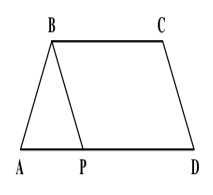
AB + BC + CD + AD = 1120 ------------Eqn(I)
PB + BC + CD + PD = 1000 -------------Eqn(II)
Subtracting eqn(II) from (I), we get :
=> AB - PB + (AD - PD) = 120
=> AB - PB + AP = 120
=> AB + AP = 120 + PB
Now, if AB = PB, => AP = 120
=> AD = 600 and BC = 480, then AB + PB + CD = 40, which is not possible (We know that BC = PD. If BC = PD = 480, then BC+PD = 960. PB + BC + CD + PD = 1000.
=> PB+CD = 40. Therefore, AB + PB+CD should be greater than 40).
Similarly, AB = AP is also not possible. Thus $$AP = BP$$

=> $$\angle ABC = x + (180 - 2x) = (180 - x)$$
=> $$sin \angle ABC = sin (180 - x) = sin x$$
Also, perimeter of PBCD = $$10y = 1000$$ => $$y = 100$$
and perimeter of ABCD = $$AB + 10y = 1120$$ => $$AB = 120$$
Applying cosine rule in $$\triangle$$ ABP
=> $$cos x = \frac{(AB)^2 + (AP)^2 - (BP)^2}{2 AB AP}$$
=> $$cos x = \frac{(120)^2 + (100)^2 - (100)^2}{2 \times 120 \times 100}$$
=> $$cos x = \frac{120}{200} = \frac{3}{5}$$
$$\therefore sin x = \sqrt{1 - (\frac{3}{5})^2} = \sqrt{1 - \frac{9}{25}}$$
= $$\sqrt{\frac{16}{25}} = \frac{4}{5}$$
A three - digit number has digits in strictly descending order and divisible by 10. By changing the places of the digits a new three - digit number is constructed in such a way that the new number is divisible by 10. The difference between the original number and the new number is divisible by 40. How many numbers will satisfy all these conditions?
Since the three digit number is divisible by 10, then the unit's digit is 0
Let the three digit number = $$a b 0$$
After the digits are interchanged, the new number is also divisible by 10, thus only a and b are interchanged.
=> New number = $$b a 0$$
Difference between number is divisible by 40
=> $$(100a + 10b) - (100b + 10a) = 40 k$$ (k is constant)
=> $$90a - 90b = 90 (a - b) = 40 k$$
=> k = $$\frac{9\left(a-b\right)}{4}$$
Since k is a natural number (a-b) should be a multiple of 4
If a = 9 , the values of b that satisfies the given equation are 1,5
If a = 8 , the value of b that satisfies the given equation is 4
If a = 7 , the values of b that satisfies the given equation is 3
If a = 6 , the values of b that satisfies the given equation is 2
If a = 5 , the values of b that satisfies the given equation is 1
The number could be = 510,620,730,840,950, 910
Thus, there are 6 numbers that satisfy these conditions.
The centre of a circle inside a triangle is at a distance of 625 cm from each of the vertices of the triangle. If the diameter of the circle is 350 cm and the circle is touching only two sides of the triangle, find the area of the triangle.

If a point is equidistant from all 3 vertices, it has to be the circumcentre. The given circle with centre S is concentric and touches two sides.
As S is equidistant from 2 of the sides (say AB and AC), => It lies on angle bisector of $$\angle A$$.
=> $$\triangle ABC$$ is isosceles with AB = AC
Radius of the circle = RS = SQ = 175 cm and SA = SB = SC = 625 cm
=> $$AR = \sqrt{625^2 - 175^2} = 600$$
Let SP = x
=> $$(BP)^2 = (BA)^2 - (AP)^2 = (BS)^2 - (SP)^2$$
=> $$1200^2 - (625 + x)^2 = 625^2 - x^2$$
=>$$1200^2 - 625^2 - x^2 - 2*625x = 625^2 - x^2$$
=> $$1200^2 - 2 * 625^2 = 1250x$$
=> $$x = \frac{658750}{1250} = 527$$
=> $$BP = \sqrt{625^2 - 527^2} = 336$$
$$\therefore$$ ar $$(\triangle ABC)$$ = $$\triangle ASB + \triangle ASC + \triangle SBC$$
= $$(600 \times 175) + (600 \times 175) + (527 \times 336)$$
= $$105000 + 105000 + 177072 = 387072$$
If the last 6 digits of [(M)! - (N)!] are 999000, which of the following option is not possible for (M) × (M - N)? Both (M) and (N) are positive integers and M > N. (M)! is factorial M.
None of the answers given are correct. The reasoning is as given below.
999000 is a multiple of 8 but not of 16. If N! is a multiple of 16, M! would also be a multiple of 16 and hence M!-N! would be a multiple of 16.
Hence, as M!-N! = 999000, it would imply that N! is a multiple of 8 and not of 16. Therefore, N is either 4 or 5. So, N! is either 24 or 120. So, it would imply that M! is either 999024 or 999120. Both of which are not factorials for any natural number.
Hence, the given question is wrong.
A person is standing at a distance of 1800 meters facing a giant clock at the top of a tower. At 5.00 p.m., he can see the tip of the minute hand of the clock at 30 degree elevation from his eye - level. Immediately, the person starts walking towards the tower. At 5.10 pm., the person noticed that the tip of the minute hand made an angle of 60 degrees with respect to his eye - level. Using three - dimensional vision, find the speed at which the person is walking. The length of the minutes hand is 200√3 meters (√3 = 1.732).

Let O be the centre of the clock. Let the person's eye be at A and the tip of minute hand at 5.00 p.m. is at P and at 5.10 p.m. at Q
AM = 1800 m and OP = OQ = $$200\sqrt{3}$$ m
In $$\triangle$$ APM
=> $$tan 30 = \frac{PM}{AM}$$
=> $$\frac{1}{\sqrt{3}} = \frac{PM}{1800}$$
=> $$PM = \frac{1800}{\sqrt{3}} = 600 \sqrt{3}$$
=> $$OM = PM - OP = 600 \sqrt{3} - 200 \sqrt{3} = 400 \sqrt{3}$$
In $$\triangle$$ OBM
=> $$tan 60 = \frac{OM}{BM}$$
=> $$\sqrt{3} = \frac{400 \sqrt{3}}{BM}$$
=> $$BM = 400$$ m
=> $$AB = AM - BM = 1800 - 400 = 1400$$ m
Time taken to reach B from A = 10 minutes = 600 sec
$$\therefore$$ Speed of the person = $$\frac{1400}{600} = \frac{7}{3}$$ m/s
= $$(\frac{7}{3} \times \frac{18}{5})$$ km/hr = $$8.4$$ km/hr
Three pipes are connected to an inverted cone, with its base at the top. Two inlet pipes, A and B, are connected to the top of the cone and can fill the empty in 8 hours and 12 hours, respectively. The outlet pipe C, connected to the bottom, can empty a filled cone in 4 hours. When the cone is completely filled with water, all three pipes are opened. Two of the three pipes remain open for 20 hours continuously and the third pipe remains open for a lesser time. As a result, the height of the water inside the cone comes down to 50%. Which of the following options would be possible?
Height of cone comes down to 50%, => it becomes $$\frac{1}{2}$$
=> Volume would become $$\frac{1}{8}$$ as radius will also become half by similar triangles.
Let the capacity of cone = 24 litres
Volume of water run-off = $$24 - \frac{1}{8} \times 24 = 21$$ litres
Volume of water left in the cone = $$ \frac{1}{8} \times 24 = 3$$ litres
Pipe A's efficiency = $$\frac{24}{8} = 3$$ litres/hr
Pipe B's efficiency = $$\frac{24}{12} = 2$$ litres/hr
Pipe C's efficiency = $$\frac{24}{-4} = -6$$ litres/hr
All will run 19 hours simultaneously (going by the options)
=> Net effect = $$(3 + 2 - 6) \times 19 = -19$$ litres
This means that after 19 hours, 19 litres of water has been removed, we need to remove 2 more litres as per the requirement. Thus, C will definitely run for another hour.
If we run A and C together for the 20th hour, net effect = $$(3 - 6) \times 1 = -3$$ litres
Run B for 30 minutes => $$2 \times \frac{1}{2} = 1$$ litres
$$\therefore$$ Volume of water removed = $$-19 -3 + 1 = -21$$ litres
Thus, Pipe B was open for 19 hours 30 minutes.
Answer the questions on the basis of information given below.
As a part of employee improvement programs, every year an organization conducts a survey on three factors: 1. Number of days (in integers) of training undergone, 2. Amount of bonus (in lacs) received by an employee and 3. Employee effectiveness score (on the scale of 1 to 10). Survey results for last two years are given below for the same seven employees.


In Survey 1, what was the average bonus earned by employees who underwent training for more than 17 days?

By using graphs 2A and 3A, we get the above table.
For employees 4 and 5, the training days is more than 17.
Average of the bonus of 4, 5 = $$\ \frac{\ 21+18}{2}$$= 19.5
D is the correct answer.
Identify the number of employees whose employee effectiveness score was higher than 7 in Survey 1, but whose bonus was lower than 20 lacs in Survey 2.

Using graphs 1 and 3A, we get the above table.
The effective score of the employees is greater than 7 for employees 1, 4, 5, 7.
Among them, the bonus is less than 20 lakhs for 4, 7.
A is the correct answer.
From Survey 1 to Survey 2, how many employees underwent more days of training but their annual bonus decreased?
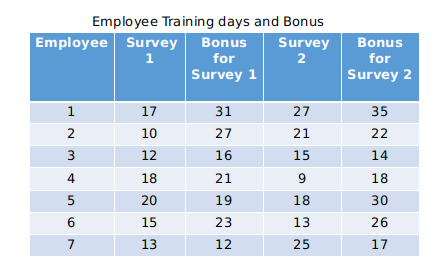
By using the data in 2A and 3A, we get the above table.
From the above table, it is clear that for the employees 1, 2, 3, 7 the number of training days increased from Survey 1 to 2.
Out of them for the employees 2, 3 the annual bonus decreased.
B is the correct answer.
From Survey 1 to Survey 2: for how many employees training days increased along with an increase of employee effective score by at least 1.0 rating?

from the above table, it is clear that for the employees 1, 2, 3, 7 the number of training days increased from Survey 1 to Survey 2.
Out of which for the employees 2, 3 the effective score increased by at least 1.0
A is the correct answer.
Answer the questions on the basis of information given below.
Twitter allows its users to post/share and read short messages known as tweets. Tweets can be of three types – Positive Tweets (in support), Negative Tweets (against) and Neutral Tweets. The following table presents the Number of Votes and Tweets received by certain political parties.
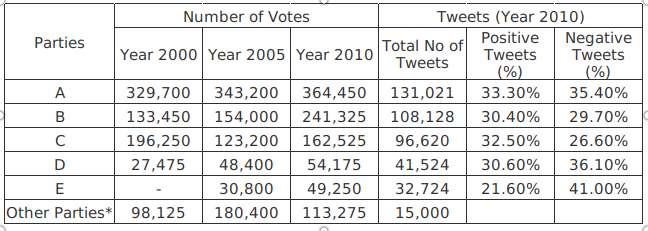
* Any party which has secured less than 2% of the total votes falls under ‘Other Parties’ category. For example, Party E secured less than 2% of total votes, in the year 2000.
Note: If the vote share (%age of total votes) of a party changes from 15% to 40%, gain in vote share would be 25% (= 40%, – 15%).
Which of the following options correctly arranges the political parties in descending order of gain in vote share from the year 2005 to the year 2010?

From the above table, it is clear that the decreasing order of gain of vote share = BCEDA
D is the correct answer.
Which of the following parties received maximum number of “neutral tweets” in the year 2010?
Using the data in the table, we can calculate the number of neutral votes for each party as follows:
Party B: 108128 * (100 - 30.4 - 29.7)/100 = 43143
Party C: 96620 * (100 - 32.50 - 26.60)/100 = 39517
Party D: 41524 * (100 - 30.60 - 36.10)/100 = 13827
Party E: 32724 * (100 - 21.60 - 41) /100 = 12239
Thus, we can see that Party B has the maximum number of neutral votes.
Hence, option A is the correct answer.
Between 2000 and 2010, in terms of gain in vote share which of the following cannot
be a possible value (approximated to one decimal place) for any party?
The table representing the Vote share of parties in the years 2000 and 2010 is as follows.
.png)
From the table, we can see that 2 and 7.5 are possible values.
Party E’s votes in 2000 are less than 2% of the total votes as given in the question. Thus, the Gain in vote share will be between 3 and 5%.
Thus, only 2.5% is the option that is not possible.
Hence, option B is the answer.
In 2010, which of the following options has maximum difference between the vote share and tweet share?
The table representing the Vote share and Tweet share in the year 2010 is as follows:
.png)
The table shows that the maximum difference between the vote share and tweet share is for “Other” parties.
Hence, option E is the correct answer.
Start your IIM journey with the right preparation and crack CAT 2026.

Educational materials for CAT preparation
 Share
Share