For the following questions answer them individually
For a reaction, N$$_2$$(g) + 3H$$_2$$(g) $$\rightarrow$$ 2NH$$_3$$(g), identify di-hydrogen (H$$_2$$) as a limiting reagent in the following reaction mixtures.
For any given series of spectral lines of atomic hydrogen, let $$\Delta\bar{v} = \bar{v}_{max} - \bar{v}_{min}$$ be the difference in maximum and minimum wave number in cm$$^{-1}$$. The ratio $$\Delta\bar{v}_{Lyman}/\Delta\bar{v}_{Balmer}$$ is:
The element having the greatest difference between its first and second ionization energies, is:
Among the following, the molecule expected to be stabilized by anion formation is: C$$_2$$, O$$_2$$, NO, F$$_2$$
Consider the van der Waal's constants, a and b, for the following gases.

Which gas is expected to have the highest critical temperature?
Among the following, the set of parameters that represents path functions, is:
i) q + w
ii) q
iii) w
iv) H - TS
Magnesium powder burns in air to give:
C$$_{60}$$, an allotrope of carbon contains:
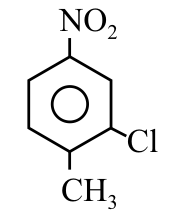
The correct IUPAC name of the following compound is:
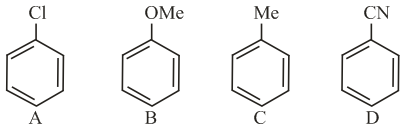
The increasing order of reactivity of the following compounds towards aromatic electrophilic substitution reaction is:
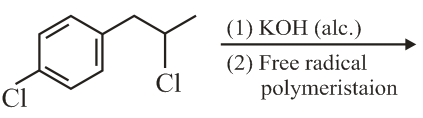
The major product of the following reaction is:
Excessive release of CO$$_2$$ into the atmosphere results in:
The osmotic pressure of a dilute solution of an ionic compound XY in water is four times that of a solution of 0.01 M BaCl$$_2$$ in water. Assuming complete dissociation of the given ionic compounds in water, the concentration of XY (in mol L$$^{-1}$$) in solution is:
Liquid M and liquid N form an ideal solution. The vapour pressures of pure liquids M and N are 450 and 700 mmHg, respectively, at the same temperature. Then correct statements is:
(x$$_M$$ = Mole fraction of 'M' in solution; x$$_N$$ = Mole fraction of 'N' in solution; y$$_M$$ = Mole fraction of 'M' in vapour phase; y$$_N$$ = Mole fraction of 'N' in vapour phase)
The standard Gibbs energy for the given cell reaction in kJ mol$$^{-1}$$ at 298 K is:
Zn(s) + Cu$$^{2+}$$(aq) $$\rightarrow$$ Zn$$^{2+}$$(aq) + Cu(s),
E$$^0$$ = 2 V at 298 K
(Faraday's constant, F = 96000 C mol$$^{-1}$$)
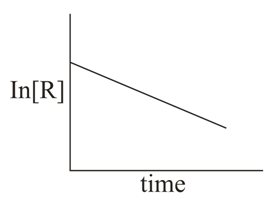
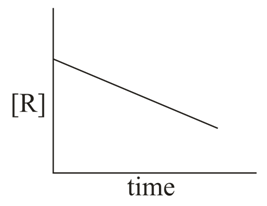
The given plots represent the variation of the concentration of a reactant R with time for two different reactions (i) and (ii). The respective orders of the reaction are:

The aerosol is a kind of colloid in which:
The ore that contains the metal in the form of fluoride is known as which of the following?
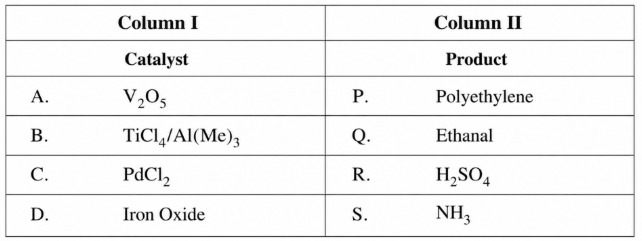
Match the catalysts (Column I) with products (Column II)
The correct order of the oxidation states of nitrogen in NO, N$$_2$$O, NO$$_2$$ and N$$_2$$O$$_3$$ is:
The number of water molecules not coordinated to copper ion directly in CuSO$$_4$$ . 5H$$_2$$O, is:
The degenerate orbitals of [Cr(H$$_2$$O)$$_6$$]$$^{3+}$$ are:
The one that will show optical activity is (en = ethane-1, 2-diamine):
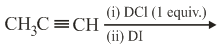
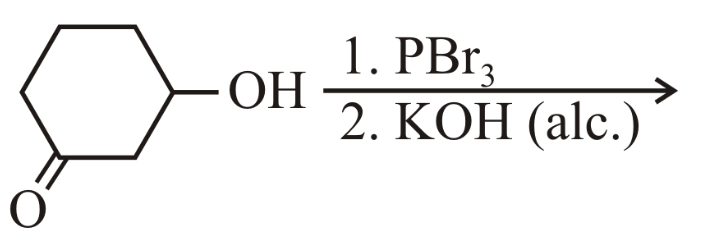
The major product of the following reaction is:
1. PBr$$_3$$
2. KOH (alc.)
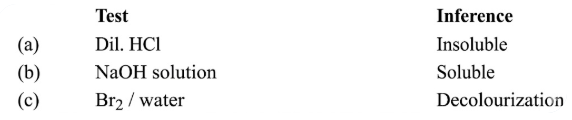
The organic compound that gives following qualitative analysis is:
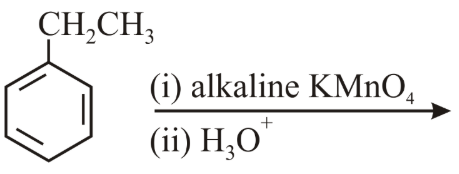
The major product of the following reaction is:
CH$$_3$$CH = CHCO$$_2$$CH$$_3$$ $$\xrightarrow{\text{LiAlH}_4}$$
Aniline dissolved in dilute HCl is reacted with sodium nitrite at 0°C. This solution was added dropwise to a solution containing an equimolar mixture of aniline and phenol in dilute HCl. The structure of the major product is:
Which of the following statements is not true about sucrose?