The percentage composition of carbon by mole in methane is:

Join Our JEE Preparation Group
Prep with like-minded aspirants; Get access to free daily tests and study material.
Sign in
Please select an account to continue using cracku.in
↓ →
Join Our JEE Preparation Group
Prep with like-minded aspirants; Get access to free daily tests and study material.
The percentage composition of carbon by mole in methane is:
Login to view the detailed solution.
0.27 g of a long chain fatty acid was dissolved in 100 cm$$^3$$ of hexane. 10 mL of this solution was added dropwise to the surface of water in a round watch glass. Hexane evaporates and a monolayer is formed. The distance from edge to centre of the watch glass is 10 cm. What is the height of the monolayer?
[Density of fatty acid = 0.9 g cm$$^{-3}$$; $$\pi = 3$$]
Login to view the detailed solution.
If p is the momentum of the fastest electron ejected from a metal surface after the irradiation of light having wavelength $$\lambda$$, then for 1.5 p momentum of the photoelectron, the wavelength of the light should be: (Assume kinetic energy of ejected photoelectron to be very high in comparison to work function)
Login to view the detailed solution.
.webp)
The IUPAC symbol for the element with atomic number 119 would be:
Login to view the detailed solution.
Among the following molecules/ions, $$C_2^{2-}$$, $$N_2^{2-}$$, $$O_2^{2-}$$, $$O_2$$, which one is diamagnetic and has the shortest bond length?
Login to view the detailed solution.
5 moles of an ideal gas at 100 K are allowed to undergo reversible compression till its temperature becomes 200 K. If $$C_V = 28$$ J K$$^{-1}$$, calculate $$\Delta U$$ and $$\Delta pV$$ for the process. (R = 8.0 J K$$^{-1}$$ mol$$^{-1}$$)
Login to view the detailed solution.
.webp)
For the following reaction, equilibrium constants are given:
$$S(s) + O_2(g) \rightleftharpoons SO_2(g); \quad K_1 = 10^{52}$$
$$2S(s) + 3O_2(g) \rightleftharpoons 2SO_3(g); \quad K_2 = 10^{129}$$
The equilibrium constant for the reaction, $$2SO_2(g) + O_2(g) \rightleftharpoons 2SO_3(g)$$ is:
Login to view the detailed solution.
The strength of 11.2 volume solution of H$$_2$$O$$_2$$ is:
[Given that, the molar mass of H = 1 g mol$$^{-1}$$ and O = 16 g mol$$^{-1}$$]
Login to view the detailed solution.
The covalent alkaline earth metal halide X = Cl, Br, I is:
Login to view the detailed solution.
.webp)
Which of the following compounds will show the maximum 'enol' content?
Login to view the detailed solution.
Polysubstitution is a major drawback in:
Login to view the detailed solution.
Which one of the following alkenes when treated with HCl yields majorly an anti Markovnikov product?
Login to view the detailed solution.
.webp)
The maximum prescribed concentration of copper in drinking water is:
Login to view the detailed solution.
Consider the bcc unit cells of the solids 1 and 2 with the position of atoms as shown below. The radius of atom B is twice that of atom A. The unit cell edge length is 50% more in solid 2 than in 1. What is the approximate packing efficiency in solid 2?
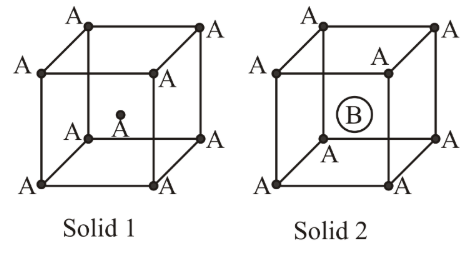
Login to view the detailed solution.
For the solution of the gases w, x, y and z in water at 298 K, the Henry's law constants (K$$_H$$) are 0.5, 2, 35 and 40 kbar, respectively. The correct plot for the given data is:
Login to view the detailed solution.

Calculate the standard cell potential (in V) of the cell in which the following reaction takes place:
Fe$$^{2+}$$(aq) + Ag$$^+$$(aq) $$\rightarrow$$ Fe$$^{3+}$$(aq) + Ag(s)
Given that $$E^{0}_{Ag^+/Ag} = x$$ V, $$E^{0}_{Fe^{2+}/Fe} = y$$ V, $$E^{0}_{Fe^{3+}/Fe} = z$$ V
Login to view the detailed solution.
For a reaction scheme A $$\xrightarrow{k_1}$$ B $$\xrightarrow{k_2}$$ C, if the net rate of formation of B is set to be zero then the concentration of B is given by:
Login to view the detailed solution.
The Mond process is used for the:
Login to view the detailed solution.
_1.webp)
The ion that has sp$$^3$$d$$^2$$ hybridization for the central atom is:
Login to view the detailed solution.
The correct statement about ICl$$_5$$ and ICl$$_4^{-}$$ is:
Login to view the detailed solution.
The statement that is INCORRECT about the interstitial compounds is:
Login to view the detailed solution.
The compound that inhibits the growth of tumors is:
Login to view the detailed solution.
The calculated spin-only magnetic moments BM of the anionic and cationic species of FeH$$_2$$O$$_6^{+2}$$ and Fe(CN)$$_6^{4-}$$ respectively, are:
Login to view the detailed solution.
The major product of the following reaction is:
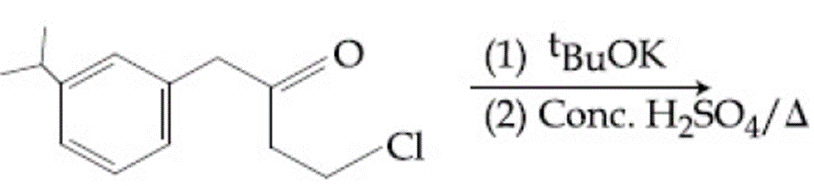
Login to view the detailed solution.
The major product of the following reaction is:
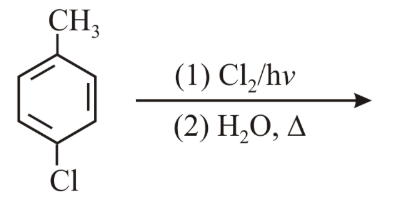
Login to view the detailed solution.
The major product obtained in the following reaction is:
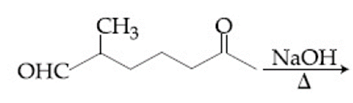
NaOH, $$\Delta$$
Login to view the detailed solution.
The major product obtained in the following reaction is:
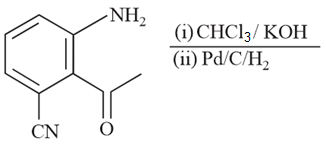
Login to view the detailed solution.
The major product in the following reaction is:
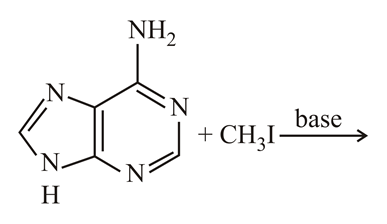
Login to view the detailed solution.
The structure of Nylon-6 is:
Login to view the detailed solution.
Fructose and glucose can be distinguished by:
Login to view the detailed solution.
Educational materials for JEE preparation
 Share
Share

