Join WhatsApp Icon JEE WhatsApp Group

NTA JEE Main 25th February 2021 Shift 2 - Physics

For the following questions answer them individually

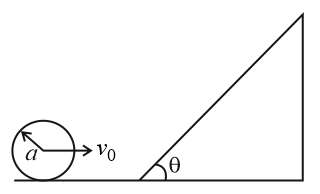
A sphere of radius $$a$$ and mass $$m$$ rolls along a horizontal plane with constant speed $$v_0$$. It encounters an inclined plane at angle $$\theta$$ and climbs upward. Assuming that it rolls without slipping, how far up the sphere will travel?

Given below are two statements:
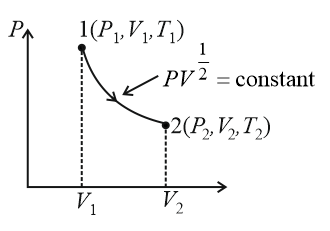
Statement I: In a diatomic molecule, the rotational energy at a given temperature obeys Maxwell's distribution.
Statement II: In a diatomic molecule, the rotational energy at a given temperature equals the translational kinetic energy for each molecule.
In the light of the above statements, choose the correct answer from the options given below:

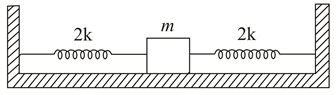
Two identical springs of spring constant $$2k$$ are attached to a block of mass $$m$$ and to fixed support (see figure). When the mass is displaced from equilibrium position on either side, it executes simple harmonic motion. The time period of oscillations of this system is:

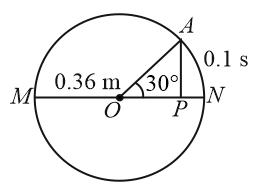
The point $$A$$ moves with a uniform speed along the circumference of a circle of radius 0.36 m and covers 30° in 0.1 s. The perpendicular projection $$P$$ from $$A$$ on the diameter $$MN$$ represents the simple harmonic motion of $$P$$. The restoration force per unit mass when $$P$$ touches $$M$$ will be:

$$Y = A\sin(\omega t + \phi_0)$$ is the time-displacement equation of a SHM. At $$t = 0$$ the displacement of the particle is $$Y = \frac{A}{2}$$ and it is moving along negative $$x$$-direction. Then the initial phase angle $$\phi_0$$ will be:

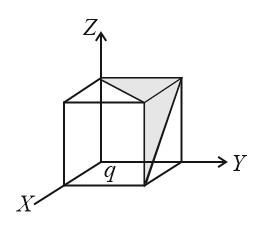
A charge $$q$$ is placed at one corner of a cube as shown in figure. The flux of electrostatic field $$\vec{E}$$ through the shaded area is:

In a ferromagnetic material, below the curie temperature, a domain is defined as:

An electron with kinetic energy $$K_1$$ enters between parallel plates of a capacitor at an angle $$\alpha$$ with the plates. It leaves the plates at angle $$\beta$$ with kinetic energy $$K_2$$. Then the ratio of kinetic energies $$K_1 : K_2$$ will be:

Match List I with List II.

List IList II
(a) Rectifier(i) Used either for stepping up or stepping down the A.C. voltage
(b) Stabilizer(ii) Used to convert A.C. voltage into D.C. voltage
(c) Transformer(iii) Used to remove any ripple in the rectified output voltage
(d) Filter(iv) Used for constant output voltage even when the input voltage or load current change


Choose the correct answer from the options given below:

An L.C.R. circuit contains resistance of 110 $$\Omega$$ and a supply of 220 V at 300 rad s$$^{-1}$$ angular frequency. If only capacitance is removed from the circuit, current lags behind the voltage by 45°. If on the other hand, only the inductor is removed the current leads by 45° with the applied voltage. The R.M.S. current flowing in the circuit will be:

Consider the diffraction pattern obtained from the sunlight incident on a pinhole of diameter 0.1 $$\mu$$m. If the diameter of the pinhole is slightly increased, it will affect the diffraction pattern such that

For extrinsic semiconductors; when doping level is increased;

The initial velocity $$v_i$$ required to project a body vertically upward from the surface of the earth to reach a height of $$10R$$, where $$R$$ is the radius of the earth, may be described in terms of escape velocity $$v_e$$ such that $$v_i = \sqrt{\frac{x}{y}} \times v_e$$. The value of $$x$$ will be

Backspace
789
456
123
0.-
Clear All

Two small spheres each of mass 10 mg are suspended from a point by threads 0.5 m long. They are equally charged and repel each other to a distance of 0.20 m. The charge on each of the sphere is $$\frac{a}{21} \times 10^{-8}$$ C. The value of $$a$$ will be ______. [Given $$g = 10$$ m s$$^{-2}$$]

Backspace
789
456
123
0.-
Clear All

Two identical conducting spheres with negligible volume have 2.1 nC and $$-0.1$$ nC charges, respectively. They are brought into contact and then separated by a distance of 0.5 m. The electrostatic force acting between the spheres is ______ $$\times 10^{-9}$$ N.
[Given : $$4\pi \epsilon_{\circ}$$ = $$ \frac{1}{9\times 10^{9}}$$ SI Units}]

Backspace
789
456
123
0.-
Clear All