
Join Our JEE Preparation Group
Prep with like-minded aspirants; Get access to free daily tests and study material.
Sign in
Please select an account to continue using cracku.in
↓ →
Join Our JEE Preparation Group
Prep with like-minded aspirants; Get access to free daily tests and study material.
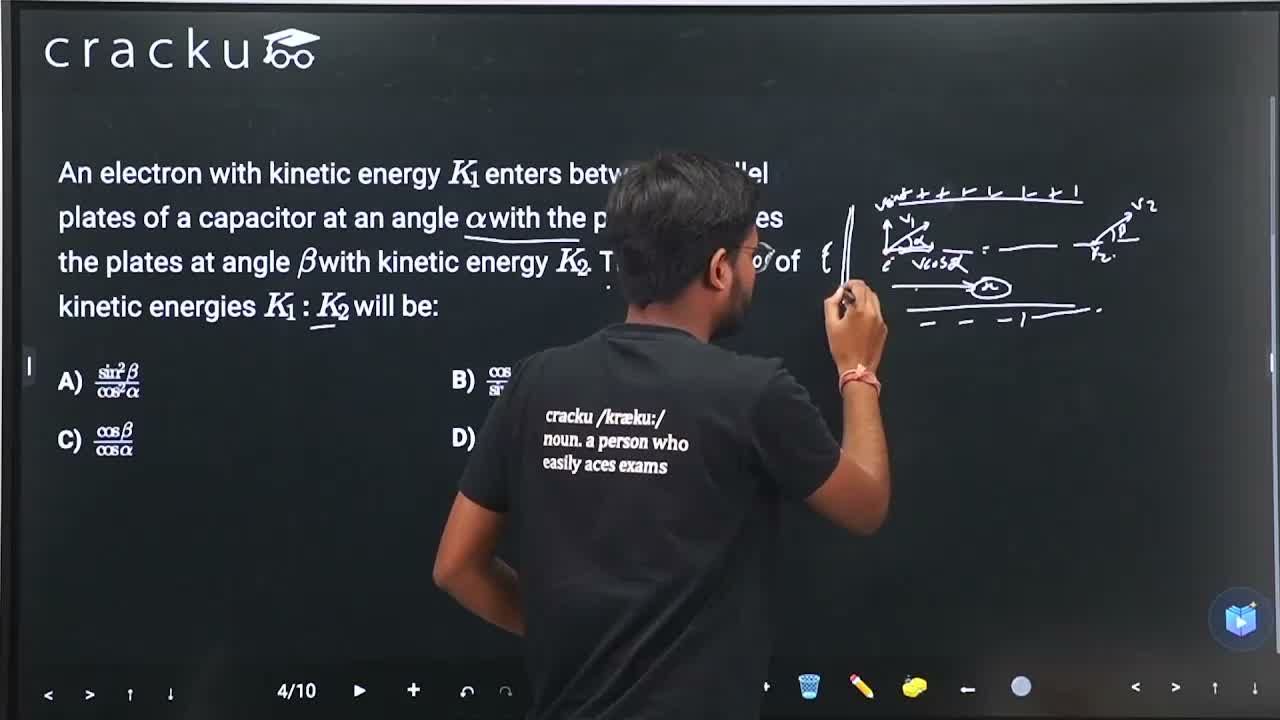
An electron with kinetic energy $$K_1$$ enters between parallel plates of a capacitor at an angle $$\alpha$$ with the plates. It leaves the plates at angle $$\beta$$ with kinetic energy $$K_2$$. Then the ratio of kinetic energies $$K_1 : K_2$$ will be:
An electron enters between the parallel plates of a capacitor at angle $$\alpha$$ with the plates and leaves at angle $$\beta$$. The electric field between the plates is perpendicular to the plates, so only the component of velocity perpendicular to the plates changes. The component of velocity parallel to the plates remains constant.
Let the speed of the electron on entering be $$v_1$$ and on leaving be $$v_2$$. The component of velocity parallel to the plates on entry is $$v_1\cos\alpha$$ and on exit is $$v_2\cos\beta$$.
Since the electric field is perpendicular to the plates, there is no force along the plates. Therefore, the parallel component of velocity is conserved: $$v_1\cos\alpha = v_2\cos\beta$$.
The kinetic energies are $$K_1 = \frac{1}{2}m v_1^2$$ and $$K_2 = \frac{1}{2}m v_2^2$$. Taking the ratio:
$$\frac{K_1}{K_2} = \frac{v_1^2}{v_2^2} = \left(\frac{v_1}{v_2}\right)^2 = \left(\frac{\cos\beta}{\cos\alpha}\right)^2 = \frac{\cos^2\beta}{\cos^2\alpha}$$
Therefore, $$K_1 : K_2 = \frac{\cos^2\beta}{\cos^2\alpha}$$.
Was this solution helpful?
Click on the Email ☝️ to Watch the Video Solution
Create a FREE account and get:
_1.webp)

Educational materials for JEE preparation

Ask our AI anything

AI can make mistakes. Please verify important information.
AI can make mistakes. Please verify important information.
