
Join Our JEE Preparation Group
Prep with like-minded aspirants; Get access to free daily tests and study material.
Sign in
Please select an account to continue using cracku.in
↓ →
Join Our JEE Preparation Group
Prep with like-minded aspirants; Get access to free daily tests and study material.
A charge $$q$$ is placed at one corner of a cube as shown in figure. The flux of electrostatic field $$\vec{E}$$ through the shaded area is:
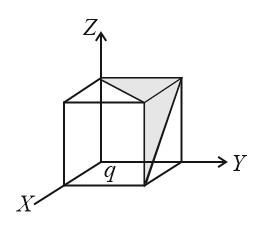
By applying Gauss's Law, a charge $$q$$ enclosed fully within a symmetric boundary emits a total flux of $$\Phi = \frac{q}{\varepsilon_0}$$. To completely enclose a charge residing precisely on a corner vertex, we must place $$8$$ identical cubes together. Thus, the total flux passing through our single designated cube is:
$$\Phi_{\text{cube}} = \frac{q}{8\varepsilon_0}$$
A single cube consists of $$6$$ individual faces:
$$\Phi_{\text{face}} = \frac{1}{3} \times \Phi_{\text{cube}} = \frac{1}{3} \times \frac{q}{8\varepsilon_0} = \frac{q}{24\varepsilon_0}$$
Let's look closely at how the shaded area is defined in this classic configuration:
Because any field line passing through the inner shaded triangle must inevitably pass through the three outer symmetric faces to exit the cube, the total flux through the shaded area is exactly equal to the shared contribution of one full face path:
$$\Phi_{\text{shaded}} = \Phi_{\text{face}} = \frac{q}{24\varepsilon_0}$$
Correct Option: B ($$\frac{q}{24\varepsilon_0}$$)
Was this solution helpful?
Create a FREE account and get:
_1.webp)

Educational materials for JEE preparation

Ask our AI anything

AI can make mistakes. Please verify important information.
AI can make mistakes. Please verify important information.
