
Join Our JEE Preparation Group
Prep with like-minded aspirants; Get access to free daily tests and study material.
Sign in
Please select an account to continue using cracku.in
↓ →
Join Our JEE Preparation Group
Prep with like-minded aspirants; Get access to free daily tests and study material.
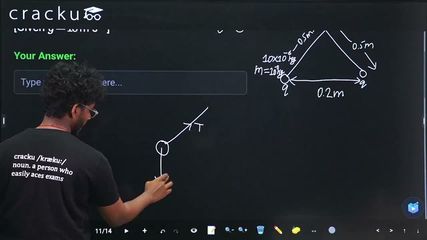
Two small spheres each of mass 10 mg are suspended from a point by threads 0.5 m long. They are equally charged and repel each other to a distance of 0.20 m. The charge on each of the sphere is $$\frac{a}{21} \times 10^{-8}$$ C. The value of $$a$$ will be ______. [Given $$g = 10$$ m s$$^{-2}$$]
Correct Answer: 20
Each sphere has mass $$m = 10$$ mg $$= 10 \times 10^{-6}$$ kg $$= 10^{-5}$$ kg, and they are suspended from the same point by threads of length $$L = 0.5$$ m. They repel each other to a separation of $$d = 0.20$$ m.
For equilibrium of each sphere, the forces acting are: tension $$T$$ along the thread, weight $$mg$$ downward, and electrostatic repulsion $$F$$ horizontally. The half-separation is $$\frac{d}{2} = 0.10$$ m, so $$\sin\theta = \frac{0.10}{0.5} = 0.2$$.
From the equilibrium conditions: $$\tan\theta = \frac{F}{mg}$$. Since $$\sin\theta = 0.2$$, we get $$\cos\theta = \sqrt{1 - 0.04} = \sqrt{0.96}$$ and $$\tan\theta = \frac{0.2}{\sqrt{0.96}}$$.
The electrostatic force is $$F = \frac{kq^2}{d^2} = \frac{9 \times 10^9 \cdot q^2}{(0.20)^2} = \frac{9 \times 10^9 \cdot q^2}{0.04}$$.
From $$\tan\theta = \frac{F}{mg}$$: $$\frac{0.2}{\sqrt{0.96}} = \frac{9 \times 10^9 \cdot q^2}{0.04 \times 10^{-5} \times 10}$$.
The denominator is $$0.04 \times 10^{-4} = 4 \times 10^{-6}$$. So $$\frac{0.2}{\sqrt{0.96}} = \frac{9 \times 10^9 \cdot q^2}{4 \times 10^{-6}}$$.
Solving for $$q^2$$: $$q^2 = \frac{0.2 \times 4 \times 10^{-6}}{9 \times 10^9 \times \sqrt{0.96}} = \frac{0.8 \times 10^{-6}}{9 \times 10^9 \times \sqrt{0.96}}$$.
Now $$\sqrt{0.96} \approx 0.98$$, so $$q^2 \approx \frac{8 \times 10^{-7}}{8.82 \times 10^9} = \frac{8}{8.82} \times 10^{-16} \approx 0.907 \times 10^{-16}$$.
Therefore $$q \approx \sqrt{0.907 \times 10^{-16}} \approx 0.953 \times 10^{-8}$$ C.
The answer is given as $$q = \frac{a}{21} \times 10^{-8}$$ C. So $$\frac{a}{21} = 0.953$$, giving $$a = 0.953 \times 21 \approx 20$$.
To verify exactly: with the standard approximation $$\tan\theta \approx \sin\theta$$ (valid for small angles), $$\tan\theta \approx 0.2$$, giving $$q^2 = \frac{0.2 \times 0.04 \times 10^{-5} \times 10}{9 \times 10^9} = \frac{0.2 \times 4 \times 10^{-6}}{9 \times 10^9} = \frac{8 \times 10^{-7}}{9 \times 10^9} = \frac{8}{9} \times 10^{-16}$$.
So $$q = \sqrt{\frac{8}{9}} \times 10^{-8} = \frac{2\sqrt{2}}{3} \times 10^{-8}$$. Now $$\frac{2\sqrt{2}}{3} \approx \frac{2 \times 1.414}{3} = \frac{2.828}{3} = 0.9428$$. Then $$a = 0.9428 \times 21 \approx 19.8 \approx 20$$.
Therefore, the value of $$a$$ is $$20$$.
Was this solution helpful?
Click on the Email ☝️ to Watch the Video Solution
Create a FREE account and get:
_1.webp)

Educational materials for JEE preparation

Ask our AI anything

AI can make mistakes. Please verify important information.
AI can make mistakes. Please verify important information.
