
Join Our JEE Preparation Group
Prep with like-minded aspirants; Get access to free daily tests and study material.
Sign in
Please select an account to continue using cracku.in
↓ →
Join Our JEE Preparation Group
Prep with like-minded aspirants; Get access to free daily tests and study material.
The peak electric field produced by the radiation coming from the 8 W bulb at a distance of 10 m is $$\frac{x}{10}\sqrt{\frac{\mu_0 c}{\pi}}$$ V m$$^{-1}$$. The efficiency of the bulb is 10% and it is a point source. The value of $$x$$ is ______,
Correct Answer: 2
The 8 W bulb acts as a point source of electromagnetic radiation. The efficiency of 10% indicates that 10% of the electrical power is converted to visible light, but the bulb still radiates the full 8 W as electromagnetic radiation (including heat radiation). For finding the peak electric field of the radiation at a distance, we use the total radiated power $$P = 8$$ W.
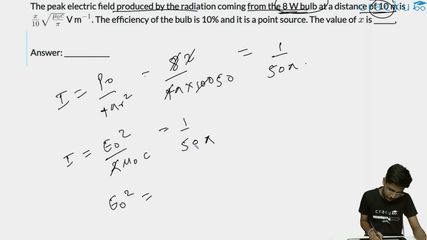
At a distance of $$r = 10$$ m from the point source, the intensity is given by $$I = \frac{P}{4\pi r^2} = \frac{8}{4\pi(10)^2} = \frac{8}{400\pi} = \frac{1}{50\pi}$$ W/m$$^2$$.
The intensity of an electromagnetic wave is related to the peak electric field $$E_0$$ by the relation $$I = \frac{E_0^2}{2\mu_0 c}$$, where $$\mu_0$$ is the permeability of free space and $$c$$ is the speed of light.
Rearranging for $$E_0^2$$: $$E_0^2 = 2\mu_0 c \cdot I = 2\mu_0 c \cdot \frac{1}{50\pi} = \frac{2\mu_0 c}{50\pi} = \frac{\mu_0 c}{25\pi}$$.
Taking the square root: $$E_0 = \sqrt{\frac{\mu_0 c}{25\pi}} = \frac{1}{5}\sqrt{\frac{\mu_0 c}{\pi}}$$. Writing this as $$\frac{2}{10}\sqrt{\frac{\mu_0 c}{\pi}}$$ and comparing with the given expression $$\frac{x}{10}\sqrt{\frac{\mu_0 c}{\pi}}$$, we get $$x = 2$$.
Was this solution helpful?
Click on the Email ☝️ to Watch the Video Solution
Create a FREE account and get:
_1.webp)

Educational materials for JEE preparation

Ask our AI anything

AI can make mistakes. Please verify important information.
AI can make mistakes. Please verify important information.
