
Join Our JEE Preparation Group
Prep with like-minded aspirants; Get access to free daily tests and study material.
Sign in
Please select an account to continue using cracku.in
↓ →
Join Our JEE Preparation Group
Prep with like-minded aspirants; Get access to free daily tests and study material.
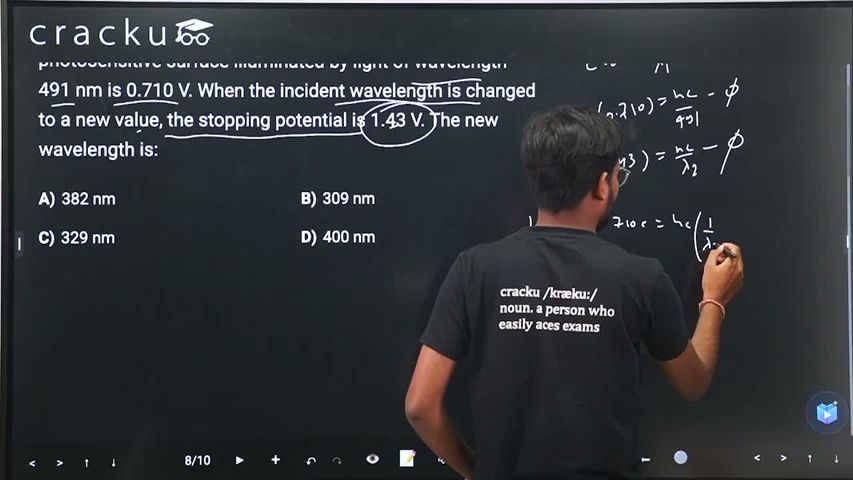
The stopping potential for electrons emitted from a photosensitive surface illuminated by light of wavelength 491 nm is 0.710 V. When the incident wavelength is changed to a new value, the stopping potential is 1.43 V. The new wavelength is:
Using Einstein's photoelectric equation, the stopping potential $$V_0$$ is related to the wavelength $$\lambda$$ of incident light by: $$eV_0 = \frac{hc}{\lambda} - \phi$$, where $$\phi$$ is the work function of the metal.
For the first case: $$eV_1 = \frac{hc}{\lambda_1} - \phi$$, with $$\lambda_1 = 491$$ nm and $$V_1 = 0.710$$ V.
For the second case: $$eV_2 = \frac{hc}{\lambda_2} - \phi$$, with $$V_2 = 1.43$$ V and $$\lambda_2$$ unknown.
Subtracting the first equation from the second: $$e(V_2 - V_1) = hc\left(\frac{1}{\lambda_2} - \frac{1}{\lambda_1}\right)$$.
Using $$hc = 1240$$ eV·nm: $$1.43 - 0.710 = 1240\left(\frac{1}{\lambda_2} - \frac{1}{491}\right)$$.
$$0.72 = 1240\left(\frac{1}{\lambda_2} - \frac{1}{491}\right)$$
$$\frac{1}{\lambda_2} = \frac{0.72}{1240} + \frac{1}{491} = 0.000581 + 0.002037 = 0.002618 \; \text{nm}^{-1}$$
$$\lambda_2 = \frac{1}{0.002618} \approx 382$$ nm.
Therefore, the new wavelength is approximately 382 nm.
Was this solution helpful?
Click on the Email ☝️ to Watch the Video Solution
Create a FREE account and get:
_1.webp)

Educational materials for JEE preparation

Ask our AI anything

AI can make mistakes. Please verify important information.
AI can make mistakes. Please verify important information.
