
Join Our JEE Preparation Group
Prep with like-minded aspirants; Get access to free daily tests and study material.
Sign in
Please select an account to continue using cracku.in
↓ →
Join Our JEE Preparation Group
Prep with like-minded aspirants; Get access to free daily tests and study material.
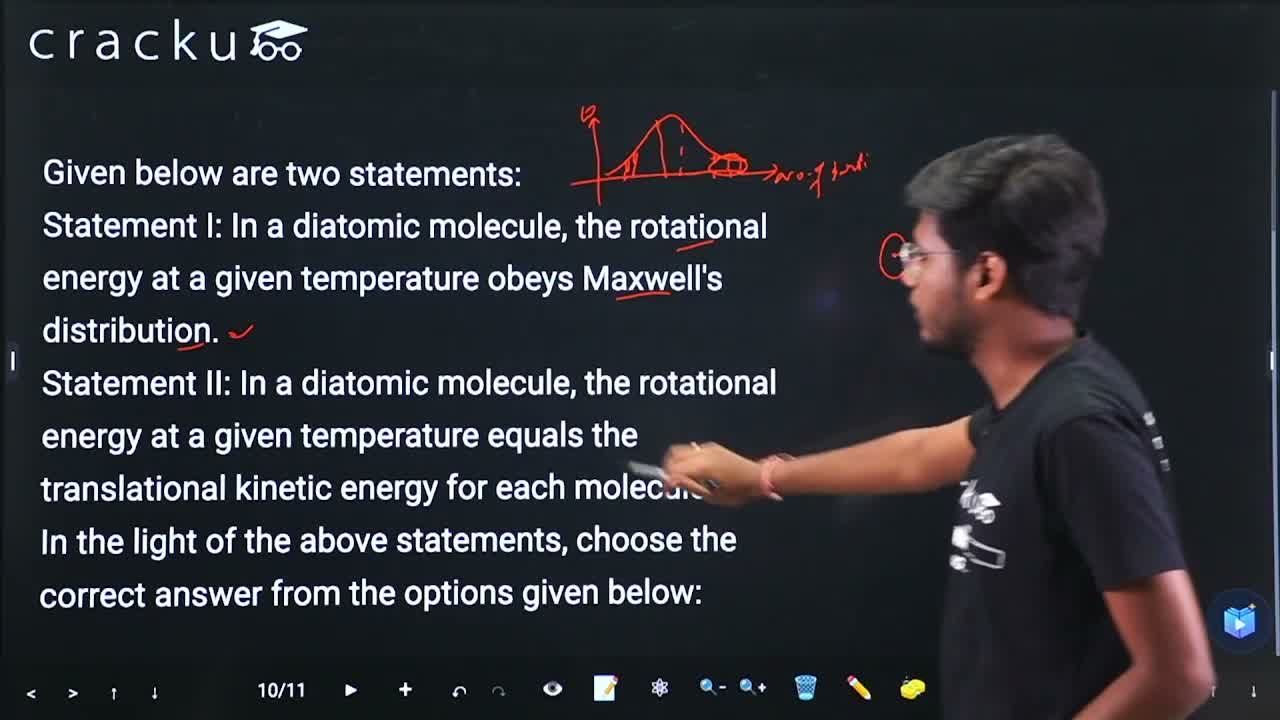
Given below are two statements:
Statement I: In a diatomic molecule, the rotational energy at a given temperature obeys Maxwell's distribution.
Statement II: In a diatomic molecule, the rotational energy at a given temperature equals the translational kinetic energy for each molecule.
In the light of the above statements, choose the correct answer from the options given below:
We analyse each statement separately.
Statement I says that in a diatomic molecule, the rotational energy at a given temperature obeys Maxwell's distribution. This is true because, according to the equipartition theorem and statistical mechanics, each quadratic degree of freedom follows the Maxwell-Boltzmann energy distribution. The rotational kinetic energy of a diatomic molecule, being a sum of quadratic terms in angular velocities, obeys this distribution.
Statement II says that the rotational energy at a given temperature equals the translational kinetic energy for each molecule. A diatomic molecule at moderate temperatures has 2 rotational degrees of freedom (rotation about two axes perpendicular to the bond axis) and 3 translational degrees of freedom. By the equipartition theorem, the average energy per degree of freedom is $$\frac{1}{2}k_BT$$. Therefore, the average translational kinetic energy is $$\frac{3}{2}k_BT$$ while the average rotational energy is $$\frac{2}{2}k_BT = k_BT$$. Since $$\frac{3}{2}k_BT \neq k_BT$$, Statement II is false.
Hence, Statement I is true but Statement II is false.
Was this solution helpful?
Click on the Email ☝️ to Watch the Video Solution
Create a FREE account and get:
_1.webp)

Educational materials for JEE preparation

Ask our AI anything

AI can make mistakes. Please verify important information.
AI can make mistakes. Please verify important information.
