
Join Our JEE Preparation Group
Prep with like-minded aspirants; Get access to free daily tests and study material.
Sign in
Please select an account to continue using cracku.in
↓ →
Join Our JEE Preparation Group
Prep with like-minded aspirants; Get access to free daily tests and study material.
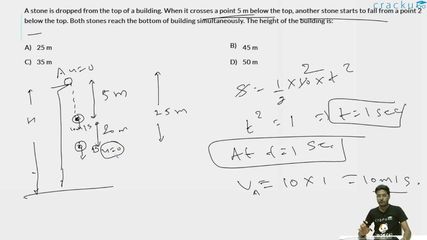
A stone is dropped from the top of a building. When it crosses a point 5 m below the top, another stone starts to fall from a point 25 m below the top. Both stones reach the bottom of building simultaneously. The height of the building is:
Let the height of the building be $$H$$ metres. A stone is dropped from the top (point A). When it has fallen 5 m (reaching point B), another stone is dropped from a point 25 m below the top (point C). Both reach the bottom simultaneously.
For stone 1, the time to fall the first 5 m is found from $$5 = \frac{1}{2}g t_1^2$$, giving $$t_1 = \sqrt{\frac{10}{g}} = \sqrt{\frac{10}{10}} = 1$$ s (taking $$g = 10$$ m/s$$^2$$).
At point B, stone 1 has velocity $$v_1 = g t_1 = 10$$ m/s. From this point, stone 1 must fall the remaining distance $$(H - 5)$$ m. Using $$H - 5 = v_1 t + \frac{1}{2}g t^2$$, we get $$H - 5 = 10t + 5t^2$$.
Stone 2 is dropped (from rest) from point C, which is 25 m below the top. It must fall $$(H - 25)$$ m in the same time $$t$$. So $$H - 25 = \frac{1}{2}g t^2 = 5t^2$$.
Subtracting the second equation from the first: $$(H - 5) - (H - 25) = 10t + 5t^2 - 5t^2$$, which gives $$20 = 10t$$, so $$t = 2$$ s.
Substituting back: $$H - 25 = 5(2)^2 = 20$$, giving $$H = 45$$ m.
Was this solution helpful?
Click on the Email ☝️ to Watch the Video Solution
Create a FREE account and get:
_1.webp)

Educational materials for JEE preparation

Ask our AI anything

AI can make mistakes. Please verify important information.
AI can make mistakes. Please verify important information.
