
Join Our JEE Preparation Group
Prep with like-minded aspirants; Get access to free daily tests and study material.
Sign in
Please select an account to continue using cracku.in
↓ →
Join Our JEE Preparation Group
Prep with like-minded aspirants; Get access to free daily tests and study material.
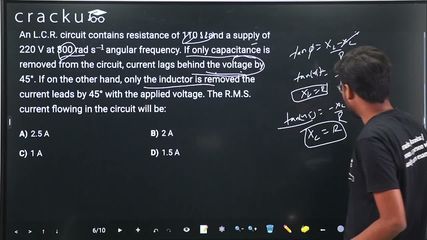
An L.C.R. circuit contains resistance of 110 $$\Omega$$ and a supply of 220 V at 300 rad s$$^{-1}$$ angular frequency. If only capacitance is removed from the circuit, current lags behind the voltage by 45°. If on the other hand, only the inductor is removed the current leads by 45° with the applied voltage. The R.M.S. current flowing in the circuit will be:
We are given an LCR circuit with $$R = 110 \; \Omega$$, supply voltage $$V = 220$$ V, and angular frequency $$\omega = 300$$ rad/s.
When only the capacitance is removed (leaving R and L in series), the current lags the voltage by 45°. This means $$\tan 45° = \frac{\omega L}{R}$$, so $$\omega L = R = 110 \; \Omega$$.
When only the inductor is removed (leaving R and C in series), the current leads the voltage by 45°. This means $$\tan 45° = \frac{1/(\omega C)}{R}$$, so $$\frac{1}{\omega C} = R = 110 \; \Omega$$.
Since $$\omega L = \frac{1}{\omega C} = 110 \; \Omega$$, the inductive reactance equals the capacitive reactance. This is the condition for resonance in an LCR circuit.
At resonance, the impedance of the circuit equals the resistance alone: $$Z = R = 110 \; \Omega$$.
The RMS current is $$I = \frac{V}{Z} = \frac{220}{110} = 2$$ A.
Was this solution helpful?
Click on the Email ☝️ to Watch the Video Solution
Create a FREE account and get:
_1.webp)

Educational materials for JEE preparation

Ask our AI anything

AI can make mistakes. Please verify important information.
AI can make mistakes. Please verify important information.
