
Join Our JEE Preparation Group
Prep with like-minded aspirants; Get access to free daily tests and study material.
Sign in
Please select an account to continue using cracku.in
↓ →
Join Our JEE Preparation Group
Prep with like-minded aspirants; Get access to free daily tests and study material.
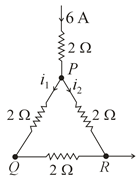
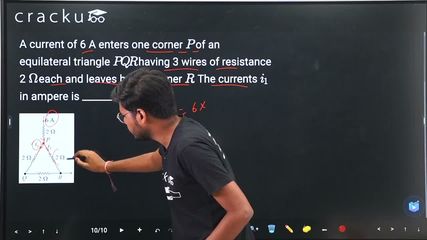
A current of 6 A enters one corner $$P$$ of an equilateral triangle $$PQR$$ having 3 wires of resistance 2 $$\Omega$$ each and leaves by the corner $$R$$. The currents $$i_1$$ in ampere is ______
Correct Answer: 2
We need to find the value of the current $$i_1$$ passing through the branch $$PQ$$ of the equilateral triangular circuit network from the shared page layout.
A total current of $$I = 6\text{ A}$$ enters corner $$P$$ and exits from corner $$R$$. The triangle $$PQR$$ has three branches, each containing a wire of resistance $$R = 2\ \Omega$$:
$$R_{\text{direct}} = R_{PR} = 2\ \Omega$$
$$R_{\text{series}} = R_{PQ} + R_{QR} = 2\ \Omega + 2\ \Omega = 4\ \Omega$$
The total current entering node $$P$$ ($$6\text{ A}$$) divides into two parallel paths: $$i_2$$ flowing directly through branch $$PR$$, and $$i_1$$ flowing through the series combination path $$PQR$$.
According to the current division rule, the current in a branch is inversely proportional to its resistance:
$$i_1 = I \times \left( \frac{R_{\text{direct}}}{R_{\text{direct}} + R_{\text{series}}} \right)$$
Substitute the given parameters into the parallel current division expression:
$$i_1 = 6\text{ A} \times \left( \frac{2\ \Omega}{2\ \Omega + 4\ \Omega} \right)$$
$$i_1 = 6 \times \left( \frac{2}{6} \right) = 2\text{ A}$$
Final Whole Number Answer: $$2$$
Was this solution helpful?
Click on the Email ☝️ to Watch the Video Solution
Create a FREE account and get:
_1.webp)

Educational materials for JEE preparation

Ask our AI anything

AI can make mistakes. Please verify important information.
AI can make mistakes. Please verify important information.
