NTA JEE Main 12th April 2014 Online
For the following questions answer them individually
NTA JEE Main 12th April 2014 Online - Question 21
Consider two thin identical conducting wires covered with very thin insulating material. One of the wires is bent into a loop and produces magnetic field B$$_1$$, at its centre when a current I passes through it. The ratio B$$_1$$ : B$$_2$$ is:
NTA JEE Main 12th April 2014 Online - Question 22
A sinusoidal voltage V(t) = 100 sin(500t) is applied across a pure inductance of L = 0.02H. The current through the coil is:
NTA JEE Main 12th April 2014 Online - Question 23
A lamp emits monochromatic green light uniformly in all directions. The lamp is 3% efficient in converting electrical power to electromagnetic waves and consumes 100 W of power. The amplitude of the electric field associated with the electromagnetic radiation at a distance of 5 m from the lamp will be nearly:

NTA JEE Main 12th April 2014 Online - Question 24
The refractive index of the material of a concave lens is $$\mu$$. It is immersed in a medium of refractive index $$\mu_1$$. A parallel beam of light is incident on the lens. The path of the emergent rays when $$\mu_1 > \mu$$ is:
NTA JEE Main 12th April 2014 Online - Question 25
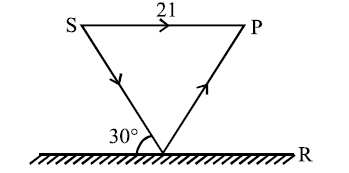
Interference pattern is observed at 'P' due to superimposition of two rays coming out from a source 'S' as shown in the figure. The value of 'l' for which maxima is obtained at 'P' is: (R is perfect reflecting surface)
NTA JEE Main 12th April 2014 Online - Question 26
In an experiment of single slit diffraction pattern, first minimum for red light coincides with first maximum of some other wavelength. If wavelength of red light is 6600 $$\text{Å}$$, then wavelength of first maximum will be:
NTA JEE Main 12th April 2014 Online - Question 27
A beam of light has two wavelengths of 4972 $$\text{Å}$$ and 6216 $$\text{Å}$$ with a total intensity of $$3.6 \times 10^{-3}$$ Wm$$^{-2}$$ equally distributed among the two wavelengths. The beam falls normally on an area of 1 cm$$^2$$ of a clean metallic surface of work function 2.3 eV. Assume that there is no loss of light by reflection and that each capable photon ejects one electron. The number of photoelectrons liberated in 2 s is approximately:
NTA JEE Main 12th April 2014 Online - Question 28
For LED's to emit light in visible region of electromagnetic light, it should have energy band gap in the range of:
NTA JEE Main 12th April 2014 Online - Question 29
A piece of bone of an animal from a ruin is found to have $$^{14}$$C activity of 12 disintegrations per minute per gm of its carbon content. The $$^{14}$$C activity of a living animal is 16 disintegrations per minute per gm. How long ago nearly did the animal die? (Given half life of $$^{14}$$C is $$t_{1/2}$$ = 5760 years)
NTA JEE Main 12th April 2014 Online - Question 30
For sky wave propagation, the radio waves must have a frequency range in between: