
Join Our JEE Preparation Group
Prep with like-minded aspirants; Get access to free daily tests and study material.
Sign in
Please select an account to continue using cracku.in
↓ →
Join Our JEE Preparation Group
Prep with like-minded aspirants; Get access to free daily tests and study material.
Two hypothetical planets of masses m$$_1$$ and m$$_2$$ are at rest when they are infinite distance apart. Because of the gravitational force they move towards each other along the line joining their centres. What is their speed when their separation is 'd'? (Speed of m$$_1$$ is v$$_1$$ and that of m$$_2$$ is v$$_2$$)
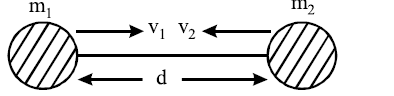
Since no external force acts on the two-planet system, the net linear momentum is conserved. Initially, both planets are at rest at infinite separation, so the total initial momentum is zero.
From conservation of linear momentum, $$m_1 v_1 - m_2 v_2 = 0$$, $$v_2 = \frac{m_1 v_1}{m_2} \quad \dots(1)$$
As gravity is a conservative force, the total mechanical energy of the system remains constant.
Total initial energy at $$r = \infty$$ is $$E_i = 0$$.
At separation $$d$$, the total energy is $$E_f = K_f + U_f = \frac{1}{2}m_1 v_1^2 + \frac{1}{2}m_2 v_2^2 - \frac{Gm_1 m_2}{d}$$
Equating $$E_i = E_f$$: $$\frac{1}{2}m_1 v_1^2 + \frac{1}{2}m_2 v_2^2 = \frac{Gm_1 m_2}{d}$$
Substituting the value of $$v_2$$ from equation (1):
$$\frac{1}{2}m_1 v_1^2 + \frac{1}{2}m_2 \left( \frac{m_1 v_1}{m_2} \right)^2 = \frac{Gm_1 m_2}{d}$$
$$\frac{1}{2}m_1 v_1^2 \left( 1 + \frac{m_1}{m_2} \right) = \frac{Gm_1 m_2}{d}$$
$$\frac{1}{2}m_1 v_1^2 \left( \frac{m_1 + m_2}{m_2} \right) = \frac{Gm_1 m_2}{d}$$
$$v_1^2 = \frac{2Gm_2^2}{d(m_1 + m_2)}$$
$$v_1 = m_2 \sqrt{\frac{2G}{d(m_1 + m_2)}}$$
By symmetry or by substituting $$v_1$$ back into equation (1):
$$v_2 = m_1 \sqrt{\frac{2G}{d(m_1 + m_2)}}$$
Was this solution helpful?
Create a FREE account and get:
_1.webp)

Educational materials for JEE preparation

Ask our AI anything

AI can make mistakes. Please verify important information.
AI can make mistakes. Please verify important information.
