For the following questions answer them individually
From the following combinations of physical constants (expressed through their usual symbols) the only combination, that would have the same value in different systems of units, is:
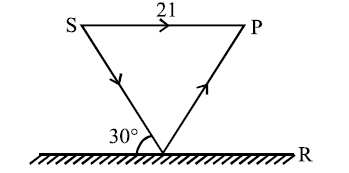
A person climbs up a stalled escalator in 60 s. If standing on the same but escalator running with constant velocity he takes 40 s. How much time is taken by the person to walk up the moving escalator?
A bullet of mass 4 g is fired horizontally with a speed of 300 m/s into 0.8 kg block of wood at rest on a table. If the coefficient of friction between the block and the table is 0.3, how far will the block slide approximately?
A spring of unstretched length l has a mass m with one end fixed to a rigid support. Assuming spring to be made of a uniform wire, the kinetic energy possessed by it if its free end is pulled with uniform velocity v is:
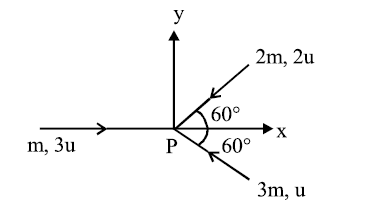
Three masses m, 2m and 3m are moving in the x-y plane with speeds 3u, 2u and u respectively as shown in the figure. The three masses collide at the same point at P and stick together. The velocity of the resulting mass will be:
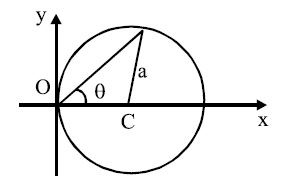
A particle is moving in a circular path of radius a, with a constant velocity v as shown in the figure. The centre of circle is marked by 'C'. The angular momentum from the origin O can be written as:
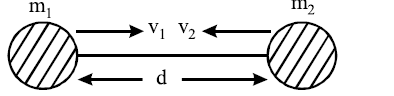
Two hypothetical planets of masses m$$_1$$ and m$$_2$$ are at rest when they are infinite distance apart. Because of the gravitational force they move towards each other along the line joining their centres. What is their speed when their separation is 'd'? (Speed of m$$_1$$ is v$$_1$$ and that of m$$_2$$ is v$$_2$$)
Steel ruptures when a shear of $$3.5 \times 10^8$$ N m$$^{-2}$$ is applied. The force needed to punch a 1 cm diameter hole in a steel sheet 0.3 cm thick is nearly:
A cylindrical vessel of cross-section A contains water to a height h. There is a hole in the bottom of radius 'a'. The time in which it will be emptied is:
Two soap bubbles coalesce to form a single bubble. If V is the subsequent change in volume of contained air and S change in total surface area, T is the surface tension and P atmospheric pressure, then which of the following relation is correct?