
Join Our JEE Preparation Group
Prep with like-minded aspirants; Get access to free daily tests and study material.
Sign in
Please select an account to continue using cracku.in
↓ →
Join Our JEE Preparation Group
Prep with like-minded aspirants; Get access to free daily tests and study material.
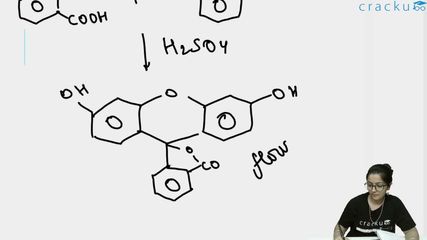
Phthalic acid reacts with resorcinol in the presence of concentrated H$$_2$$SO$$_4$$ to give:
Phthalic acid, when heated with concentrated sulfuric acid, first dehydrates to form phthalic anhydride. The reaction then proceeds with phthalic anhydride acting as an electrophile.
Resorcinol (1,3-dihydroxybenzene) has a highly activated benzene ring due to the presence of two electron-donating hydroxyl groups in the meta position. The ortho and para positions relative to each hydroxyl group are nucleophilic sites.
In the presence of concentrated H₂SO₄, phthalic anhydride undergoes electrophilic substitution with resorcinol. The carbonyl carbon of the anhydride attacks the para position of one hydroxyl group in resorcinol (specifically, the position between the two hydroxyl groups, which is highly activated). This forms an intermediate keto-acid:
$$\text{Phthalic anhydride} + \text{Resorcinol} \rightarrow \text{2-(2,4-dihydroxybenzoyl)benzoic acid}$$
This intermediate undergoes intramolecular cyclization: the carboxylic acid group attacks the ortho position relative to the other hydroxyl group in the resorcinol moiety. This forms a six-membered lactone ring, releasing a water molecule. The resulting compound is fluorescein, which has a xanthene ring system fused to a benzoic acid derivative.
Now, evaluating the options:
Hence, the correct answer is Option D.
Was this solution helpful?
Click on the Email ☝️ to Watch the Video Solution
Create a FREE account and get:
_1.webp)

Educational materials for JEE preparation

Ask our AI anything

AI can make mistakes. Please verify important information.
AI can make mistakes. Please verify important information.
