
Join Our JEE Preparation Group
Prep with like-minded aspirants; Get access to free daily tests and study material.
Sign in
Please select an account to continue using cracku.in
↓ →
Join Our JEE Preparation Group
Prep with like-minded aspirants; Get access to free daily tests and study material.
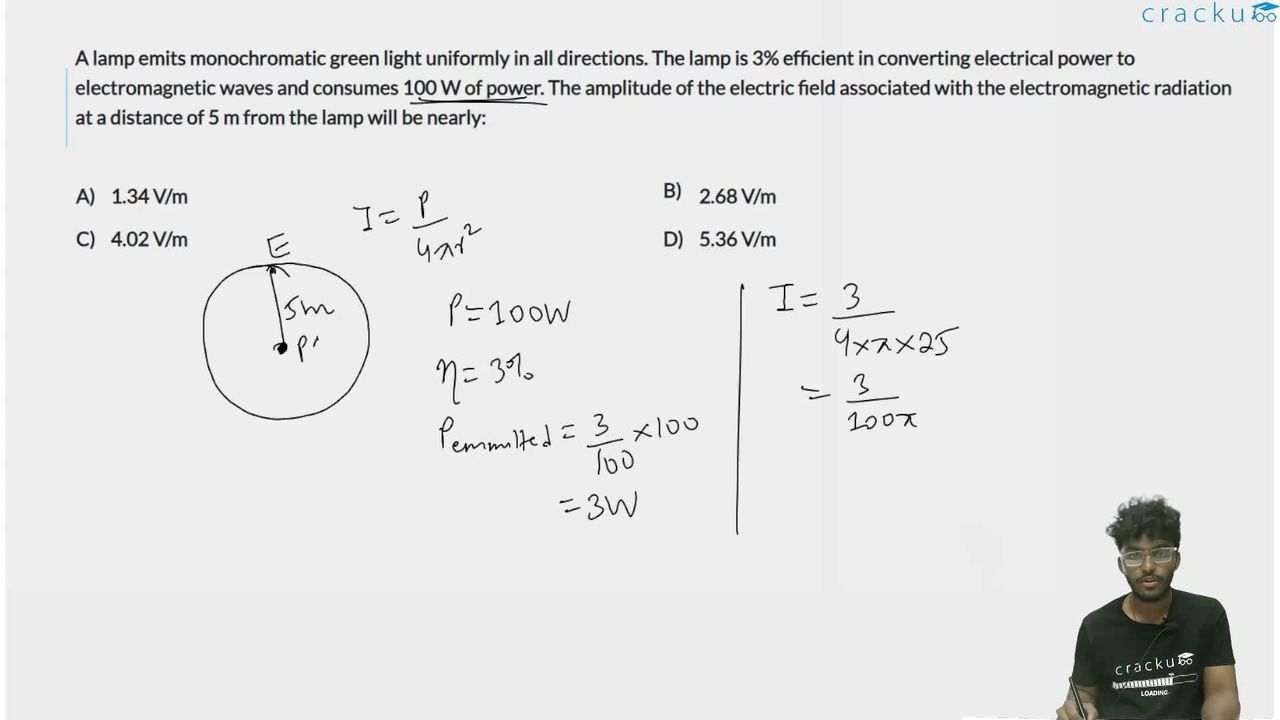
A lamp emits monochromatic green light uniformly in all directions. The lamp is 3% efficient in converting electrical power to electromagnetic waves and consumes 100 W of power. The amplitude of the electric field associated with the electromagnetic radiation at a distance of 5 m from the lamp will be nearly:
The lamp consumes 100 W of electrical power and is 3% efficient in converting this power to electromagnetic waves. Therefore, the radiant power emitted as light is calculated as follows:
Radiant power = Efficiency × Consumed power = (3/100) × 100 W = 3 W.
This power is emitted uniformly in all directions, so at a distance of 5 m, it spreads over the surface of a sphere with radius 5 m. The surface area of a sphere is given by $$4\pi r^2$$. Substituting $$r = 5$$ m:
Surface area = $$4\pi (5)^2 = 4\pi \times 25 = 100\pi$$ m².
The intensity $$I$$ is the power per unit area, so:
$$I = \frac{\text{Radiant power}}{\text{Surface area}} = \frac{3}{100\pi} \text{ W/m}^2.$$
For an electromagnetic wave, the intensity $$I$$ is related to the amplitude of the electric field $$E_0$$ by the formula:
$$I = \frac{1}{2} \epsilon_0 c E_0^2,$$
where $$\epsilon_0$$ is the permittivity of free space ($$8.85 \times 10^{-12}$$ C²/N·m²) and $$c$$ is the speed of light ($$3 \times 10^8$$ m/s). Rearranging for $$E_0^2$$:
$$E_0^2 = \frac{2I}{\epsilon_0 c}.$$
Substituting the expression for $$I$$:
$$E_0^2 = \frac{2 \times \frac{3}{100\pi}}{\epsilon_0 c} = \frac{6}{100\pi \epsilon_0 c} = \frac{3}{50\pi \epsilon_0 c}.$$
Now, compute $$\epsilon_0 c$$:
$$\epsilon_0 c = (8.85 \times 10^{-12}) \times (3 \times 10^8) = 8.85 \times 3 \times 10^{-12+8} = 26.55 \times 10^{-4} = 2.655 \times 10^{-3}.$$
Using $$\pi \approx 3.1416$$, compute $$50\pi$$:
$$50\pi \approx 50 \times 3.1416 = 157.08.$$
Now, compute the denominator $$50\pi \epsilon_0 c$$:
$$50\pi \epsilon_0 c \approx 157.08 \times 2.655 \times 10^{-3}.$$
First, $$157.08 \times 2.655$$:
$$157.08 \times 2 = 314.16,$$
$$157.08 \times 0.6 = 94.248,$$
$$157.08 \times 0.055 = 8.6394,$$
Adding these: $$314.16 + 94.248 = 408.408$$, then $$408.408 + 8.6394 = 417.0474$$.
Now multiply by $$10^{-3}$$:
$$417.0474 \times 10^{-3} = 0.4170474.$$
So,
$$E_0^2 = \frac{3}{0.4170474} \approx 7.193.$$
Taking the square root:
$$E_0 \approx \sqrt{7.193} \approx 2.6815 \text{ V/m}.$$
Rounding to two decimal places, $$E_0 \approx 2.68$$ V/m.
Hence, the amplitude of the electric field is nearly 2.68 V/m, which corresponds to option B.
Was this solution helpful?
Click on the Email ☝️ to Watch the Video Solution
Create a FREE account and get:
_1.webp)

Educational materials for JEE preparation

Ask our AI anything

AI can make mistakes. Please verify important information.
AI can make mistakes. Please verify important information.
