
Join Our JEE Preparation Group
Prep with like-minded aspirants; Get access to free daily tests and study material.
Sign in
Please select an account to continue using cracku.in
↓ →
Join Our JEE Preparation Group
Prep with like-minded aspirants; Get access to free daily tests and study material.
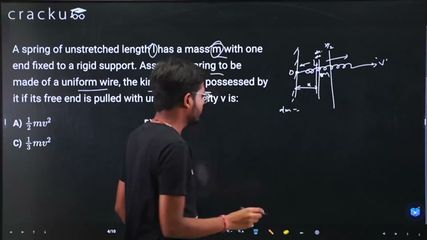
A spring of unstretched length l has a mass m with one end fixed to a rigid support. Assuming spring to be made of a uniform wire, the kinetic energy possessed by it if its free end is pulled with uniform velocity v is:
A spring of unstretched length $$l$$ and mass $$m$$ is fixed at one end and pulled at the free end with a uniform velocity $$v$$. The spring is made of a uniform wire, so its mass per unit length is constant. We need to find the kinetic energy of the entire spring.
Since the spring is uniform, its mass distribution is linear along its unstretched length. Let the mass per unit length be $$\mu = \frac{m}{l}$$. Consider a small element of the spring at a distance $$s$$ from the fixed end in the unstretched state. The mass of this element is $$dm = \mu ds = \frac{m}{l} ds$$.
When the free end is pulled with uniform velocity $$v$$, the spring stretches uniformly. The displacement of a point originally at distance $$s$$ from the fixed end is proportional to $$s$$. If the displacement of the free end (at $$s = l$$) is $$\delta(t) = v t$$ (since velocity is constant), then the displacement of a point at $$s$$ is $$u(s, t) = \frac{s}{l} \delta(t) = \frac{s}{l} v t$$.
The velocity of this point is the time derivative of displacement: $$v(s) = \frac{\partial u}{\partial t} = \frac{s}{l} v$$.
The kinetic energy of the small element is $$dK = \frac{1}{2} dm [v(s)]^2$$. Substituting $$dm$$ and $$v(s)$$:
$$dK = \frac{1}{2} \left( \frac{m}{l} ds \right) \left( \frac{s}{l} v \right)^2$$
Simplify the expression:
$$dK = \frac{1}{2} \cdot \frac{m}{l} \cdot \frac{s^2}{l^2} v^2 ds = \frac{1}{2} \cdot \frac{m v^2}{l^3} s^2 ds$$
To find the total kinetic energy, integrate $$dK$$ over the entire length of the spring from $$s = 0$$ to $$s = l$$:
$$K = \int_{0}^{l} dK = \int_{0}^{l} \frac{1}{2} \cdot \frac{m v^2}{l^3} s^2 ds$$
Factor out the constants:
$$K = \frac{1}{2} \cdot \frac{m v^2}{l^3} \int_{0}^{l} s^2 ds$$
Evaluate the integral:
$$\int_{0}^{l} s^2 ds = \left[ \frac{s^3}{3} \right]_{0}^{l} = \frac{l^3}{3}$$
Substitute back:
$$K = \frac{1}{2} \cdot \frac{m v^2}{l^3} \cdot \frac{l^3}{3} = \frac{1}{2} \cdot \frac{m v^2}{3} = \frac{1}{6} m v^2$$
Hence, the kinetic energy possessed by the spring is $$\frac{1}{6} m v^2$$. Comparing with the options, this corresponds to Option D.
So, the answer is Option D.
Was this solution helpful?
Click on the Email ☝️ to Watch the Video Solution
Create a FREE account and get:
_1.webp)

Educational materials for JEE preparation

Ask our AI anything

AI can make mistakes. Please verify important information.
AI can make mistakes. Please verify important information.
