
Join Our JEE Preparation Group
Prep with like-minded aspirants; Get access to free daily tests and study material.
Sign in
Please select an account to continue using cracku.in
↓ →
Join Our JEE Preparation Group
Prep with like-minded aspirants; Get access to free daily tests and study material.
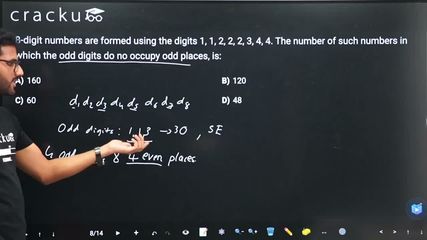
8-digit numbers are formed using the digits 1, 1, 2, 2, 2, 3, 4, 4. The number of such numbers in which the odd digits do no occupy odd places, is:
To solve this problem, we need to form 8-digit numbers using the digits 1, 1, 2, 2, 2, 3, 4, 4, such that no odd digit occupies an odd place. The odd places in an 8-digit number are positions 1, 3, 5, and 7, while the even places are positions 2, 4, 6, and 8. The odd digits are 1 and 3 (since 1 and 3 are odd), and there are three odd digits in total: two 1's and one 3. The even digits are 2 and 4, with five even digits in total: three 2's and two 4's.
The condition requires that odd digits do not occupy odd places. Therefore, all odd digits must be placed in even places. Since there are four even places but only three odd digits, one of the even places must be occupied by an even digit. Additionally, all four odd places must be occupied by even digits because no odd digit can be there.
We can break down the arrangement into steps:
First, we need to choose which even position (out of positions 2, 4, 6, and 8) will be occupied by an even digit. The remaining three even positions will be occupied by the three odd digits. The number of ways to choose which even position gets the even digit is given by the combination formula. Since there are four even positions and we choose one, the number of ways is $$\binom{4}{1} = 4$$.
Next, we arrange the three odd digits in the remaining three even positions. The odd digits are two identical 1's and one 3. The number of distinct arrangements for these three digits in three positions is calculated by considering the repetitions. We choose a position for the digit 3 (since the two 1's are identical), which can be done in $$\binom{3}{1} = 3$$ ways. The other two positions automatically get the 1's. Thus, there are 3 ways to arrange the odd digits.
Now, we have five positions that must be filled with even digits: the four odd places (positions 1, 3, 5, 7) and the one chosen even position (from step 1). The even digits available are three identical 2's and two identical 4's. We need to arrange these five digits in the five positions. The number of distinct arrangements is given by the multinomial coefficient, which accounts for identical items. Specifically, we choose positions for the three 2's (or equivalently for the two 4's). The number of ways is $$\binom{5}{3} = 10$$ (since choosing three positions for the 2's leaves the remaining two for the 4's).
To find the total number of such 8-digit numbers, we multiply the number of choices from each step: the number of ways to choose the even position for the even digit, the number of ways to arrange the odd digits in the remaining even positions, and the number of ways to arrange the even digits in the five designated positions. Therefore, the total is $$4 \times 3 \times 10 = 120$$.
This satisfies the condition that no odd digit occupies an odd place, as all odd digits are in even positions, and all odd positions have even digits.
Hence, the correct answer is Option B.
Was this solution helpful?
Click on the Email ☝️ to Watch the Video Solution
Create a FREE account and get:
_1.webp)

Educational materials for JEE preparation

Ask our AI anything

AI can make mistakes. Please verify important information.
AI can make mistakes. Please verify important information.
