
Join Our JEE Preparation Group
Prep with like-minded aspirants; Get access to free daily tests and study material.
Sign in
Please select an account to continue using cracku.in
↓ →
Join Our JEE Preparation Group
Prep with like-minded aspirants; Get access to free daily tests and study material.
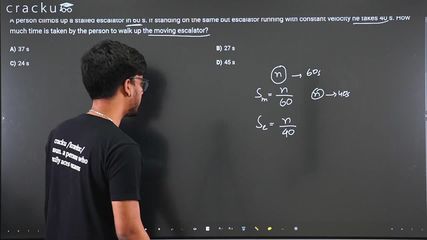
A person climbs up a stalled escalator in 60 s. If standing on the same but escalator running with constant velocity he takes 40 s. How much time is taken by the person to walk up the moving escalator?
Let the length of the escalator be $$ d $$. We need to find the time taken by the person to walk up the moving escalator.
First, when the escalator is stalled (not moving), the person climbs the entire length $$ d $$ in 60 seconds. So, the speed of the person relative to the escalator is $$ v_p = \frac{d}{60} $$.
Second, when the person stands still on the moving escalator, it takes 40 seconds to cover the same distance $$ d $$. So, the speed of the escalator is $$ v_e = \frac{d}{40} $$.
Now, when the person walks up the moving escalator, both the person and the escalator are moving in the same upward direction. Therefore, the effective speed of the person relative to the ground is the sum of their individual speeds: $$ v_p + v_e $$.
The time $$ t $$ taken to cover distance $$ d $$ at this combined speed is:
$$ t = \frac{d}{v_p + v_e} $$
Substitute the expressions for $$ v_p $$ and $$ v_e $$:
$$ t = \frac{d}{\frac{d}{60} + \frac{d}{40}} $$
Factor $$ d $$ out of the denominator:
$$ t = \frac{d}{d \left( \frac{1}{60} + \frac{1}{40} \right)} $$
Cancel $$ d $$ from numerator and denominator (since $$ d \neq 0 $$):
$$ t = \frac{1}{\frac{1}{60} + \frac{1}{40}} $$
Now, compute the denominator. Find the sum $$ \frac{1}{60} + \frac{1}{40} $$. The least common multiple of 60 and 40 is 120. Rewrite each fraction:
$$ \frac{1}{60} = \frac{2}{120}, \quad \frac{1}{40} = \frac{3}{120} $$
Add them:
$$ \frac{2}{120} + \frac{3}{120} = \frac{5}{120} = \frac{1}{24} $$
So,
$$ t = \frac{1}{\frac{1}{24}} = 24 \text{ seconds} $$
Hence, the time taken by the person to walk up the moving escalator is 24 seconds. Comparing with the options, Option C is 24 s.
So, the answer is 24 seconds.
Was this solution helpful?
Click on the Email ☝️ to Watch the Video Solution
Create a FREE account and get:
_1.webp)

Educational materials for JEE preparation

Ask our AI anything

AI can make mistakes. Please verify important information.
AI can make mistakes. Please verify important information.
