
Join Our JEE Preparation Group
Prep with like-minded aspirants; Get access to free daily tests and study material.
Sign in
Please select an account to continue using cracku.in
↓ →
Join Our JEE Preparation Group
Prep with like-minded aspirants; Get access to free daily tests and study material.
Interference pattern is observed at 'P' due to superimposition of two rays coming out from a source 'S' as shown in the figure. The value of 'l' for which maxima is obtained at 'P' is: (R is perfect reflecting surface)
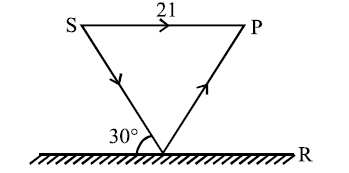
The direct path traveled by the first ray is $$x_1 = SP = 2l$$
For the second ray reflected from surface $$R$$, let the point of reflection be $$O$$. $$SO = OP = \frac{l}{\cos 30^\circ} = \frac{2l}{\sqrt{3}}$$
The total path length of the reflected ray is $$x_2 = SO + OP = \frac{4l}{\sqrt{3}}$$
The geometric path difference between the two rays is $$\Delta x_{geom} = x_2 - x_1 = \frac{4l}{\sqrt{3}} - 2l = 2l \left( \frac{2 - \sqrt{3}}{\sqrt{3}} \right)$$
Reflection from the perfect reflecting surface $$R$$ (denser medium) introduces a phase change of $$\pi$$, which is equivalent to an additional path difference of $$\frac{\lambda}{2}$$. The net path difference is $$\Delta x = \Delta x_{geom} + \frac{\lambda}{2}$$
$$\Delta x = 2l \left( \frac{2 - \sqrt{3}}{\sqrt{3}} \right) + \frac{\lambda}{2}$$
For constructive interference (maxima) at point $$P$$: $$\Delta x = n\lambda$$
$$2l \left( \frac{2 - \sqrt{3}}{\sqrt{3}} \right) + \frac{\lambda}{2} = n\lambda$$
$$2l \left( \frac{2 - \sqrt{3}}{\sqrt{3}} \right) = \left(n - \frac{1}{2}\right)\lambda = \frac{(2n - 1)\lambda}{2}$$
$$l = \frac{(2n - 1)\lambda \sqrt{3}}{4(2 - \sqrt{3})}$$
Was this solution helpful?
Create a FREE account and get:
_1.webp)

Educational materials for JEE preparation

Ask our AI anything

AI can make mistakes. Please verify important information.
AI can make mistakes. Please verify important information.
