Group
Group
 Group
Group

JEE Properties of Fluids PYQ
Solving JEE Properties of Fluids PYQ problems helps students understand the behaviour of liquids and gases under different physical conditions. Questions from this chapter commonly cover pressure, buoyancy, surface tension, viscosity, fluid flow and Bernoulli’s principle.
The chapter includes both conceptual and numerical problems. Some questions require direct application of a standard result, while others test whether students can identify the correct physical principle from a given situation. Questions involving floating bodies, liquid columns, capillary rise and fluid flow often require careful diagrams.
Properties of Fluids is also connected with gravitation, work and energy, thermal physics and rotational motion. Regular practice from a JEE Mains Previous Paper helps students recognise repeated question patterns and understand how different fluid concepts are combined.
JEE Properties of Fluids Important PYQ PDF
The JEE Properties of Fluids Important PYQ PDF provided below contains selected previous-year questions for chapter-wise practice. It covers fluid pressure, Pascal’s law, buoyancy, Archimedes’ principle, surface tension, excess pressure, capillarity, viscosity, terminal velocity, continuity equation and Bernoulli’s principle.
Attempt every question independently before checking the answer or explanation. Begin by identifying whether the fluid is at rest or in motion. For fluids at rest, focus on pressure, buoyancy and surface effects. For moving fluids, check whether the question involves conservation of mass, pressure differences or energy conservation.
While reviewing your attempt, note whether the mistake occurred because of an incorrect diagram, wrong pressure reference, unsuitable formula or unit-conversion error. Add these questions to your JEE Study Material and reattempt the difficult ones after revising the corresponding concept.
Important Topics Covered in Properties of Fluids PYQs
Properties of Fluids PYQs cover both fluid statics and fluid dynamics. Important topics include:
- Density and relative density
- Pressure inside a fluid
- Variation of pressure with depth
- Atmospheric and gauge pressure
- Pascal’s law
- Hydraulic lift and hydraulic brakes
- Archimedes’ principle
- Buoyant force
- Floating and submerged bodies
- Apparent weight in a fluid
- Surface tension and surface energy
- Angle of contact
- Capillary rise and fall
- Excess pressure inside drops and bubbles
- Viscosity
- Stokes’ law
- Terminal velocity
- Streamline and turbulent flow
- Equation of continuity
- Bernoulli’s principle
- Torricelli’s theorem
- Venturimeter and dynamic lift
Pressure at a depth inside a liquid depends on the density of the liquid, gravitational acceleration and vertical depth. Students should measure depth vertically from the free surface rather than along the shape of the container.
Archimedes’ principle states that the buoyant force on an immersed body equals the weight of the fluid displaced by it. In floating-body problems, the buoyant force balances the weight of the body when the system is in equilibrium.
Surface-tension questions may involve liquid drops, soap bubbles, capillary tubes or surface energy. Students should distinguish between a liquid drop, which has one free surface, and a soap bubble, which has two surfaces.
Viscosity measures the resistance offered by a fluid to relative motion between its layers. Terminal velocity is reached when the net force on a falling object becomes zero.
For moving fluids, the continuity equation represents the conservation of mass. Bernoulli’s principle relates pressure, speed and height along a streamline under ideal-flow conditions. A concise JEE Mains Formula Sheet can help revise these results, but students must also understand the conditions under which they apply.
How to Solve Properties of Fluids PYQs Effectively
Begin by drawing a clear diagram and marking the fluid levels, depths, areas, velocities and pressure points. Then determine whether the problem belongs to fluid statics, surface phenomena, viscosity or fluid dynamics.
Follow these steps while solving questions:
- Identify whether the fluid is stationary or moving.
- Mark all relevant heights and depths vertically.
- Distinguish between absolute, atmospheric and gauge pressure.
- Draw a free-body diagram for floating or submerged objects.
- Calculate the displaced volume carefully.
- Check the number of surfaces in drops and bubbles.
- Identify whether the flow is steady and incompressible.
- Apply continuity before using Bernoulli’s principle when required.
- Use consistent SI units throughout the calculation.
- Verify the dimensions and physical meaning of the answer.
Students often assume that pressure depends on the shape of the vessel. At the same horizontal level in a connected liquid at rest, pressure remains equal. Another common mistake is using total distance instead of vertical depth.
In Bernoulli-based problems, higher fluid speed is associated with lower static pressure when other relevant conditions remain comparable. However, Bernoulli’s principle should not be applied blindly to viscous, turbulent or unsteady flow.
After chapter-wise practice, attempt a Free JEE Mains Mock Test to evaluate speed, accuracy and question selection. Maintain an error log for incorrect pressure references, missed buoyant forces, wrong surface counts and unsuitable fluid-flow assumptions.
List of JEE Properties of Fluids PYQs
The questions listed below can be attempted as a timed chapter-wise test. They cover pressure, buoyancy, surface tension, viscosity, terminal velocity and fluid dynamics.
Solve the questions without checking the answers. After completing the test, review every incorrect, guessed and skipped problem. Revise the required concept using your JEE Study Material and attempt it again.
Question 1
A large liquid drop of radius $$R$$ and surface tension $$\sigma$$ is placed on a smooth horizontal surface. A tiny pin is used to pierce the drop, causing it to instantly split into $$N$$ identical smaller droplets. During this process, surface energy of the system increases. If the entire change in surface energy is given to the collective kinetic energy of the expanding cloud of new droplets, the initial outward speed $$v$$ of each droplet of mass $$m$$ immediately after the split is given by:
correct answer:- 2
Question 2
A horizontal pipe has a non-uniform cross-section. The velocity of water at a point where the radius is $$2r$$ is found to be $$v$$. The velocity of water at another point in the same pipe where the radius is $$r$$ will be:
correct answer:- 4
Question 3
Two wires $$A$$ and $$B$$ of the same material have lengths in the ratio $$1:2$$ and diameters in the ratio $$2:1$$. If both wires are subjected to the same stretching force, the ratio of the elongation produced in wire $$A$$ to that in wire $$B$$ ($$\Delta L_A : \Delta L_B$$) will be:
correct answer:- 2
Question 4
A long cylindrical vessel is half filled with a liquid. When the vessel is rotated about its own vertical axis, the liquid rises up near the wall. If the radius of vessel is 5 cm and its rotational speed is 2 rotations per second, then the difference in the heights between the center and the sides, in cm, will be:
correct answer:- 2
Question 5
A small spherical ball of radius 0.1 mm and density $$10^4$$ kg m$$^{-3}$$ falls freely under gravity through a distance $$h$$ before entering a tank of water. If, after entering the water the velocity of ball does not change and it continue to fall with same constant velocity inside water, then the value of $$h$$ will be ______ m. (Given $$g = 10$$ m s$$^{-2}$$, viscosity of water $$= 1.0 \times 10^{-5}$$ N-s m$$^{-2}$$).
correct answer:- 20

Question 6
Two narrow bores of diameter 5.0 mm and 8.0 mm are joined together to form a U-shaped tube open at both ends. If this U-tube contains water, what is the difference in the level of two limbs of the tube.
[Take surface tension of water $$T = 7.3 \times 10^{-2}$$ N m$$^{-1}$$, angle of contact = 0, $$g = 10$$ m s$$^{-2}$$ and density of water = $$1.0 \times 10^3$$ kg m$$^{-3}$$]
correct answer:- 3
Question 7
A sample of a liquid is kept at 1 atm. It is compressed to 5 atm which leads to change of volume of 0.8 cm$$^3$$. If the bulk modulus of the liquid is 2 GPa, the initial volume of the liquid was _____ litre. (Take 1 atm = $$10^5$$ Pa)
correct answer:- 4
Question 8
A small spherical droplet of density $$d$$ is floating exactly half immersed in a liquid of density $$\rho$$ and surface tension $$T$$. The radius of the droplet is (take note that the surface tension applies an upward force on the droplet):
correct answer:- 4
Question 9
Pressure inside a soap bubble is greater than the pressure outside by an amount : (given : $$R$$ = Radius of bubble, $$S$$ = Surface tension of bubble)
correct answer:- 4
Question 10
A certain pressure 'P' is applied to 1 litre of water and 2 litre of a liquid separately. Water gets compressed to 0.01% whereas the liquid gets compressed to 0.03%. The ratio of Bulk modulus of water to that of the liquid is $$\frac{3}{x}$$. The value of $$x$$ is _____.
correct answer:- 1
.webp)
Question 11
A small ball of mass $$M$$ and density $$\rho$$ is dropped in a viscous liquid of density $$\rho_0$$. After some time, the ball falls with a constant velocity. What is the viscous force on the ball?
correct answer:- 3
Question 12
A U- tube whose ends are open and whose limbs are vertical, contains oil of specific gravity 0.8 and surface tension 28 dynes/cm. If one limb has a diameter of 2.2 mm and other of 0.8mm, difference in level of oil in the two limbs is: (contact angle = 0)
correct answer:- 4
Question 13
A cube (edge length $$L$$) of specific gravity $$"n"$$ is suspended from a thin metal wire. The fundamental frequency for transverse standing waves in the wire is $$f_0$$. When the same cube is partially immersed in a liquid of specific gravity $$2$$ up to a depth of $$h$$, the new fundamental frequency will be
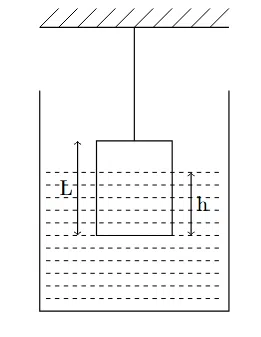
correct answer:- 2
Question 14
An incompressible liquid flows steadily through a horizontal pipe of non-uniform cross-section. If the radius of the pipe at a point where the velocity of flow is $$2 \,\, \text{m/s}$$ is $$4 \,\, \text{cm}$$, then the velocity of flow at another point where the radius of the pipe is $$2 \,\, \text{cm}$$ will be:
correct answer:- 8
Question 15
A spherical liquid drop of radius $$R$$ acquires the terminal velocity $$v_1$$ when falls through a gas of viscosity $$\eta$$. Now the drop is broken into 64 identical droplets and each droplet acquires terminal velocity $$v_2$$ falling through the same gas. The ratio of terminal velocities $$v_1/v_2$$ is __________.
correct answer:- 4
.webp)
Question 16
A cylindrical vessel of 40 cm radius is completely filled with water and its capacity is 528 dm$$^3$$ (dm : decimeter). The vessel is placed on a solid block of exactly same height as vessel. If a small hole is made at 70 cm below the top of water level, then horizontal range of water falling on the ground in the beginning is __________ cm.
correct answer:- 2
Question 17
If it takes 5 minutes to fill a 15 litre bucket from a water tap of diameter $$\frac{2}{\sqrt{\pi}}$$ cm then the Reynolds number for the flow is (density of water = $$10^3$$ kg/m$$^3$$ and viscosity of water = $$10^{-3}$$ Pa.s) close to:
correct answer:- 1
Question 18
The velocity of water in a river is 18 km h$$^{-1}$$ near the surface. If the river is 5 m deep, find the shearing stress between the horizontal layers of water. The coefficient of viscosity of water = $$10^{-2}$$ poise.
correct answer:- 2
Question 19
Wax is coated on the inner wall of a capillary tube and the tube is then dipped in water. Then, compared to the unwaxed capillary, the angle of contact $$\theta$$ and the height $$h$$ upto which water rises change. These changes are :
correct answer:- 3
Question 20
The bulk moduli of ethanol, mercury and water are given as 0.9, 25 and 2.2 respectively in units of $$10^9$$ Nm$$^{-2}$$. For a given value of pressure, the fractional compression in volume is $$\frac{\Delta V}{V}$$. Which of the following statements about $$\frac{\Delta V}{V}$$ for these three liquids is correct?
correct answer:- 1
.webp)
Question 21
Water is flowing at a speed of 1.5 m s$$^{-1}$$ through a horizontal tube of cross-sectional area $$10^{-2}$$ m$$^2$$ and you are trying to stop the flow by your palm. Assuming that the water stops immediately after hitting the palm, the minimum force that you must exert should be (density of water = $$10^3$$ kg m$$^{-3}$$)
correct answer:- 4
Question 22
A capillary tube made of glass of radius 0.15 mm is dipped vertically in a beaker filled with methylene iodide (surface tension = 0.05 N m$$^{-1}$$, density = 667 kg m$$^{-3}$$) which rises to height h in the tube. It is observed that the two tangents drawn from observed that the two tangents drawn from liquid-glass interfaces (from opp. sides of the capillary) make an angle of 60$$°$$ with one another. Then h is close to (g = 10 m s$$^{-2}$$):
correct answer:- 2
Question 23
Consider a cylindrical tank of radius 1 m is filled with water. The top surface of water is at 15 m from the bottom of the cylinder. There is a hole on the wall of cylinder at a height of 5 m from the bottom. A force of $$5 \times 10^5$$ N is applied on the top surface of water using a piston. The speed of efflux from the hole will be: (given atmospheric pressure $$P_A = 1.01 \times 10^5$$ Pa, density of water $$\rho_w = 1000$$ kg m$$^{-3}$$ and gravitational acceleration $$g = 10 \ m s^{-2}$$)
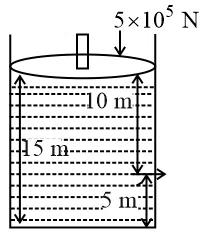
correct answer:- 3
Question 24
Water from a tap emerges vertically downwards with an initial speed of 1.0 ms$$^{-1}$$. The cross-sectional area of the tap is $$10^{-4}$$ m$$^2$$. Assume that the pressure is constant throughout the stream of water and that the flow is streamlined. The cross-sectional area of the stream, 0.15 m below the tap would be:
(Take g = 10 ms$$^{-2}$$)
correct answer:- 4
Question 25
A liquid of density 750 kg m$$^{-3}$$ flows smoothly through a horizontal pipe that tapers in cross-sectional area from $$A_1 = 1.2 \times 10^{-2}$$ m$$^2$$ to $$A_2 = \frac{A_1}{2}$$. The pressure difference between the wide and narrow sections of the pipe is 4500 Pa. The rate of flow of liquid is ______ $$\times 10^{-3}$$ m$$^3$$ s$$^{-1}$$.
correct answer:- 24
Question 26
The pressure acting on a submarine is $$3 \times 10^5$$ Pa at a certain depth. If the depth is doubled, the percentage increase in the pressure acting on the submarine would be: (Assume that atmospheric pressure is $$1 \times 10^5$$ Pa, density of water is $$10^3$$ kg m$$^{-3}$$, g = 10 ms$$^{-2}$$)
correct answer:- 1
Question 27
Two small drops of mercury each of radius $$R$$ coalesce to form a single large drop. The ratio of total surface energy before and after the change is:
correct answer:- 1
Question 28
Water flows in a horizontal tube (see figure). The pressure of water changes by $$700 \; Nm^{-2}$$ between $$A$$ and $$B$$ where the area of cross section are $$40 \; cm^2$$ and $$20 \; cm^2$$, respectively. Find the rate of flow of water through the tube. (density of water $$= 1000 \; kgm^{-3}$$)
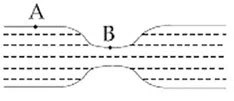
correct answer:- 2
Question 29
An ideal fluid flows (laminar flow) through a pipe of non-uniform diameter. The maximum and minimum diameters of the pipes are 6.4 cm and 4.8 cm, respectively. The ratio of the minimum and the maximum velocities of fluid in this pipe is:
correct answer:- 1
Question 30
The ratio of surface tensions of mercury and water is given to be 7.5, while the ratio of their densities is 13.6. Their contact angles, with glass, are close to 135° and 0°, respectively. If it is observed that mercury gets depressed by an amount $$h$$ in a capillary tube of radius $$r_1$$, while water rises by the same amount $$h$$ in a capillary tube of radius $$r_2$$, then the ratio $$\frac{r_1}{r_2}$$ is close to
correct answer:- 4
Question 31
A cubical block of side 0.5 m floats on water with 30% of its volume under water. What is the maximum weight that can be put on the block without fully submerging it under water?
[Take, density of water = 10$$^3$$ kg/m$$^3$$]
correct answer:- 1
Question 32
A submarine experiences a pressure of $$5.05 \times 10^6$$ Pa at a depth of d$$_1$$ in a sea. When it goes further to a depth of d$$_2$$, it experiences a pressure of $$8.08 \times 10^6$$ Pa. Then d$$_2$$ - d$$_1$$ is approximately (density of water = 10$$^3$$ kg/m$$^3$$ and acceleration due to gravity = 10 ms$$^{-2}$$):
correct answer:- 3