
Join Our JEE Preparation Group
Prep with like-minded aspirants; Get access to free daily tests and study material.
Sign in
Please select an account to continue using cracku.in
↓ →
Join Our JEE Preparation Group
Prep with like-minded aspirants; Get access to free daily tests and study material.
The pressure acting on a submarine is $$3 \times 10^5$$ Pa at a certain depth. If the depth is doubled, the percentage increase in the pressure acting on the submarine would be: (Assume that atmospheric pressure is $$1 \times 10^5$$ Pa, density of water is $$10^3$$ kg m$$^{-3}$$, g = 10 ms$$^{-2}$$)
We need to find the percentage increase in the pressure acting on a submarine when its depth in water is doubled.
The total pressure $$P$$ acting on a submarine at a depth $$h$$ below the surface of the water is the sum of the atmospheric pressure $$P_a$$ and the hydrostatic pressure due to the water column: $$P = P_a + \rho g h$$, where $$\rho$$ is the density of water and $$g$$ is the acceleration due to gravity.
We are given the initial total pressure at a certain depth: $$P_1 = 3 \times 10^5\text{ Pa}$$.
The atmospheric pressure is given as: $$P_a = 1 \times 10^5\text{ Pa}$$.
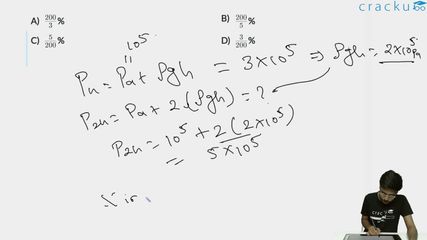
Substituting these values into the pressure equation allows us to find the initial gauge pressure ($$\rho g h$$) from the water: $$3 \times 10^5 = 1 \times 10^5 + \rho g h$$, which simplifies to: $$\rho g h = 2 \times 10^5\text{ Pa}$$.
When the depth is doubled, the new depth becomes $$2h$$. The new total pressure $$P_2$$ acting on the submarine is: $$P_2 = P_a + \rho g (2h) = P_a + 2(\rho g h)$$.
Substituting the known values of $$P_a$$ and $$\rho g h$$ into this expression gives: $$P_2 = 1 \times 10^5 + 2(2 \times 10^5) = 1 \times 10^5 + 4 \times 10^5 = 5 \times 10^5\text{ Pa}$$.
The percentage increase in the total pressure is calculated using the formula: $$\text{Percentage Increase} = \frac{P_2 - P_1}{P_1} \times 100\%$$.
Substituting the pressure values yields: $$\text{Percentage Increase} = \frac{5 \times 10^5 - 3 \times 10^5}{3 \times 10^5} \times 100\% = \frac{2 \times 10^5}{3 \times 10^5} \times 100\% = \frac{200}{3}\%$$.
Therefore, the correct answer is Option A: $$\frac{200}{3}\%$$.
Was this solution helpful?
Click on the Email ☝️ to Watch the Video Solution
Create a FREE account and get:
_1.webp)

Educational materials for JEE preparation

Ask our AI anything

AI can make mistakes. Please verify important information.
AI can make mistakes. Please verify important information.
