
Join Our JEE Preparation Group
Prep with like-minded aspirants; Get access to free daily tests and study material.
Sign in
Please select an account to continue using cracku.in
↓ →
Join Our JEE Preparation Group
Prep with like-minded aspirants; Get access to free daily tests and study material.
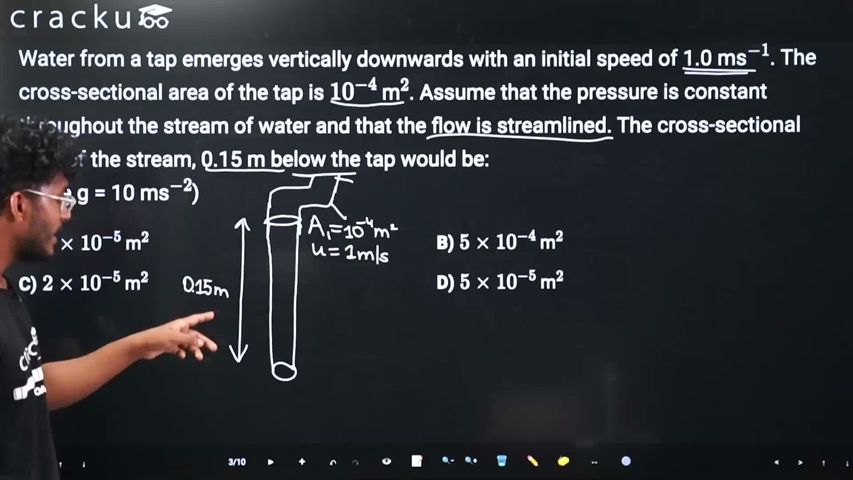
Water from a tap emerges vertically downwards with an initial speed of 1.0 ms$$^{-1}$$. The cross-sectional area of the tap is $$10^{-4}$$ m$$^2$$. Assume that the pressure is constant throughout the stream of water and that the flow is streamlined. The cross-sectional area of the stream, 0.15 m below the tap would be:
(Take g = 10 ms$$^{-2}$$)
We begin at the mouth of the tap, where the water has an initial speed $$v_1 = 1.0\ \mathrm{m\,s^{-1}}$$ and a cross-sectional area $$A_1 = 10^{-4}\ \mathrm{m^2}$$. The water then falls vertically downward through a distance $$h = 0.15\ \mathrm{m}$$ under gravity. Because the motion is steadily downward in air, the pressure everywhere in the thin stream is the same atmospheric pressure; hence the pressure term in Bernoulli’s equation will cancel out between any two points along the streamline.
First, we apply Bernoulli’s theorem, which states
$$P + \frac{1}{2}\rho v^2 + \rho g z = \text{constant along a streamline},$$
where $$P$$ is pressure, $$\rho$$ is the density of the fluid, $$v$$ is speed and $$z$$ is the vertical height (measured upward from an arbitrary reference level).
Taking point 1 at the tap opening and point 2 at the position $$0.15\ \mathrm{m}$$ below the tap, we note that $$P_1 = P_2$$ (both equal to atmospheric pressure). Therefore, equating the remaining terms, we have
$$\frac{1}{2}\rho v_1^2 + \rho g z_1 = \frac{1}{2}\rho v_2^2 + \rho g z_2.$$ Because $$z_2 = z_1 - 0.15$$ (point 2 is lower), we substitute $$z_2 = z_1 - 0.15$$:
$$\frac{1}{2}\rho v_1^2 + \rho g z_1 = \frac{1}{2}\rho v_2^2 + \rho g (z_1 - 0.15).$$
Now we cancel the common $$\rho g z_1$$ term from both sides:
$$\frac{1}{2}\rho v_1^2 = \frac{1}{2}\rho v_2^2 - \rho g (0.15).$$
Dividing every term by $$\rho$$ and multiplying by 2 to clear the fractions, we get
$$v_1^2 = v_2^2 - 2g(0.15).$$
Rearranging to make $$v_2^2$$ the subject,
$$v_2^2 = v_1^2 + 2g(0.15).$$
Now we substitute the given numerical values $$v_1 = 1.0\ \mathrm{m\,s^{-1}}$$ and $$g = 10\ \mathrm{m\,s^{-2}}$$:
$$v_2^2 = (1.0)^2 + 2 \times 10 \times 0.15 = 1 + 3 = 4.$$
Hence,
$$v_2 = \sqrt{4} = 2\ \mathrm{m\,s^{-1}}.$$
Next, we invoke the equation of continuity for incompressible, steady flow, which states
$$A_1 v_1 = A_2 v_2,$$
where $$A_2$$ is the (unknown) cross-sectional area of the water stream at the lower point. Solving for $$A_2$$ gives
$$A_2 = \frac{A_1 v_1}{v_2}.$$
Substituting the known quantities $$A_1 = 10^{-4}\ \mathrm{m^2},\; v_1 = 1.0\ \mathrm{m\,s^{-1}},\; v_2 = 2\ \mathrm{m\,s^{-1}},$$ we obtain
$$A_2 = \frac{10^{-4} \times 1.0}{2} = 0.5 \times 10^{-4}\ \mathrm{m^2}.$$
Expressing the numerical factor in standard scientific notation,
$$A_2 = 5 \times 10^{-5}\ \mathrm{m^2}.$$
Hence, the correct answer is Option D.
Was this solution helpful?
Click on the Email ☝️ to Watch the Video Solution
Create a FREE account and get:
_1.webp)

Educational materials for JEE preparation

Ask our AI anything

AI can make mistakes. Please verify important information.
AI can make mistakes. Please verify important information.
