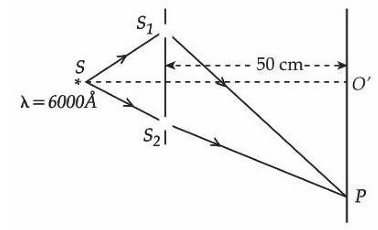
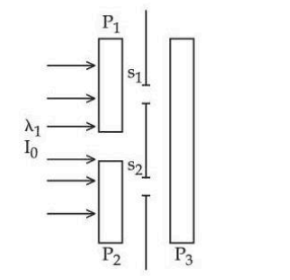
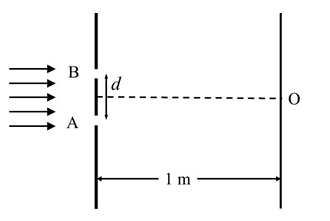
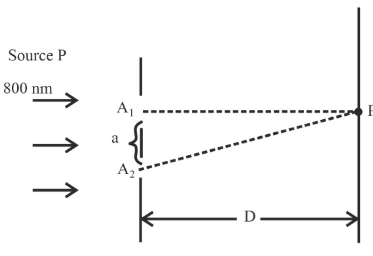
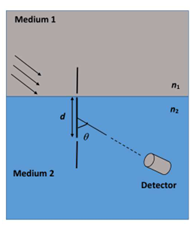
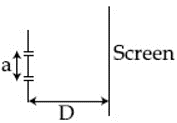
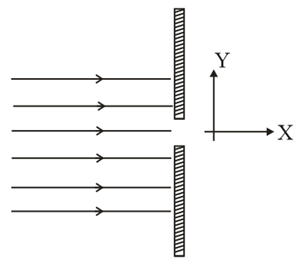
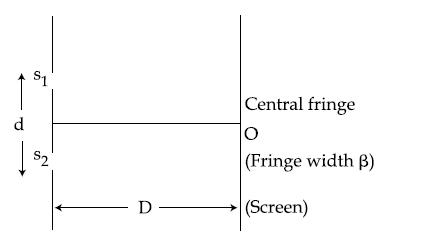
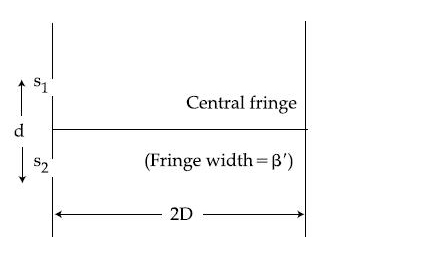
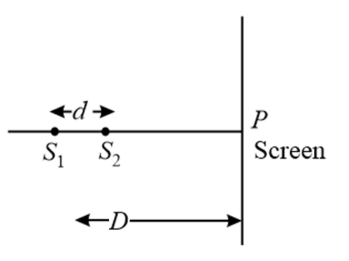
In Young's double-slit experiment, we have two identical slits, and the distance between the centers of these slits is denoted by $$d$$. The width of each slit is denoted by $$a$$. According to the problem, the distance between the slits is 6.1 times larger than the slit width, so we can write:
$$ d = 6.1a $$
We need to find the number of intensity maxima observed within the central maximum of the single-slit diffraction pattern. The central maximum of the single-slit diffraction pattern is the region between the first minima on either side of the central peak. For a single slit of width $$a$$, the first minimum occurs at an angle $$\theta$$ where:
$$ a \sin \theta = \lambda $$
Here, $$\lambda$$ is the wavelength of light. Therefore, the angular positions of the first minima are at $$\sin \theta = \pm \frac{\lambda}{a}$$. The central maximum extends from $$\sin \theta = -\frac{\lambda}{a}$$ to $$\sin \theta = \frac{\lambda}{a}$$.
In the double-slit experiment, the interference maxima occur at angles where the path difference is an integer multiple of the wavelength. The condition for the $$m$$-th interference maximum is:
$$ d \sin \theta = m \lambda $$
where $$m$$ is an integer (the order of the maximum). To find which interference maxima lie within the central maximum of the diffraction pattern, we require that $$\sin \theta$$ satisfies:
$$ -\frac{\lambda}{a} \leq \sin \theta \leq \frac{\lambda}{a} $$
Substituting $$\sin \theta = \frac{m \lambda}{d}$$ from the interference condition, we get:
$$ -\frac{\lambda}{a} \leq \frac{m \lambda}{d} \leq \frac{\lambda}{a} $$
Since $$\lambda > 0$$, we can divide all parts of the inequality by $$\lambda$$:
$$ -\frac{1}{a} \leq \frac{m}{d} \leq \frac{1}{a} $$
Multiplying through by $$d$$:
$$ -\frac{d}{a} \leq m \leq \frac{d}{a} $$
Given that $$d = 6.1a$$, we substitute $$\frac{d}{a} = 6.1$$:
$$ -6.1 \leq m \leq 6.1 $$
Since $$m$$ must be an integer, the possible values of $$m$$ are:
$$ m = -6, -5, -4, -3, -2, -1, 0, 1, 2, 3, 4, 5, 6 $$
This gives 13 values: from $$-6$$ to $$6$$ inclusive.
However, the central interference maximum at $$m = 0$$ is the brightest and is considered separately in some contexts. The problem asks for the number of intensity maxima within the central maximum of the single-slit diffraction pattern, and in many interpretations, this excludes the central interference maximum ($$m = 0$$) but includes all other maxima inside the central diffraction envelope. Therefore, we exclude $$m = 0$$ and count the remaining maxima.
The values excluding $$m = 0$$ are:
$$ m = -6, -5, -4, -3, -2, -1, 1, 2, 3, 4, 5, 6 $$
This gives 12 maxima: six on the left side ($$m = -6$$ to $$m = -1$$) and six on the right side ($$m = 1$$ to $$m = 6$$).
It is important to verify that these maxima are visible and not suppressed by diffraction minima. The diffraction minima occur at $$a \sin \theta = n \lambda$$ for $$n = \pm 1, \pm 2, \pm 3, \ldots$$. The interference maxima at $$d \sin \theta = m \lambda$$ coincide with diffraction minima when $$\frac{d}{a} = \frac{m}{n}$$, which is $$\frac{6.1}{1} = \frac{61}{10}$$. For $$m$$ and $$n$$ integers, this would require $$m$$ to be a multiple of 61 and $$n$$ a multiple of 10. Within the range $$|m| \leq 6$$, the only possible $$m$$ is 0 (when $$n = 0$$), but $$n = 0$$ corresponds to the central maximum, not a minimum. Thus, no interference maximum in this range coincides with a diffraction minimum, and all 12 maxima are visible within the central diffraction envelope.
Therefore, the number of intensity maxima observed within the central maximum of the single-slit diffraction pattern, excluding the central interference maximum, is 12.
Hence, the correct answer is Option D.
 JEE WhatsApp Group