
Join Our JEE Preparation Group
Prep with like-minded aspirants; Get access to free daily tests and study material.
Sign in
Please select an account to continue using cracku.in
↓ →
Join Our JEE Preparation Group
Prep with like-minded aspirants; Get access to free daily tests and study material.
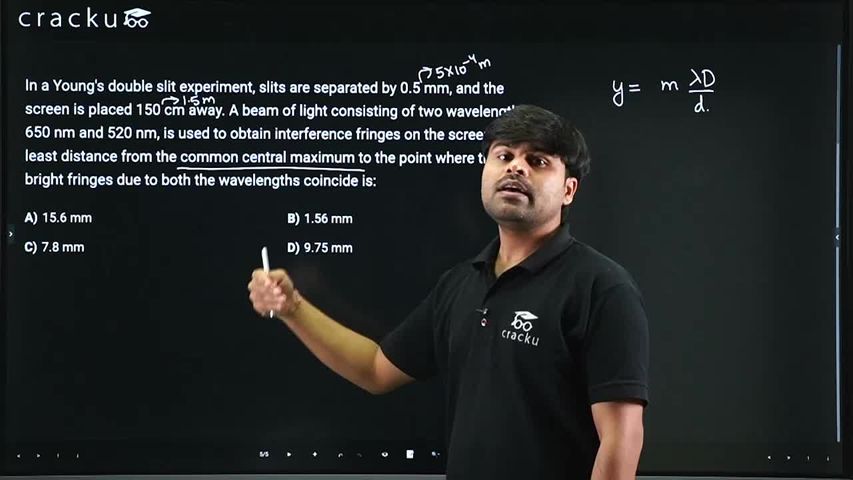
In a Young's double slit experiment, slits are separated by 0.5 mm, and the screen is placed 150 cm away. A beam of light consisting of two wavelengths, 650 nm and 520 nm, is used to obtain interference fringes on the screen. The least distance from the common central maximum to the point where the bright fringes due to both the wavelengths coincide is:
In a Young’s double slit experiment the distance between the slits is given as $$d = 0.5\;\text{mm} = 0.5 \times 10^{-3}\;\text{m}$$ and the distance of the screen from the slits is $$D = 150\;\text{cm} = 1.5\;\text{m}.$$ The two wavelengths in the incident light are $$\lambda_1 = 650\;\text{nm} = 650 \times 10^{-9}\;\text{m}$$ and $$\lambda_2 = 520\;\text{nm} = 520 \times 10^{-9}\;\text{m}.$$
For any wavelength, the position $$y$$ of the $$m^{\text{th}}$$ bright (constructive) fringe from the central maximum is obtained from the standard fringe-width relation
$$ y = m \,\frac{\lambda D}{d}. $$
A point on the screen will be simultaneously bright for both wavelengths if their bright fringes coincide there. If the orders of the two coincident bright fringes are $$m_1$$ (for $$\lambda_1$$) and $$m_2$$ (for $$\lambda_2$$), we must have the same geometrical position $$y$$ for both:
$$ m_1 \,\frac{\lambda_1 D}{d} \;=\; m_2 \,\frac{\lambda_2 D}{d}. $$
The common factors $$D$$ and $$d$$ cancel, leaving
$$ m_1 \,\lambda_1 \;=\; m_2 \,\lambda_2. $$
Substituting the two wavelengths,
$$ m_1 \,(650 \times 10^{-9}) \;=\; m_2 \,(520 \times 10^{-9}). $$
Dividing both sides by $$130 \times 10^{-9}$$ simplifies the numerical coefficients:
$$ m_1 \times 5 \;=\; m_2 \times 4. $$
So the ratio of the orders must satisfy
$$ \frac{m_1}{m_2} = \frac{4}{5}. $$
The smallest positive integers with this ratio are therefore $$m_1 = 4$$ and $$m_2 = 5.$$ Taking any higher multiple would move the coincidence farther out, so this choice gives the least (nearest) distance we seek.
Now we calculate that distance using $$m_1 = 4$$ with the wavelength $$\lambda_1 = 650 \times 10^{-9}\;\text{m}:$$
$$ y_{\text{least}} = m_1 \,\frac{\lambda_1 D}{d} = 4 \times \frac{650 \times 10^{-9}\,\text{m} \times 1.5\;\text{m}}{0.5 \times 10^{-3}\;\text{m}}. $$
First multiply in the numerator:
$$ 4 \times 650 = 2600, \qquad 2600 \times 10^{-9}\,\text{m} = 2.6 \times 10^{-6}\,\text{m}. $$
Then include the factor $$1.5$$ from $$D$$:
$$ 2.6 \times 10^{-6}\,\text{m} \times 1.5 = 3.9 \times 10^{-6}\,\text{m}. $$
Now divide by the denominator $$0.5 \times 10^{-3}\,\text{m}:$$
$$ y_{\text{least}} = \frac{3.9 \times 10^{-6}}{0.5 \times 10^{-3}} = \frac{3.9}{0.5} \times 10^{-6 + 3} = 7.8 \times 10^{-3}\,\text{m}. $$
Finally convert metres to millimetres (1 mm = $$10^{-3}$$ m):
$$ y_{\text{least}} = 7.8 \;\text{mm}. $$
Hence, the correct answer is Option C.
Was this solution helpful?
Click on the Email ☝️ to Watch the Video Solution
Create a FREE account and get:
_1.webp)

Educational materials for JEE preparation

Ask our AI anything

AI can make mistakes. Please verify important information.
AI can make mistakes. Please verify important information.
