For the following questions answer them individually
The following observations were taken for determining surface tension $$T$$ of water by capillary method:
diameter of capillary, $$D = 1.25 \times 10^{-2}$$ m
rise of water, $$h = 1.45 \times 10^{-2}$$ m
Using $$g = 9.80$$ m s$$^{-2}$$ and the simplified relation $$T = \frac{rhg}{2} \times 10^{3}$$ N m$$^{-1}$$, the possible error in surface tension is closest to:
A body is thrown vertically upwards. Which one of the following graphs correctly represents the velocity $$v$$ vs time $$t$$?
A time dependent force $$F = 6t$$ acts on a particle of mass 1 kg. If the particle starts from the rest, the work done by the force during the first 1 sec will be:
A body of mass $$m = 10^{-2}$$ kg is moving in a medium and experiences a frictional force $$F = -kv^{2}$$. Its initial speed is $$v_{0} = 10$$ m s$$^{-1}$$. After 10 s its kinetic energy is $$\frac{1}{8}mv_{0}^{2}$$, then the value of $$k$$ will be:
The moment of inertia of a uniform cylinder of length $$l$$ and radius $$R$$ about its perpendicular bisector is $$I$$. What is the ratio $$l/R$$ such that the moment of inertia is minimum?
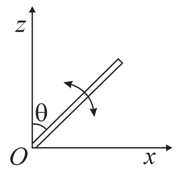
A slender uniform rod of mass $$M$$ and length $$l$$ is pivoted at one end so that it can rotate in a vertical plane (see figure). There is negligible friction at the pivot. The free end is held vertically above the pivot and then released. The angular acceleration of the rod when it makes an angle $$\theta$$ with the vertical is:
The variation of acceleration due to gravity $$g$$ with distance $$d$$ from the centre of the earth is best represented by ($$R$$ = Earth's radius):
A man grows into a giant such that his linear dimensions increase by a factor of 9. Assuming that his density remains same, the stress in the leg will change by a factor of:
A copper ball of mass 100 g is at a temperature $$T$$. It is dropped in a copper calorimeter of mass 100 g, filled with 170 g of water at room temperature. Subsequently, the temperature of the system is found to be 75°C. $$T$$ is given by:
(Given: room temperature = 30°C, specific heat of copper = 0.1 cal g$$^{-1}$$ °C$$^{-1}$$)
An external pressure $$P$$ is applied on a cube at 0°C so that it is equally compressed from all sides. $$K$$ is the bulk modulus of the material of the cube and $$\alpha$$ is its coefficient of linear expansion. Suppose we want to bring the cube to its original size by heating. The temperature should be raised by: