NTA JEE Main 2nd April 2017 Offline
For the following questions answer them individually
NTA JEE Main 2nd April 2017 Offline - Question 11
$$C_{p} - C_{v} = \frac{R}{M}$$ and $$C_{v}$$ are specific heats at constant pressure and constant volume respectively. It is observed that, $$C_{p} - C_{v} = a$$ for hydrogen gas and $$C_{p} - C_{v} = b$$ for nitrogen gas. The correct relation between $$a$$ and $$b$$ is:
NTA JEE Main 2nd April 2017 Offline - Question 12
The temperature of an open room of volume 30 m$$^{3}$$ increases from 17°C to 27°C due to the sunshine. The atmospheric pressure in the room remains $$1 \times 10^{5}$$ Pa. If $$n_{i}$$ and $$n_{f}$$ are the number of molecules in the room before and after heating, then $$n_{f} - n_{i}$$ will be:
NTA JEE Main 2nd April 2017 Offline - Question 13
A particle is executing simple harmonic motion with a time period $$T$$. At time $$t = 0$$, it is at its position of equilibrium. The kinetic energy - time graph of the particle will look like:

NTA JEE Main 2nd April 2017 Offline - Question 14
An observer is moving with half the speed of light towards a stationary microwave source emitting waves at frequency 10 GHz. What is the frequency of the microwave measured by the observer? (speed of light = $$3 \times 10^{8}$$ m s$$^{-1}$$)
NTA JEE Main 2nd April 2017 Offline - Question 15
An electric dipole has fixed dipole moment $$\vec{p}$$, which makes angle $$\theta$$ with respect to $$x$$-axis. When subjected to an electric field $$\vec{E}_{1} = E\hat{i}$$, it experiences a torque $$\vec{T}_{1} = \tau\hat{k}$$. When subjected to another electric field $$\vec{E}_{2} = \sqrt{3}E_{1}\hat{j}$$, it experiences a torque $$\vec{T}_{2} = -\vec{T}_{1}$$. The angle $$\theta$$ is:
NTA JEE Main 2nd April 2017 Offline - Question 16
A capacitance of 2 μF is required in an electrical circuit across a potential difference of 1.0 kV. A large number of 1 μF capacitors are available which can withstand a potential difference of not more than 300 V. The minimum number of capacitors required to achieve this is:
NTA JEE Main 2nd April 2017 Offline - Question 17
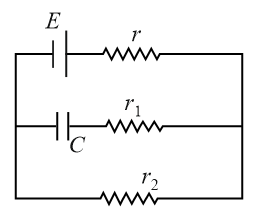
In the given circuit diagram, when the current reaches a steady-state in the circuit, the charge on the capacitor of capacitance $$C$$ will be:
NTA JEE Main 2nd April 2017 Offline - Question 18
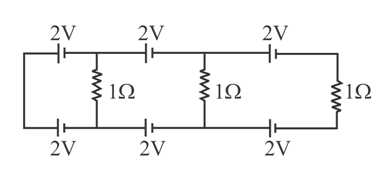
In the above circuit the current in each resistance is:
NTA JEE Main 2nd April 2017 Offline - Question 19
Which of the following statements is false?
NTA JEE Main 2nd April 2017 Offline - Question 20
When a current of 5 mA is passed through a galvanometer having a coil of resistance 15 Ω, it shows full-scale deflection. The value of the resistance to be put in series with the galvanometer to convert it into a voltmeter of range 0 - 10 V is: