NTA JEE Main 2nd April 2017 Offline
For the following questions answer them individually
NTA JEE Main 2nd April 2017 Offline - Question 21
A magnetic needle of magnetic moment $$6.7 \times 10^{-2}$$ A m$$^{2}$$ and moment of inertia $$7.5 \times 10^{-6}$$ kg m$$^{2}$$ is performing simple harmonic oscillations in a magnetic field of 0.01 T. Time taken for 10 complete oscillations is:
NTA JEE Main 2nd April 2017 Offline - Question 22
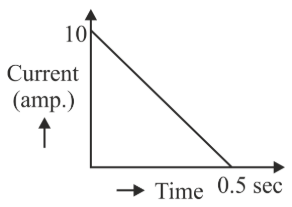
In a coil of resistance 100 Ω, a current is induced by changing the magnetic flux through it as shown in the figure. The magnitude of change in flux through the coil is:
NTA JEE Main 2nd April 2017 Offline - Question 23
An electron beam is accelerated by a potential difference $$V$$ to hit a metallic target to produce X-rays. It produces continuous as well as characteristic X-rays. If $$\lambda_{min}$$ is the smallest possible wavelength of X-ray in the spectrum, the variation of $$\log\lambda_{min}$$ with $$\log V$$ is correctly represented in:

NTA JEE Main 2nd April 2017 Offline - Question 24
A diverging lens with magnitude of focal length 25 cm is placed at a distance of 15 cm from a converging lens of magnitude of focal length 20 cm. A beam of parallel light falls on the diverging lens. The final image formed is:
NTA JEE Main 2nd April 2017 Offline - Question 25
In a Young's double slit experiment, slits are separated by 0.5 mm, and the screen is placed 150 cm away. A beam of light consisting of two wavelengths, 650 nm and 520 nm, is used to obtain interference fringes on the screen. The least distance from the common central maximum to the point where the bright fringes due to both the wavelengths coincide is:
NTA JEE Main 2nd April 2017 Offline - Question 26
A particle $$A$$ of mass $$m$$ and initial velocity $$v$$ collides with a particle $$B$$ of mass $$\frac{m}{2}$$ which is at rest. The collision is head on, and elastic. The ratio of the de-Broglie wavelengths $$\lambda_{A}$$ to $$\lambda_{B}$$ after the collision is:
NTA JEE Main 2nd April 2017 Offline - Question 27
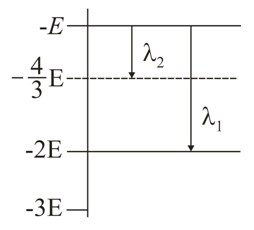
Some energy levels of a molecule are shown in the figure. The ratio of the wavelengths $$r = \frac{\lambda_{1}}{\lambda_{2}}$$, is given by:
NTA JEE Main 2nd April 2017 Offline - Question 28
A radioactive nucleus $$A$$ with a half-life $$T$$, decays into a nucleus $$B$$. At $$t = 0$$, there is no nucleus $$B$$. At some time $$t$$, the ratio of the number of $$B$$ to that of $$A$$ is 0.3. Then, $$t$$ is given by: (Consider $$\log_{e} x = \log x$$)
NTA JEE Main 2nd April 2017 Offline - Question 29
In a common emitter amplifier circuit using an $$n$$-$$p$$-$$n$$ transistor, the phase difference between the input and the output voltages will be:
NTA JEE Main 2nd April 2017 Offline - Question 30
In amplitude modulation, the sinusoidal carrier frequency used is denoted by $$\omega_{c}$$ and the signal frequency is denoted by $$\omega_{m}$$. The bandwidth $$\Delta\omega_{m}$$ of the signal is such that $$\Delta\omega_{m} \ll \omega_{c}$$. Which of the following frequencies is not contained in the modulated wave?