
Join Our JEE Preparation Group
Prep with like-minded aspirants; Get access to free daily tests and study material.
Sign in
Please select an account to continue using cracku.in
↓ →
Join Our JEE Preparation Group
Prep with like-minded aspirants; Get access to free daily tests and study material.
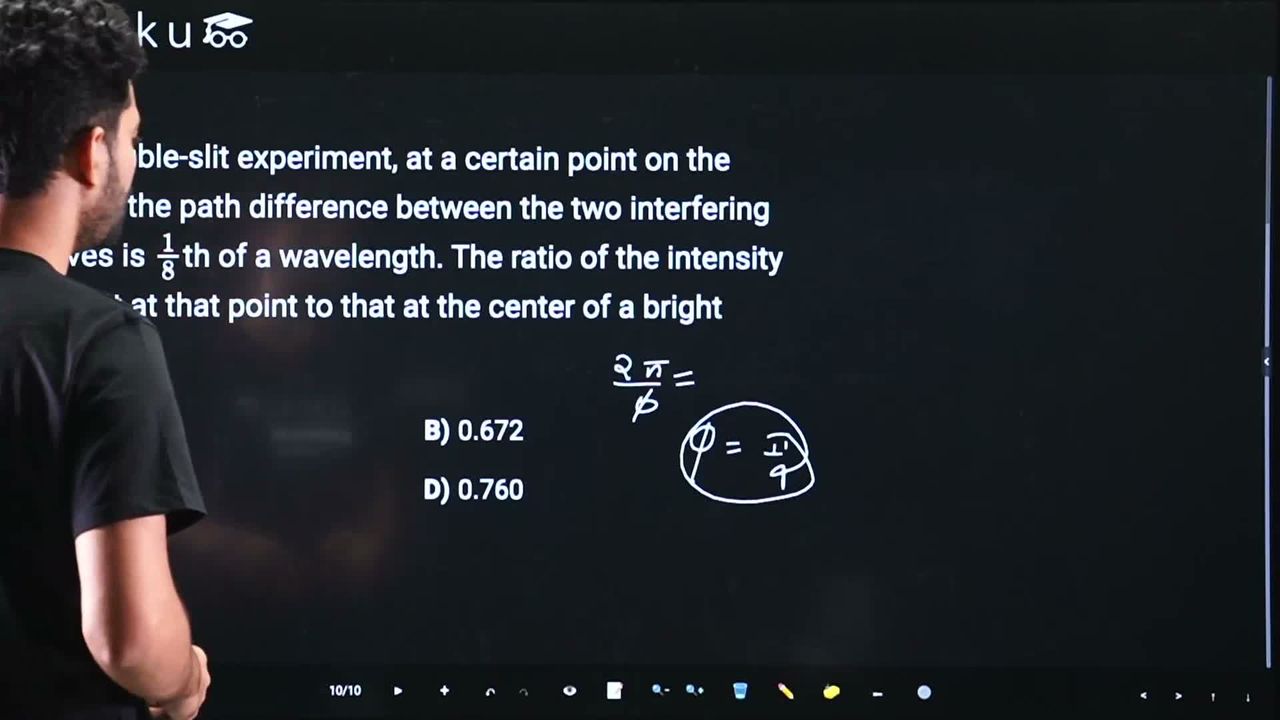
In a double-slit experiment, at a certain point on the screen the path difference between the two interfering waves is $$\frac{1}{8}$$th of a wavelength. The ratio of the intensity of light at that point to that at the center of a bright fringe is:
For a double-slit arrangement let the two slits give waves of equal individual intensity $$I_0$$. The general interference formula is first stated:
$$I \;=\; I_1 + I_2 + 2\sqrt{I_1I_2}\,\cos\phi,$$
where $$\phi$$ is the phase difference of the two waves at the observation point. Because both slits are identical, we have $$I_1 = I_2 = I_0$$, so the expression becomes
$$I \;=\; 2I_0 + 2I_0\cos\phi \;=\; 2I_0\bigl(1+\cos\phi\bigr).$$
Now we use the trigonometric identity $$1+\cos\phi = 2\cos^2\frac{\phi}{2}$$, giving
$$I \;=\; 2I_0 \times 2\cos^2\frac{\phi}{2} \;=\; 4I_0\cos^2\frac{\phi}{2}.$$
At the centre of a bright fringe (the central maximum) the two waves are in phase, so $$\phi = 0$$ and we obtain the maximum intensity
$$I_{\max} = 4I_0\cos^2 0 = 4I_0.$$
Our task is to find the intensity $$I$$ when the path difference $$\Delta$$ equals $$\dfrac{\lambda}{8}$$. Phase difference and path difference are connected by the relation
$$\phi = \dfrac{2\pi}{\lambda}\,\Delta.$$
Substituting $$\Delta = \dfrac{\lambda}{8}$$ gives
$$\phi \;=\; \dfrac{2\pi}{\lambda}\,\Bigl(\dfrac{\lambda}{8}\Bigr) = \dfrac{2\pi}{8} = \dfrac{\pi}{4}.$$
Now we insert this value of $$\phi$$ into the intensity formula:
$$I \;=\; 4I_0\cos^2\frac{\phi}{2} = 4I_0\cos^2\!\Bigl(\dfrac{\pi}{4}\times\dfrac12\Bigr) = 4I_0\cos^2\!\Bigl(\dfrac{\pi}{8}\Bigr).$$
We are interested in the ratio of this intensity to the central maximum:
$$\dfrac{I}{I_{\max}} = \dfrac{4I_0\cos^2\!\bigl(\dfrac{\pi}{8}\bigr)}{4I_0} = \cos^2\!\Bigl(\dfrac{\pi}{8}\Bigr).$$
To evaluate $$\cos\!\bigl(\dfrac{\pi}{8}\bigr)$$ we employ the half-angle identity once more:
$$\cos\!\Bigl(\dfrac{\pi}{8}\Bigr) = \sqrt{\dfrac{1+\cos\!\bigl(\dfrac{\pi}{4}\bigr)}{2}} = \sqrt{\dfrac{1+\tfrac{1}{\sqrt2}}{2}} = \sqrt{\dfrac{1+\;0.7071}{2}} = \sqrt{\dfrac{1.7071}{2}} = \sqrt{0.8536} \approx 0.9239.$$
Squaring this value we obtain
$$\cos^2\!\Bigl(\dfrac{\pi}{8}\Bigr) \;=\; (0.9239)^2 \;\approx\; 0.8536.$$
Thus,
$$\dfrac{I}{I_{\max}} \approx 0.853.$$
Hence, the correct answer is Option A.
Was this solution helpful?
Click on the Email ☝️ to Watch the Video Solution
Create a FREE account and get:
_1.webp)

Educational materials for JEE preparation

Ask our AI anything

AI can make mistakes. Please verify important information.
AI can make mistakes. Please verify important information.


