
Join Our JEE Preparation Group
Prep with like-minded aspirants; Get access to free daily tests and study material.
Sign in
Please select an account to continue using cracku.in
↓ →
Join Our JEE Preparation Group
Prep with like-minded aspirants; Get access to free daily tests and study material.
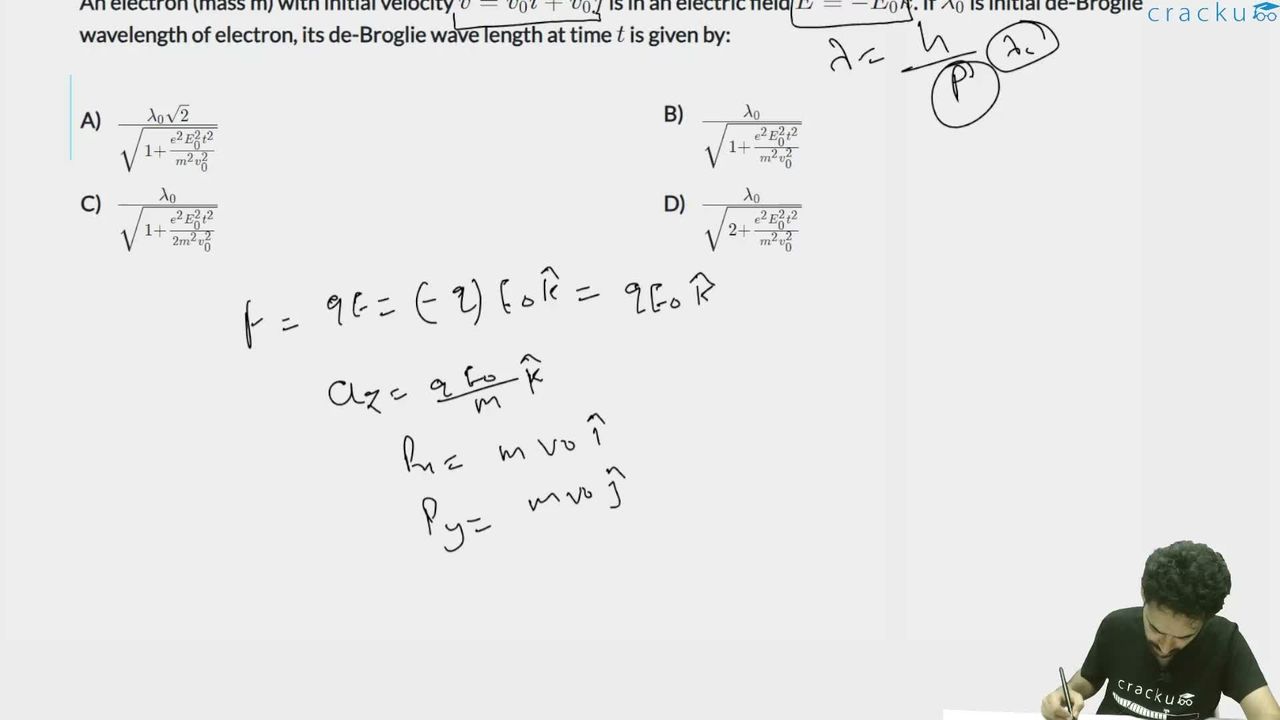
An electron (mass m) with initial velocity $$\vec{v} = v_0\hat{i} + v_0\hat{j}$$ is in an electric field $$\vec{E} = -E_0\hat{k}$$. If $$\lambda_0$$ is initial de-Broglie wavelength of electron, its de-Broglie wave length at time $$t$$ is given by:
We are told that an electron of mass $$m$$ starts with velocity $$\vec{v}_0 = v_0\hat{i}+v_0\hat{j}$$ and is placed in a uniform electric field $$\vec{E} = -E_0\hat{k}$$. Remember that the charge of an electron is $$q = -e$$ (negative).
First we write the force on a charged particle in an electric field. The formula is $$\vec{F}=q\vec{E}.$$ Substituting the values of $$q$$ and $$\vec{E}$$ we get
$$\vec{F}=(-e)(-E_0\hat{k}) = +eE_0\hat{k}.$$
This force acts only in the $$\hat{k}$$ (or $$z$$) direction. Therefore:
The acceleration produced in the $$z$$ direction is
$$a_z = \frac{F_z}{m}= \frac{eE_0}{m}.$$
Initially the electron has no $$z$$-velocity, so $$v_{z0}=0$$. After a time $$t$$ the velocity component in the $$z$$ direction is
$$v_z = v_{z0}+a_zt = 0+\frac{eE_0}{m}t=\frac{eE_0 t}{m}.$$
Now we list the three momentum components at time $$t$$:
$$\begin{aligned} p_x &= m v_0,\\[4pt] p_y &= m v_0,\\[4pt] p_z &= m v_z = m\left(\frac{eE_0 t}{m}\right)=eE_0t. \end{aligned}$$
The magnitude of the total momentum vector $$\vec{p}$$ is therefore
$$\begin{aligned} p &= \sqrt{p_x^2+p_y^2+p_z^2}\\[4pt] &= \sqrt{(mv_0)^2+(mv_0)^2+(eE_0t)^2}\\[4pt] &= \sqrt{2m^2v_0^2+e^2E_0^2t^2}. \end{aligned}$$
We can factor out $$m^2v_0^2$$ from the square root:
$$p = \sqrt{m^2v_0^2}\,\sqrt{2+\frac{e^2E_0^2t^2}{m^2v_0^2}} = mv_0\sqrt{2+\frac{e^2E_0^2t^2}{m^2v_0^2}}.$$
The de-Broglie relation connects wavelength and momentum by
$$\lambda = \frac{h}{p},$$
where $$h$$ is Planck’s constant.
Initially ($$t=0$$) the magnitude of the momentum is
$$p_0 = \sqrt{(mv_0)^2+(mv_0)^2}=mv_0\sqrt{2},$$
so the initial de-Broglie wavelength is
$$\lambda_0 = \frac{h}{p_0} =\frac{h}{mv_0\sqrt{2}}.$$
At a later time $$t$$ the wavelength is
$$\lambda(t)=\frac{h}{p} =\frac{h}{mv_0\sqrt{2+\dfrac{e^2E_0^2t^2}{m^2v_0^2}}}.$$
We now express $$h/(mv_0\sqrt{2})$$ as $$\lambda_0$$, obtained above. Substituting, we have
$$\lambda(t) = \frac{\lambda_0\sqrt{2}} {\sqrt{2+\dfrac{e^2E_0^2t^2}{m^2v_0^2}}}.$$
To simplify further we factor $$\sqrt{2}$$ out of the denominator:
$$\begin{aligned} \sqrt{2+\frac{e^2E_0^2t^2}{m^2v_0^2}} &= \sqrt{2}\sqrt{1+\frac{e^2E_0^2t^2}{2m^2v_0^2}},\\[6pt] \lambda(t) &= \frac{\lambda_0\sqrt{2}} {\sqrt{2}\sqrt{1+\dfrac{e^2E_0^2t^2}{2m^2v_0^2}}} =\frac{\lambda_0} {\sqrt{1+\dfrac{e^2E_0^2t^2}{2m^2v_0^2}}}. \end{aligned}$$
This expression matches option C in the given list:
$$\lambda(t)=\frac{\lambda_0}{\sqrt{1+\dfrac{e^2E_0^2t^2}{2m^2v_0^2}}}.$$
Hence, the correct answer is Option C.
Was this solution helpful?
Click on the Email ☝️ to Watch the Video Solution
Create a FREE account and get:
_1.webp)

Educational materials for JEE preparation

Ask our AI anything

AI can make mistakes. Please verify important information.
AI can make mistakes. Please verify important information.


