
Join Our JEE Preparation Group
Prep with like-minded aspirants; Get access to free daily tests and study material.
Sign in
Please select an account to continue using cracku.in
↓ →
Join Our JEE Preparation Group
Prep with like-minded aspirants; Get access to free daily tests and study material.
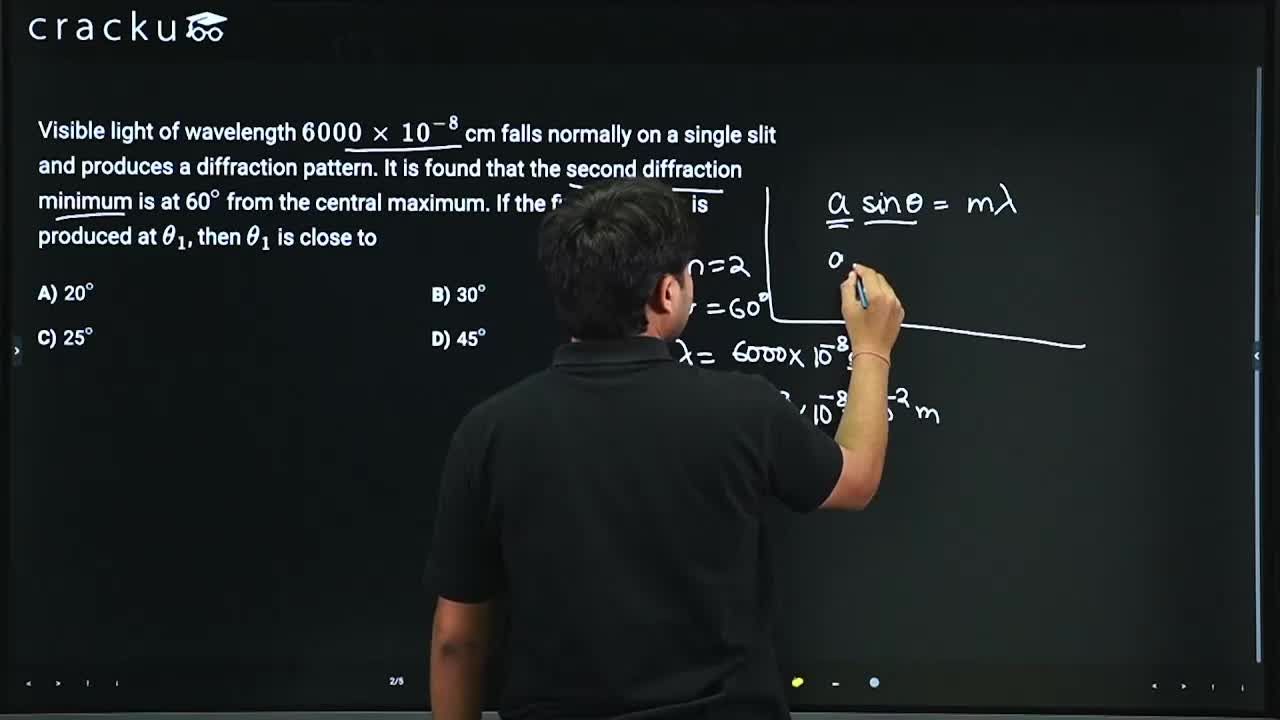
Visible light of wavelength $$6000 \times 10^{-8}$$ cm falls normally on a single slit and produces a diffraction pattern. It is found that the second diffraction minimum is at 60$$^\circ$$ from the central maximum. If the first minimum is produced at $$\theta_1$$, then $$\theta_1$$ is close to
For a single-slit Fraunhofer diffraction pattern the angular position of the dark minima is given by the well-known condition
$$a\,\sin\theta = m\,\lambda$$
where $$a$$ is the width of the slit, $$\lambda$$ is the wavelength of the incident light, $$\theta$$ is the angle measured from the central (zero-order) maximum to the minimum, and $$m=1,2,3,\ldots$$ denotes the order of the minimum.
We are told that the second minimum (that is, $$m=2$$) occurs at an angle $$\theta_2 = 60^{\circ}$$. Substituting these values into the formula gives
$$a \,\sin 60^{\circ} = 2\,\lambda.$$
First we write the numerical value of the wavelength in convenient form. The statement gives $$\lambda = 6000 \times 10^{-8}\ \text{cm}$$, and multiplying the coefficients we get
$$\lambda = 6\,000 \times 10^{-8}\ \text{cm} = 6 \times 10^{-5}\ \text{cm}.$$
Now we evaluate the sine of $$60^{\circ}$$:
$$\sin 60^{\circ} = \frac{\sqrt3}{2} \approx 0.866.$$
Putting these into the relation for $$a$$ we have
$$a = \frac{2\,\lambda}{\sin 60^{\circ}} = \frac{2 \times 6 \times 10^{-5}\ \text{cm}}{0.866} = \frac{12 \times 10^{-5}\ \text{cm}}{0.866} \approx 1.386 \times 10^{-4}\ \text{cm}.$$
The angle $$\theta_1$$ of the first diffraction minimum corresponds to $$m=1$$, so the same formula gives
$$a\,\sin\theta_1 = 1 \times \lambda.$$ Substituting the value of $$a$$ that we have just obtained, we get
$$\sin\theta_1 = \frac{\lambda}{a} = \frac{\lambda}{\dfrac{2\,\lambda}{\sin 60^{\circ}}} = \lambda \;\times\; \frac{\sin 60^{\circ}}{2\,\lambda} = \frac{\sin 60^{\circ}}{2}.$$
Because the wavelength $$\lambda$$ has cancelled out, the numerical evaluation is very easy:
$$\sin\theta_1 = \frac{0.866}{2} = 0.433.$$
We now find the angle whose sine is $$0.433$$. Taking the inverse sine (in degrees),
$$\theta_1 = \sin^{-1}(0.433) \approx 25.6^{\circ}.$$
This value lies closest to $$25^{\circ}$$ among the alternatives provided.
Hence, the correct answer is Option C.
Was this solution helpful?
Click on the Email ☝️ to Watch the Video Solution
Create a FREE account and get:
_1.webp)

Educational materials for JEE preparation

Ask our AI anything

AI can make mistakes. Please verify important information.
AI can make mistakes. Please verify important information.


