
Join Our JEE Preparation Group
Prep with like-minded aspirants; Get access to free daily tests and study material.
Sign in
Please select an account to continue using cracku.in
↓ →
Join Our JEE Preparation Group
Prep with like-minded aspirants; Get access to free daily tests and study material.
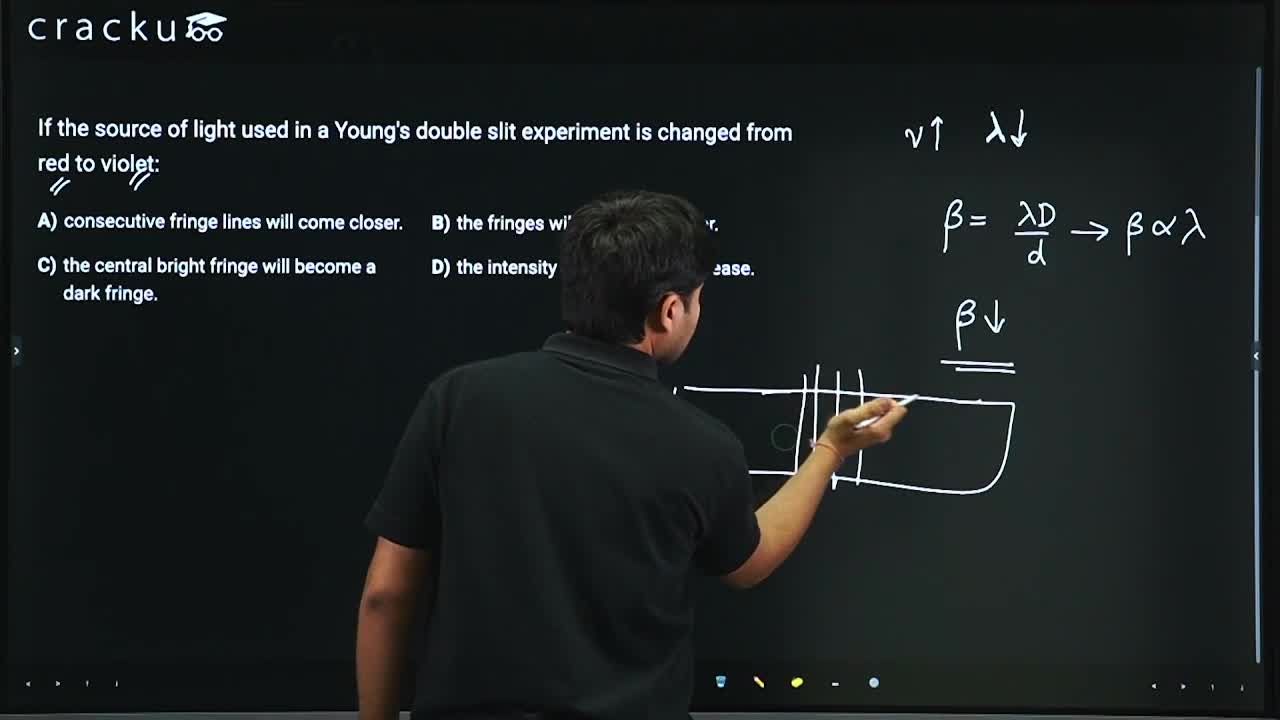
If the source of light used in a Young's double slit experiment is changed from red to violet:
In Young's double slit experiment, the fringe width is given by $$\beta = \frac{\lambda D}{d}$$, where $$\lambda$$ is the wavelength of light, $$D$$ is the distance from the slits to the screen, and $$d$$ is the separation between the slits.
When the source is changed from red to violet light, the wavelength decreases since violet light has a shorter wavelength (approximately 400 nm) compared to red light (approximately 700 nm).
Since the fringe width $$\beta$$ is directly proportional to $$\lambda$$, a decrease in wavelength causes a decrease in fringe width. This means the consecutive fringe lines come closer together on the screen.
The central bright fringe remains bright regardless of wavelength change, the brightness of fringes depends on intensity not wavelength, and the intensity of minima remains zero for perfectly coherent sources.
The correct answer is that consecutive fringe lines will come closer.
Was this solution helpful?
Click on the Email ☝️ to Watch the Video Solution
Create a FREE account and get:
_1.webp)

Educational materials for JEE preparation

Ask our AI anything

AI can make mistakes. Please verify important information.
AI can make mistakes. Please verify important information.


