
Join Our JEE Preparation Group
Prep with like-minded aspirants; Get access to free daily tests and study material.
Sign in
Please select an account to continue using cracku.in
↓ →
Join Our JEE Preparation Group
Prep with like-minded aspirants; Get access to free daily tests and study material.
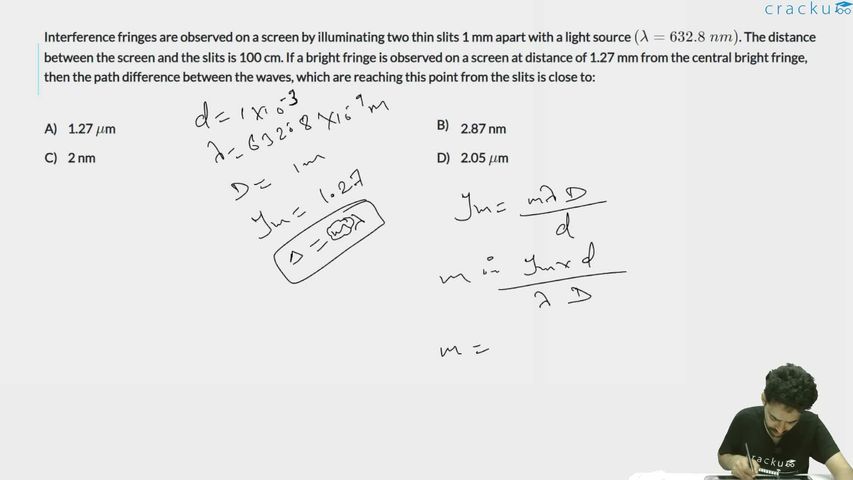
Interference fringes are observed on a screen by illuminating two thin slits 1 mm apart with a light source $$(\lambda = 632.8 \; nm)$$. The distance between the screen and the slits is 100 cm. If a bright fringe is observed on a screen at distance of 1.27 mm from the central bright fringe, then the path difference between the waves, which are reaching this point from the slits is close to:
First of all, for a double-slit interference pattern the position $$y_m$$ of the $$m^{\text{th}}$$ bright fringe on the screen is given by the formula
$$y_m \;=\; \frac{m \lambda D}{d}$$
where
$$\lambda$$ is the wavelength of light, $$D$$ is the distance between the slits and the screen, $$d$$ is the separation between the two slits, $$m$$ is the order number of the bright fringe (an integer 0, 1, 2, …).
We know the following numerical values:
$$d \;=\; 1\;\text{mm} \;=\; 1 \times 10^{-3}\;\text{m}$$ $$D \;=\; 100\;\text{cm} \;=\; 1\;\text{m}$$ $$\lambda \;=\; 632.8\;\text{nm} \;=\; 632.8 \times 10^{-9}\;\text{m}$$ The observed distance of the bright fringe from the central bright fringe is $$y_m \;=\; 1.27\;\text{mm} \;=\; 1.27 \times 10^{-3}\;\text{m}$$
We substitute these numbers into the formula and solve for $$m$$:
$$ m = \frac{y_m \, d}{\lambda D} = \frac{\bigl(1.27 \times 10^{-3}\bigr)\bigl(1 \times 10^{-3}\bigr)} {\bigl(632.8 \times 10^{-9}\bigr)\bigl(1\bigr)} $$
To simplify the numerator, we multiply the powers of ten:
$$1.27 \times 10^{-3} \times 1 \times 10^{-3} = 1.27 \times 10^{-6}$$
So we have
$$ m = \frac{1.27 \times 10^{-6}}{632.8 \times 10^{-9}} = \frac{1.27}{632.8} \times 10^{-6+9} = \frac{1.27}{632.8} \times 10^{3} $$
Now,
$$\frac{1.27}{632.8} \approx 0.002007$$
Hence,
$$m \approx 0.002007 \times 1000 = 2.007$$
Since $$m$$ must be an integer for a bright fringe, we take $$m = 2$$. This tells us that the observed bright band is the second-order bright fringe.
The path difference $$\Delta$$ between the waves from the two slits at the position of the $$m^{\text{th}}$$ bright fringe is
$$\Delta = m \lambda$$
Substituting $$m = 2$$ and $$\lambda = 632.8\;\text{nm}$$, we get
$$ \Delta = 2 \times 632.8\;\text{nm} = 1265.6\;\text{nm} $$
We convert nanometres to micrometres using $$1\;\mu\text{m} = 1000\;\text{nm}$$:
$$ \Delta = \frac{1265.6\;\text{nm}}{1000} = 1.2656\;\mu\text{m} \approx 1.27\;\mu\text{m} $$
Hence, the correct answer is Option A.
Was this solution helpful?
Click on the Email ☝️ to Watch the Video Solution
Create a FREE account and get:
_1.webp)

Educational materials for JEE preparation

Ask our AI anything

AI can make mistakes. Please verify important information.
AI can make mistakes. Please verify important information.
