
Join Our JEE Preparation Group
Prep with like-minded aspirants; Get access to free daily tests and study material.
Sign in
Please select an account to continue using cracku.in
↓ →
Join Our JEE Preparation Group
Prep with like-minded aspirants; Get access to free daily tests and study material.
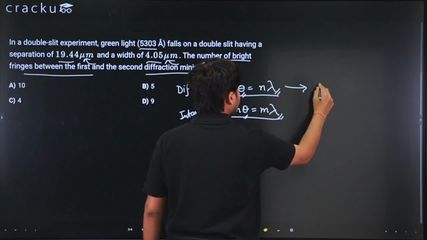
In a double-slit experiment, green light (5303 Å) falls on a double slit having a separation of $$19.44 \mu m$$ and a width of $$4.05 \mu m$$. The number of bright fringes between the first and the second diffraction minima is
We first recall that in a double-slit set-up the intensity pattern observed on the screen is the product of two separate effects:
1. Single-slit diffraction from each slit of width $$a$$ gives dark (minimum-intensity) directions obeying the well-known condition
$$a\,\sin\theta \;=\; m\,\lambda,$$
where $$m = \pm 1, \pm 2, \pm 3,\dots$$. The values of $$m$$ label the successive diffraction minima. The first minimum corresponds to $$m = 1$$, the second to $$m = 2$$, and so on.
2. Interference between the two slits of centre-to-centre separation $$d$$ produces bright fringes in the directions that satisfy
$$d\,\sin\theta \;=\; n\,\lambda,$$
with $$n = 0, \pm 1, \pm 2,\dots$$. Each integer $$n$$ therefore labels one interference maximum (bright fringe).
We are asked to count how many interference maxima lie between the first and the second diffraction minima, i.e. for angles satisfying
$$\text{first minimum:}\; a\sin\theta = 1\,\lambda \quad \text{to} \quad \text{second minimum:}\; a\sin\theta = 2\,\lambda.$$
To proceed, we substitute the expression for $$\sin\theta$$ obtained from the diffraction condition into the interference condition so that the two formulae can be linked directly.
From the diffraction minima condition we have
$$\sin\theta = \dfrac{m\,\lambda}{a}.$$
Placing this value of $$\sin\theta$$ into the interference condition $$d\sin\theta = n\lambda$$ gives
$$d \left(\dfrac{m\,\lambda}{a}\right) = n\,\lambda.$$
The factor $$\lambda$$ cancels on both sides, leaving
$$n = \dfrac{d}{a}\,m.$$
This remarkably simple relation tells us that whenever $$m$$ takes an integer value at a diffraction minimum, the corresponding interference order is
$$n = \left(\dfrac{d}{a}\right)m.$$
We now put in the numerical values supplied in the question:
$$d = 19.44\;\mu \text{m}, \quad a = 4.05\;\mu \text{m}.$$
Hence
$$\dfrac{d}{a} = \dfrac{19.44}{4.05} = 4.8.$$
Let us evaluate $$n$$ at the two diffraction minima in question.
For the first diffraction minimum ($$m = 1$$) we obtain
$$n_1 = (4.8)(1) = 4.8.$$
For the second diffraction minimum ($$m = 2$$) we obtain
$$n_2 = (4.8)(2) = 9.6.$$
Between these two values of $$\theta$$, the interference maxima correspond to integer $$n$$ lying strictly between 4.8 and 9.6 (because at the minima themselves the intensity is zero, so those angular positions are excluded). All integers satisfying
$$4.8 < n < 9.6$$
are therefore counted. Listing them explicitly, we have
$$n = 5,\;6,\;7,\;8,\;9.$$
This is a total of
$$5 \text{ bright fringes}.$$
Hence, the correct answer is Option B.
Was this solution helpful?
Click on the Email ☝️ to Watch the Video Solution
Create a FREE account and get:
_1.webp)

Educational materials for JEE preparation

Ask our AI anything

AI can make mistakes. Please verify important information.
AI can make mistakes. Please verify important information.


