
Join Our JEE Preparation Group
Prep with like-minded aspirants; Get access to free daily tests and study material.
Sign in
Please select an account to continue using cracku.in
↓ →
Join Our JEE Preparation Group
Prep with like-minded aspirants; Get access to free daily tests and study material.
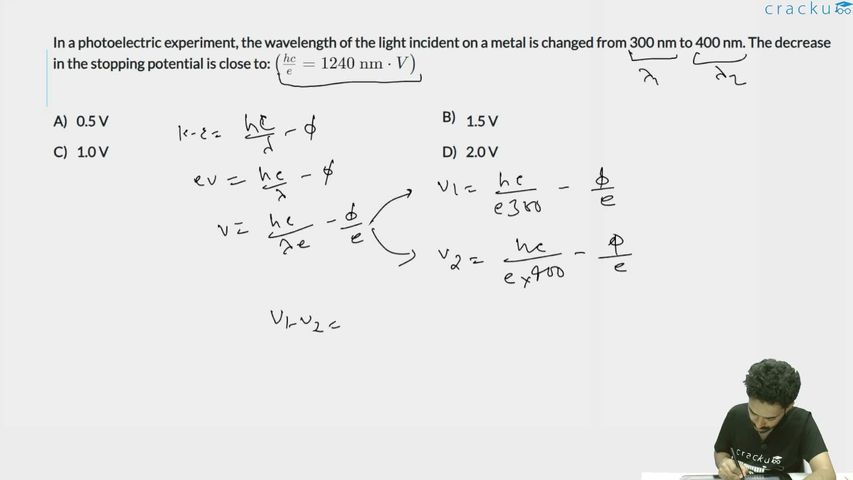
In a photoelectric experiment, the wavelength of the light incident on a metal is changed from 300 nm to 400 nm. The decrease in the stopping potential is close to: $$\left(\frac{hc}{e} = 1240 \text{ nm} \cdot V\right)$$
The photoelectric equation, first stated by Einstein, relates the stopping potential $$V_0$$ to the frequency $$\nu$$ (or wavelength $$\lambda$$) of the incident light as
$$eV_0 \;=\; h\nu \;-\;\phi_0$$
where $$e$$ is the electronic charge, $$h$$ is Planck’s constant, and $$\phi_0$$ is the work function of the metal. Using the relation between frequency and wavelength $$\nu = \dfrac{c}{\lambda}$$, this can be rewritten in terms of wavelength:
$$eV_0 \;=\; \dfrac{hc}{\lambda} \;-\;\phi_0$$
We perform the experiment at two different wavelengths, $$\lambda_1 = 300 \text{ nm}$$ and $$\lambda_2 = 400 \text{ nm}$$, and obtain two corresponding stopping potentials $$V_1$$ and $$V_2$$. Writing the equation for each wavelength, we have
$$eV_1 \;=\; \dfrac{hc}{\lambda_1} \;-\;\phi_0$$
$$eV_2 \;=\; \dfrac{hc}{\lambda_2} \;-\;\phi_0$$
To eliminate the unknown work function $$\phi_0$$, we subtract the second equation from the first:
$$eV_1 \;-\; eV_2 \;=\;\dfrac{hc}{\lambda_1} \;-\;\dfrac{hc}{\lambda_2}$$
Taking $$e$$ common on the left side, this becomes
$$e\,(V_1 - V_2) \;=\; \dfrac{hc}{\lambda_1} \;-\; \dfrac{hc}{\lambda_2}$$
Dividing by $$e$$ gives the change (decrease) in stopping potential:
$$\Delta V \;=\; V_1 - V_2 \;=\; \dfrac{hc}{e}\left(\dfrac{1}{\lambda_1} - \dfrac{1}{\lambda_2}\right)$$
We are supplied with the convenient constant $$\dfrac{hc}{e} = 1240 \text{ nm}\cdot\text{V}$$. Substituting the given wavelengths, we obtain
$$\Delta V \;=\; 1240 \,\text{nm}\cdot\text{V}\;\Bigl(\dfrac{1}{300 \,\text{nm}} - \dfrac{1}{400 \,\text{nm}}\Bigr)$$
Now we evaluate the term in parentheses carefully, keeping every algebraic step explicit:
$$\dfrac{1}{300 \,\text{nm}} \;=\; 0.003333\;\text{nm}^{-1}$$
$$\dfrac{1}{400 \,\text{nm}} \;=\; 0.002500\;\text{nm}^{-1}$$
Hence,
$$\dfrac{1}{300} - \dfrac{1}{400} \;=\; 0.003333 - 0.002500 \;=\; 0.000833\;\text{nm}^{-1}$$
Multiplying by the constant 1240 nm·V, we get
$$\Delta V \;=\; 1240 \times 0.000833 \;\text{V}$$
Carrying out the multiplication step by step,
$$1240 \times 0.000833 \;=\; 1.033\;\text{V (approximately)}$$
The decrease in the stopping potential is therefore about $$1.0 \text{ V}$$ when expressed to one significant figure, matching the choice closest to our calculated value.
Hence, the correct answer is Option C.
Was this solution helpful?
Click on the Email ☝️ to Watch the Video Solution
Create a FREE account and get:
_1.webp)

Educational materials for JEE preparation

Ask our AI anything

AI can make mistakes. Please verify important information.
AI can make mistakes. Please verify important information.


