
Join Our JEE Preparation Group
Prep with like-minded aspirants; Get access to free daily tests and study material.
Sign in
Please select an account to continue using cracku.in
↓ →
Join Our JEE Preparation Group
Prep with like-minded aspirants; Get access to free daily tests and study material.
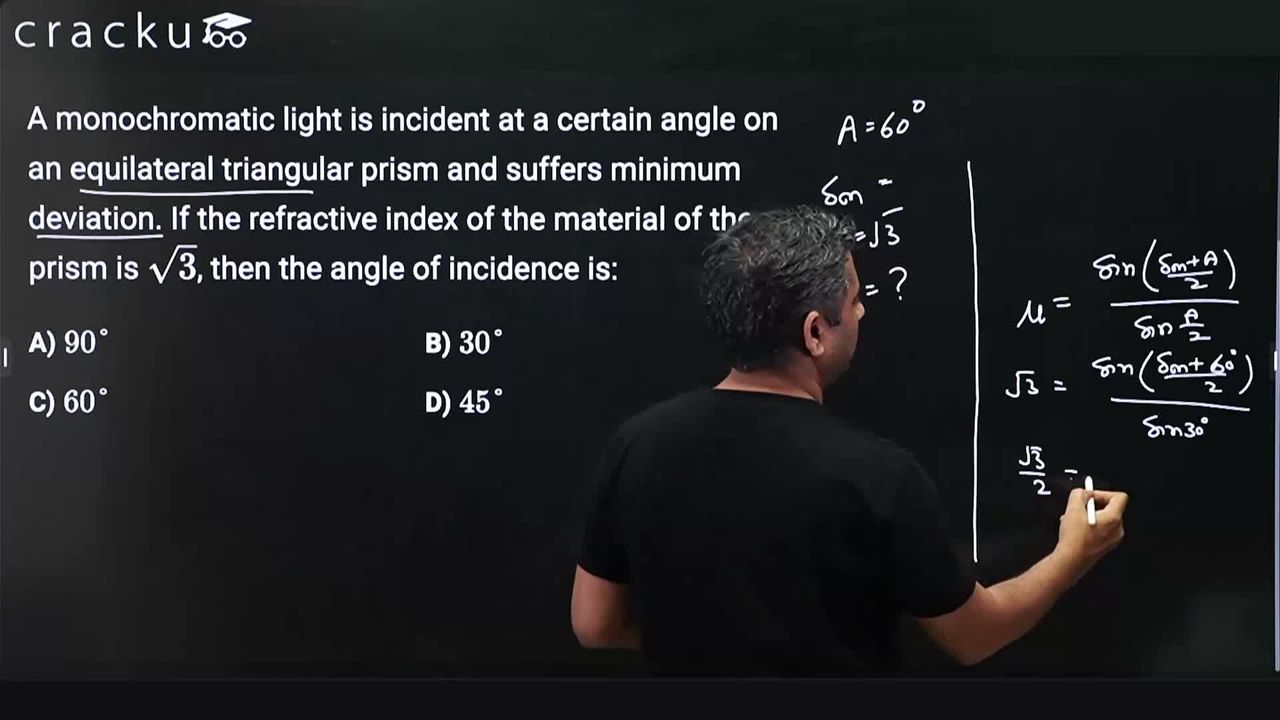
A monochromatic light is incident at a certain angle on an equilateral triangular prism and suffers minimum deviation. If the refractive index of the material of the prism is $$\sqrt{3}$$, then the angle of incidence is:
We are dealing with an equilateral triangular prism, so its apex angle is $$A = 60^\circ$$ because each angle of an equilateral triangle measures $$60^\circ$$.
For a prism, the condition of minimum deviation is very useful. At minimum deviation the light ray travels symmetrically inside the prism, giving us two important equalities:
$$i = e \quad\text{and}\quad r_1 = r_2 = r$$
where
$$i$$ = angle of incidence,
$$e$$ = angle of emergence,
$$r_1, r_2$$ = angles of refraction at the two surfaces, and
$$r$$ = their common value in the symmetric case.
Because the two refracted angles add up to the apex angle inside the prism, we have
$$r + r = A \Longrightarrow 2r = A.$$
Substituting the value $$A = 60^\circ$$, we get
$$2r = 60^\circ \;\Longrightarrow\; r = \frac{60^\circ}{2} = 30^\circ.$$
Now we invoke Snell’s Law at the first refracting surface. Snell’s law states
$$n = \frac{\sin i}{\sin r},$$
where $$n$$ is the refractive index of the prism material. The problem tells us that
$$n = \sqrt{3}.$$
So we write
$$\sqrt{3} = \frac{\sin i}{\sin 30^\circ}.$$
We know that $$\sin 30^\circ = \dfrac{1}{2}$$, therefore
$$\sqrt{3} = \frac{\sin i}{1/2} = 2 \sin i.$$
Rearranging gives
$$\sin i = \frac{\sqrt{3}}{2}.$$
The angle whose sine equals $$\dfrac{\sqrt{3}}{2}$$ is $$60^\circ$$, because $$\sin 60^\circ = \dfrac{\sqrt{3}}{2}.$$ Hence
$$i = 60^\circ.$$
Therefore, the required angle of incidence is $$60^\circ$$.
Hence, the correct answer is Option C.
Was this solution helpful?
Click on the Email ☝️ to Watch the Video Solution
Create a FREE account and get:
_1.webp)

Educational materials for JEE preparation

Ask our AI anything

AI can make mistakes. Please verify important information.
AI can make mistakes. Please verify important information.


