
Join Our JEE Preparation Group
Prep with like-minded aspirants; Get access to free daily tests and study material.
Sign in
Please select an account to continue using cracku.in
↓ →
Join Our JEE Preparation Group
Prep with like-minded aspirants; Get access to free daily tests and study material.
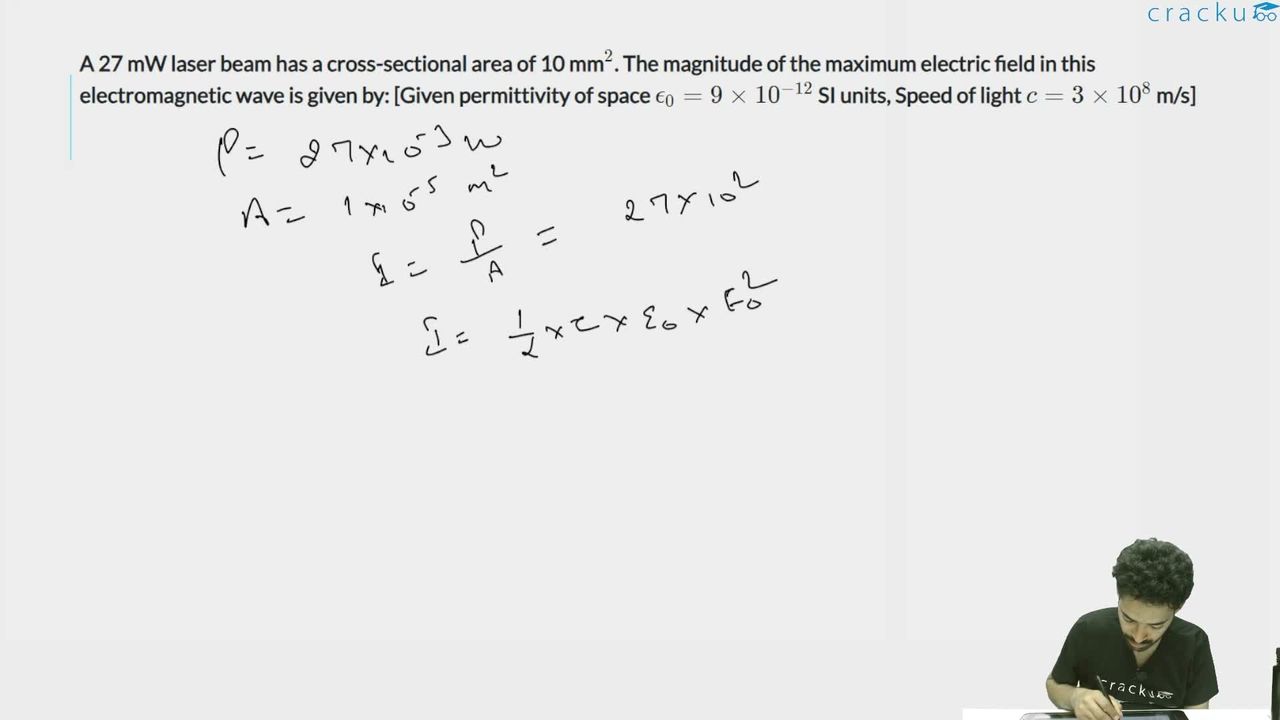
A 27 mW laser beam has a cross-sectional area of 10 mm$$^2$$. The magnitude of the maximum electric field in this electromagnetic wave is given by: [Given permittivity of space $$\epsilon_0 = 9 \times 10^{-12}$$ SI units, Speed of light $$c = 3 \times 10^8$$ m/s]
We have a laser beam whose power (rate of energy transport) is given as $$P = 27 \text{ mW}$$. First, we convert this power into SI units:
$$P = 27 \text{ mW} = 27 \times 10^{-3}\, \text{W}$$
The cross-sectional area of the beam is given as $$10 \text{ mm}^2$$. Converting square millimetres to square metres:
$$1 \text{ mm} = 10^{-3} \text{ m} \quad \Longrightarrow \quad 1 \text{ mm}^2 = (10^{-3} \text{ m})^2 = 10^{-6} \text{ m}^2$$
Hence,
$$A = 10 \text{ mm}^2 = 10 \times 10^{-6} \text{ m}^2 = 1 \times 10^{-5} \text{ m}^2$$
Intensity $$I$$ of an electromagnetic wave is the power per unit area, so we write
$$I = \dfrac{P}{A}$$
Substituting the numerical values,
$$I = \dfrac{27 \times 10^{-3}\, \text{W}}{1 \times 10^{-5}\, \text{m}^2}$$
$$I = 27 \times 10^{-3} \times 10^{5}\, \text{W m}^{-2}$$
$$I = 27 \times 10^{2}\, \text{W m}^{-2}$$
$$I = 2700\, \text{W m}^{-2}$$
Now, for a plane electromagnetic wave in free space, the relationship between the intensity and the maximum (peak) electric field $$E_0$$ is
$$I = \dfrac{1}{2}\, c\, \varepsilon_0\, E_0^{\,2}$$
where $$c$$ is the speed of light in vacuum and $$\varepsilon_0$$ is the permittivity of free space.
Rearranging for $$E_0$$, we get
$$E_0 = \sqrt{\dfrac{2I}{c\,\varepsilon_0}}$$
Substituting the numerical values $$I = 2700\,\text{W m}^{-2}$$, $$c = 3 \times 10^{8}\,\text{m s}^{-1}$$, and $$\varepsilon_0 = 9 \times 10^{-12}\,\text{F m}^{-1}$$, we have
$$E_0 = \sqrt{\dfrac{2 \times 2700}{(3 \times 10^{8})(9 \times 10^{-12})}}$$
First compute the numerator:
$$2 \times 2700 = 5400$$
Next compute the denominator $$c\,\varepsilon_0$$:
$$c\,\varepsilon_0 = (3 \times 10^{8})(9 \times 10^{-12})$$
$$= 27 \times 10^{-4}$$
$$= 2.7 \times 10^{-3}$$
So we now have
$$E_0 = \sqrt{\dfrac{5400}{2.7 \times 10^{-3}}}$$
Dividing inside the square root:
$$\dfrac{5400}{2.7 \times 10^{-3}} = \dfrac{5400}{2.7} \times 10^{3} = 2000 \times 10^{3} = 2.0 \times 10^{6}$$
Therefore,
$$E_0 = \sqrt{2.0 \times 10^{6}}$$
$$E_0 = \sqrt{2}\,\times 10^{3}\, \text{V m}^{-1}$$
$$E_0 \approx 1.414 \times 10^{3}\, \text{V m}^{-1}$$
$$E_0 \approx 1.4 \times 10^{3}\, \text{V m}^{-1}$$
Since $$1\,\text{kV m}^{-1} = 10^{3}\,\text{V m}^{-1}$$, we have
$$E_0 \approx 1.4\,\text{kV m}^{-1}$$
Hence, the correct answer is Option D.
Was this solution helpful?
Click on the Email ☝️ to Watch the Video Solution
Create a FREE account and get:
_1.webp)

Educational materials for JEE preparation

Ask our AI anything

AI can make mistakes. Please verify important information.
AI can make mistakes. Please verify important information.


