
Join Our JEE Preparation Group
Prep with like-minded aspirants; Get access to free daily tests and study material.
Sign in
Please select an account to continue using cracku.in
↓ →
Join Our JEE Preparation Group
Prep with like-minded aspirants; Get access to free daily tests and study material.
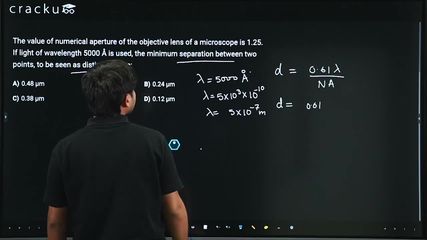
The value of numerical aperture of the objective lens of a microscope is 1.25. If light of wavelength 5000 Å is used, the minimum separation between two points, to be seen as distinct, will be:
We are told that the numerical aperture of the objective lens is $$\text{NA}=1.25$$ and that light of wavelength $$\lambda=5000\ \text{\AA}$$ is used.
First, the wavelength must be expressed in metres. We recall that $$1\ \text{\AA}=10^{-10}\ \text{m}.$$ Hence
$$ \lambda = 5000\ \text{\AA}=5000 \times 10^{-10}\ \text{m}=5 \times 10^{-7}\ \text{m}. $$
For a microscope objective, the Rayleigh criterion gives the minimum resolvable distance (limit of resolution) as
$$ d = \frac{0.61\,\lambda}{\text{NA}}. $$
Substituting the known values, we have
$$ d = \frac{0.61 \times 5 \times 10^{-7}\ \text{m}}{1.25}. $$
First multiply the numerator:
$$ 0.61 \times 5 = 3.05, $$
so
$$ d = \frac{3.05 \times 10^{-7}\ \text{m}}{1.25}. $$
Now divide by 1.25:
$$ \frac{3.05}{1.25}=2.44, $$
hence
$$ d = 2.44 \times 10^{-7}\ \text{m}. $$
To convert this result into micrometres, we remember that $$1\ \mu\text{m}=10^{-6}\ \text{m}.$$ Therefore
$$ d = 2.44 \times 10^{-7}\ \text{m} = 2.44 \times 10^{-7}\ \text{m} \times \frac{1\ \mu\text{m}}{10^{-6}\ \text{m}} = 0.244\ \mu\text{m}. $$
Rounded to two significant figures, this is $$0.24\ \mu\text{m}.$$
Hence, the correct answer is Option B.
Click on the Email ☝️ to Watch the Video Solution
Create a FREE account and get:
_1.webp)

Educational materials for JEE preparation

Ask our AI anything

AI can make mistakes. Please verify important information.
AI can make mistakes. Please verify important information.


