
Join Our JEE Preparation Group
Prep with like-minded aspirants; Get access to free daily tests and study material.
Sign in
Please select an account to continue using cracku.in
↓ →
Join Our JEE Preparation Group
Prep with like-minded aspirants; Get access to free daily tests and study material.
A concave mirror has radius of curvature of 40 cm. It is at the bottom of a glass that has water filled up to 5 cm (see figure). If a small particle is floating on the surface of water, its image as seen, from directly above the glass, is at a distance d from the surface of water. The value of d is close to: (Refractive index of water = 1.33)
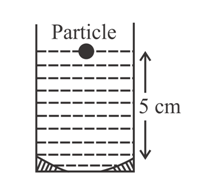
$$\text{For the reflection at the concave mirror: } R = -40\text{ cm} \implies f = \frac{R}{2} = -20\text{ cm}$$
$$\text{The particle is at the surface, so the object distance is: } u = -5\text{ cm}$$
$$\frac{1}{v} + \frac{1}{u} = \frac{1}{f} \implies \frac{1}{v} + \frac{1}{-5} = \frac{1}{-20}$$
$$\frac{1}{v} = \frac{1}{5} - \frac{1}{20} = \frac{3}{20} \implies v = +\frac{20}{3}\text{ cm}$$
$$\text{The positive sign means the virtual image } I_1 \text{ forms behind the mirror at a distance of } \frac{20}{3}\text{ cm.}$$
$$\text{Real depth of } I_1 \text{ from the water surface: } d_{\text{real}} = 5 + \frac{20}{3} = \frac{35}{3}\text{ cm}$$
$$\text{Apparent depth } d \text{ after refraction at the water-air interface: } d = \frac{d_{\text{real}}}{\mu_{\text{water}}}$$
$$d = \frac{35/3}{4/3} = \frac{35}{4} = 8.75\text{ cm} \approx 8.8\text{ cm}$$
Create a FREE account and get:
_1.webp)

Educational materials for JEE preparation

Ask our AI anything

AI can make mistakes. Please verify important information.
AI can make mistakes. Please verify important information.


