
Join Our JEE Preparation Group
Prep with like-minded aspirants; Get access to free daily tests and study material.
Sign in
Please select an account to continue using cracku.in
↓ →
Join Our JEE Preparation Group
Prep with like-minded aspirants; Get access to free daily tests and study material.
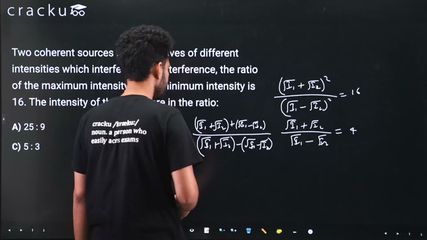
Two coherent sources produce waves of different intensities which interfere. After interference, the ratio of the maximum intensity to the minimum intensity is 16. The intensity of the waves are in the ratio:
We start with the well-known expressions for the maximum and minimum intensities obtained when two coherent light waves of individual intensities $$I_1$$ and $$I_2$$ interfere.
The formulae are stated as:
$$I_{\text{max}}=(\sqrt{I_1}+\sqrt{I_2})^{2}$$
$$I_{\text{min}}=(\sqrt{I_1}-\sqrt{I_2})^{2}$$
The question tells us that after interference the ratio $$I_{\text{max}}:I_{\text{min}}$$ equals $$16:1$$. Translating this into an equation, we have
$$\frac{I_{\text{max}}}{I_{\text{min}}}=16$$
Substituting the expressions for $$I_{\text{max}}$$ and $$I_{\text{min}}$$,
$$\frac{(\sqrt{I_1}+\sqrt{I_2})^{2}}{(\sqrt{I_1}-\sqrt{I_2})^{2}}=16$$
To simplify, we let the ratio of the amplitudes (square-root intensities) be
$$a=\frac{\sqrt{I_1}}{\sqrt{I_2}}$$
Rewriting the equation in terms of $$a$$ gives
$$\frac{(a+1)^{2}}{(a-1)^{2}}=16$$
Cross-multiplying,
$$(a+1)^{2}=16(a-1)^{2}$$
Now we expand both binomials:
$$a^{2}+2a+1 = 16(a^{2}-2a+1)$$
$$a^{2}+2a+1 = 16a^{2}-32a+16$$
Bringing every term to the right side yields zero on the left:
$$0 = 16a^{2}-32a+16 - (a^{2}+2a+1)$$
$$0 = 15a^{2}-34a+15$$
The quadratic $$15a^{2}-34a+15=0$$ can be factorised as
$$(5a-3)(3a-5)=0$$
So, the possible values of $$a$$ are
$$a=\frac{3}{5} \quad \text{or} \quad a=\frac{5}{3}$$
Because amplitudes are positive and we conventionally take $$a\ge 1$$ by choosing the larger intensity in the numerator, we select
$$a=\frac{5}{3}$$
The ratio of the original intensities is the square of the amplitude ratio:
$$\frac{I_1}{I_2}=a^{2}=\left(\frac{5}{3}\right)^{2}=\frac{25}{9}$$
Thus the two waves have intensities in the ratio $$25:9$$.
Hence, the correct answer is Option A.
Was this solution helpful?
Click on the Email ☝️ to Watch the Video Solution
Create a FREE account and get:
_1.webp)

Educational materials for JEE preparation

Ask our AI anything

AI can make mistakes. Please verify important information.
AI can make mistakes. Please verify important information.
