
Join Our JEE Preparation Group
Prep with like-minded aspirants; Get access to free daily tests and study material.
Sign in
Please select an account to continue using cracku.in
↓ →
Join Our JEE Preparation Group
Prep with like-minded aspirants; Get access to free daily tests and study material.
Consider a tank made of glass (refractive index 1.5) with a thick bottom. It is filled with a liquid of refractive index $$\mu$$. A student finds that, irrespective of what the incident angle $$i$$ (see figure) is for a beam of light entering the liquid, the light reflected from the liquid glass interface is never completely polarized. For this to happen, the minimum value of $$\mu$$ is:
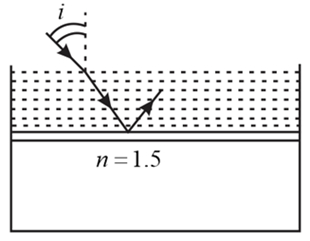
Let $$r$$ be the angle of refraction inside the liquid. By Snell's Law at the air-liquid interface: $$1 \cdot \sin i = \mu \sin r \implies \sin r = \frac{\sin i}{\mu}$$
Since the maximum value of $$\sin i$$ is 1, the maximum possible angle of refraction $$r_{\text{max}}$$ is bounded by:
$$\sin r_{\text{max}} = \frac{1}{\mu}$$
For light reflected from the liquid-glass interface to be completely polarized, the angle of incidence on that interface must equal Brewster's angle $$\theta_p$$:
$$\tan \theta_p = \frac{n_g}{\mu} = \frac{1.5}{\mu}$$
$$\sin \theta_p = \frac{1.5}{\sqrt{1.5^2 + \mu^2}} = \frac{3}{\sqrt{9 + 4\mu^2}}$$
If the reflected light is never completely polarized for any incident angle $$i$$, it means the Brewster's angle $$\theta_p$$ is physically unattainable because it exceeds the maximum available angle of refraction inside the liquid:
$$\theta_p > r_{\text{max}} \implies \sin \theta_p > \sin r_{\text{max}}$$
$$\frac{3}{\sqrt{9 + 4\mu^2}} > \frac{1}{\mu}$$
$$\frac{9}{9 + 4\mu^2} > \frac{1}{\mu^2} \implies 9\mu^2 > 9 + 4\mu^2$$
$$5\mu^2 > 9 \implies \mu > \frac{3}{\sqrt{5}}$$
Therefore, the minimum value required for this condition to hold is: $$\mu_{\text{min}} = \frac{3}{\sqrt{5}}$$
Was this solution helpful?
Create a FREE account and get:
_1.webp)

Educational materials for JEE preparation

Ask our AI anything

AI can make mistakes. Please verify important information.
AI can make mistakes. Please verify important information.
