
Join Our JEE Preparation Group
Prep with like-minded aspirants; Get access to free daily tests and study material.
Sign in
Please select an account to continue using cracku.in
↓ →
Join Our JEE Preparation Group
Prep with like-minded aspirants; Get access to free daily tests and study material.
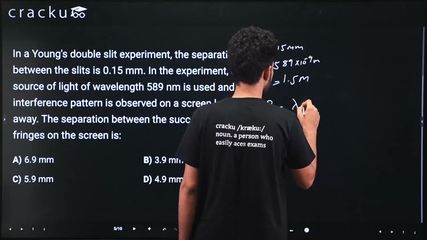
In a Young's double slit experiment, the separation between the slits is 0.15 mm. In the experiment, a source of light of wavelength 589 nm is used and the interference pattern is observed on a screen kept 1.5 m away. The separation between the successive bright fringes on the screen is:
We know that, in Young’s double slit experiment, the linear separation between two successive bright (or dark) fringes on the screen is called the fringe width $$\beta$$ and is given by the formula
$$\beta \;=\;\dfrac{\lambda\,D}{d}$$
where
$$\lambda$$ = wavelength of the monochromatic light,
$$D$$ = distance between the double-slit plane and the screen,
$$d$$ = separation between the two slits.
First, we convert every quantity to SI units:
Wavelength: $$\lambda = 589 \text{ nm} = 589 \times 10^{-9}\ \text{m}$$
Slit separation: $$d = 0.15 \text{ mm} = 0.15 \times 10^{-3}\ \text{m}$$
Screen distance: $$D = 1.5\ \text{m}$$ (already in SI units).
Now we substitute these values into the formula:
$$ \beta = \dfrac{\lambda\,D}{d} = \dfrac{(589 \times 10^{-9}\ \text{m}) \;(1.5\ \text{m})}{0.15 \times 10^{-3}\ \text{m}} $$
First we multiply the numerical values in the numerator:
$$589 \times 1.5 = 883.5$$
So,
$$ \beta = \dfrac{883.5 \times 10^{-9}\ \text{m}^{2}}{0.15 \times 10^{-3}\ \text{m}} $$
Next, we divide the powers of ten separately. We have
$$\dfrac{10^{-9}}{10^{-3}} = 10^{-9 - (-3)} = 10^{-6}$$
and for the numerical division:
$$\dfrac{883.5}{0.15} = \dfrac{883.5 \times 100}{15} = \dfrac{88350}{15} = 5890$$
Hence,
$$ \beta = 5890 \times 10^{-6}\ \text{m} = 5.890 \times 10^{-3}\ \text{m} $$
To convert metres to millimetres, we recall that $$1\ \text{m} = 1000\ \text{mm}$$, so
$$ \beta = 5.890 \times 10^{-3}\ \text{m} \times 1000\ \dfrac{\text{mm}}{\text{m}} = 5.890\ \text{mm} \approx 5.9\ \text{mm}. $$
Hence, the correct answer is Option C.
Was this solution helpful?
Click on the Email ☝️ to Watch the Video Solution
Create a FREE account and get:
_1.webp)

Educational materials for JEE preparation

Ask our AI anything

AI can make mistakes. Please verify important information.
AI can make mistakes. Please verify important information.
