
Join Our JEE Preparation Group
Prep with like-minded aspirants; Get access to free daily tests and study material.
Sign in
Please select an account to continue using cracku.in
↓ →
Join Our JEE Preparation Group
Prep with like-minded aspirants; Get access to free daily tests and study material.
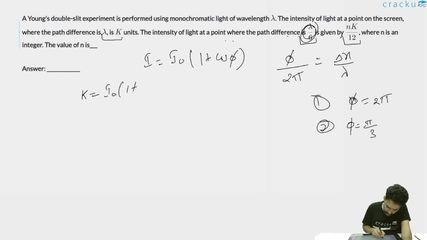
A Young's double-slit experiment is performed using monochromatic light of wavelength $$\lambda$$. The intensity of light at a point on the screen, where the path difference is $$\lambda$$, is $$K$$ units. The intensity of light at a point where the path difference is $$\dfrac{\lambda}{6}$$ is given by $$\dfrac{nK}{12}$$, where n is an integer. The value of n is___
Correct Answer: 9
For interference of two coherent sources in a Young’s double-slit arrangement, the resultant intensity at any point is obtained from the formula
$$I \;=\; I_0\,\bigl(1+\cos\phi\bigr),$$
where $$I_0$$ is the intensity due to each slit taken separately, and $$\phi$$ is the phase difference between the two waves at the observation point. The phase difference in terms of path difference $$\Delta x$$ is
$$\phi \;=\; \frac{2\pi}{\lambda}\,\Delta x.$$
We first use the given information for the point where the path difference is $$\lambda$$.
For $$\Delta x = \lambda$$ we have
$$\phi \;=\; \frac{2\pi}{\lambda}\,\lambda \;=\; 2\pi.$$
Substituting $$\phi = 2\pi$$ in the intensity expression, we obtain
$$I_{\lambda} \;=\; I_0\bigl(1+\cos 2\pi\bigr).$$
Since $$\cos 2\pi = 1,$$ this gives
$$I_{\lambda} \;=\; I_0(1+1) \;=\; 2I_0.$$
The problem states that this intensity equals $$K$$ units, so
$$K \;=\; 2I_0.$$
Now we move to the point where the path difference is $$\dfrac{\lambda}{6}$$.
For $$\Delta x = \dfrac{\lambda}{6},$$ the phase difference is
$$\phi \;=\; \frac{2\pi}{\lambda}\,\frac{\lambda}{6} \;=\; \frac{\pi}{3}.$$
Using the intensity formula again, we have
$$I_{\lambda/6} \;=\; I_0\bigl(1 + \cos\!\tfrac{\pi}{3}\bigr).$$
Because $$\cos\!\tfrac{\pi}{3} = \tfrac{1}{2},$$ the expression becomes
$$I_{\lambda/6} \;=\; I_0\bigl(1 + \tfrac12\bigr) \;=\; \tfrac32 I_0.$$
The question tells us that this same intensity can be written as $$\dfrac{nK}{12}$$. We therefore set
$$\tfrac32 I_0 \;=\; \frac{nK}{12}.$$
Substituting $$K = 2I_0$$ from our earlier result, we get
$$\tfrac32 I_0 \;=\; \frac{n(2I_0)}{12} \;=\; \frac{n I_0}{6}.$$
Dividing both sides by $$I_0$$ to eliminate it, we are left with
$$\tfrac32 \;=\; \frac{n}{6}.$$
Multiplying by 6, we finally obtain
$$n = 9.$$
Hence, the correct answer is Option 9.
Was this solution helpful?
Click on the Email ☝️ to Watch the Video Solution
Create a FREE account and get:
_1.webp)

Educational materials for JEE preparation

Ask our AI anything

AI can make mistakes. Please verify important information.
AI can make mistakes. Please verify important information.


