Join WhatsApp Icon JEE WhatsApp Group
JEE Solutions Questions

JEE Solutions Questions

Question 1

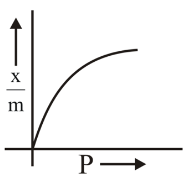
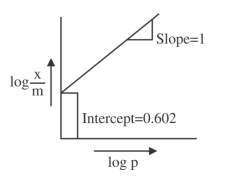
At a given temperature, 0.45 g of acetic acid in 50 mL of water is shaken with 1.0 g of charcoal and the pH of the resulting solution is 3.0. Assume, the adsorption of acetic acid from the aqueous solution by charcoal follows Freundlich isotherm,

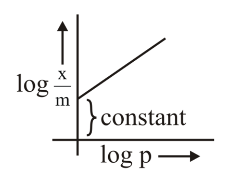
$$\dfrac{x}{m}=kC^{1/n}$$

If the plot of $$\log_{10}(x/m)$$ against $$\log_{10}C$$ gives a straight line with slope 1, the value of $$k$$ in L mol$$^{-1}$$ is ___.

Given: The molar mass of acetic acid is 60 g mol$$^{-1}$$.
The acid dissociation constant of acetic acid is $$1.0\times 10^{-5}$$ at the given temperature.
$$x$$ is the mass (in grams) of acetic acid adsorbed. $$m$$ is the mass (in grams) of charcoal.
$$C$$ is the equilibrium concentration of acetic acid in the solution after the adsorption is complete.
$$k$$ and $$n$$ are constants for acetic acid$$-$$charcoal system at the given temperature.

Question 2

In a solvent S, a compound B is partially dissociated into C and D as given below:

$$\mathbf{B}\rightleftharpoons 2\mathbf{C}+2\mathbf{D}$$

B, C and D are non-volatile in nature. The molar mass of B is 10 times the molar mass of S. The standard boiling point and the standard enthalpy of vaporization of S are 400 K and $$10R$$ J mol$$^{-1}$$, respectively ($$R$$ is the gas constant in J K$$^{-1}$$ mol$$^{-1}$$). A solution of B in S with an initial concentration of B as 0.25% (mass/mass) has a boiling point of 408 K at 1 bar pressure. In this solution, the mole percent of B that has been dissociated is ___.

Question 3

Question Stem (Q15 & Q16): Two volatile liquids A and B form an ideal solution. Consider a 5 molal solution of B in A inside a closed container having a total vapour pressure of 100 mm Hg at 300 K. The vapour pressure of pure A at 300 K is 105 mm Hg. Assume that A and B behave as ideal gases in the vapour phase.

Given: The gas constant $$R=0.08$$ L atm K$$^{-1}$$ mol$$^{-1}$$;
Molar mass of A is 50 g mol$$^{-1}$$;
Molar mass of B is 57 g mol$$^{-1}$$;
Density of liquid B at 300 K is 0.5 g/mL; 1 atm $$=760$$ mm Hg.

At 300 K, the ratio of the molar volume of pure B in vapour phase to its molar volume in liquid phase is ___.

Question 4

Question Stem (Q15 & Q16): Two volatile liquids A and B form an ideal solution. Consider a 5 molal solution of B in A inside a closed container having a total vapour pressure of 100 mm Hg at 300 K. The vapour pressure of pure A at 300 K is 105 mm Hg. Assume that A and B behave as ideal gases in the vapour phase.

Given: The gas constant $$R=0.08$$ L atm K$$^{-1}$$ mol$$^{-1}$$;
Molar mass of A is 50 g mol$$^{-1}$$;
Molar mass of B is 57 g mol$$^{-1}$$;
Density of liquid B at 300 K is 0.5 g/mL; 1 atm $$=760$$ mm Hg.

The mole fraction of B in vapour phase which is in equilibrium with this solution is ___.

Question 5

Given below are two statements :
Given : Molar mass of C, H, O, Cl are 12, 1, 16 and 35.5 g mol$$^{-1}$$, respectively
Statement I : In 30% (w/w) solution of methanol in CCl$$_4$$(at T K), the mole fraction of CCl$$_4$$ is equal to 0.33.
Statement II : Mixture of methanol and CCl$$_4$$ shows positive deviation from Raoult's law.
In the light of the above statements, choose the correct answer from the options given below :

Question 6

Consider a solution of $$CO_{2} (g)$$ dissolved in water in a closed container.

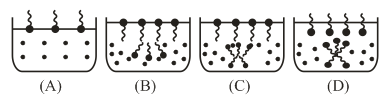
Which one of the following plots correctly represents variation of log (partial pressure of $$CO_{2}$$ in vapour phase above water) [y-axis] with log (mole fraction of $$CO_{2}$$ in water) [x-axis] at $$ 25^{o}C $$?

Question 7

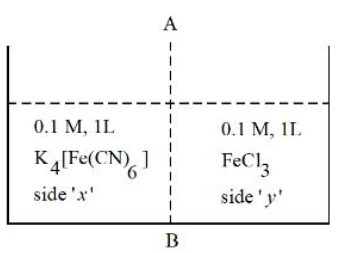
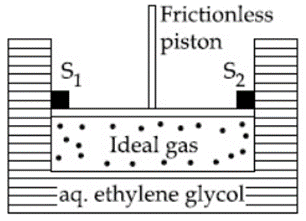
At 27 °C, 0.1 M, 1 L K$$_4$$[Fe(CN)$$_6$$] aqueous solution and 0.1 M, 1 L FeCl$$_3$$ aqueous solution are placed in a container separated by a semi permeable membrane AB. Assume complete dissociation of both the solutes. Which of the following statement is correct?

image
Question 8

What is the mole fraction of water in 10% by weight (w/w) of aqueous urea solution? [Given: Molar mass of H, O, C and N are 1, 16, 12 and 14 g mol$$^{-1}$$ respectively.]

Question 9

Which of the following statements are not correct?
A. For water, magnitude of $$K_b$$ is more than the magnitude of $$K_f$$.
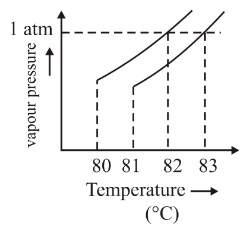
B. The elevation in boiling point of water when a non-volatile solute is added to it is larger in magnitude than its depression in freezing point.
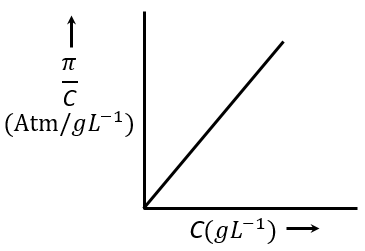
C. Osmotic pressure measurement is preferred over any other colligative property to determine molar mass of proteins and polymers.
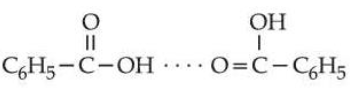
D. The dimerised form of benzoic acid in benzene is 

image


Choose the correct answer from the options given below :

Question 10

19.5 g of fluoro acetic acid (molar mass = 78 g mol$$^{-1}$$) is dissolved in 500 g of water at 298 K. The depression in the freezing point was 1°C. What is K$$_a$$ of fluoro acetic acid? (For water, K$$_f$$ = 1.86 K kg mol$$^{-1}$$). Assume molarity and molality to have same values.

Question 11

Given below are two statements :

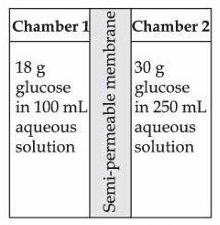
image


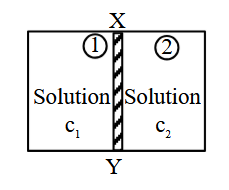
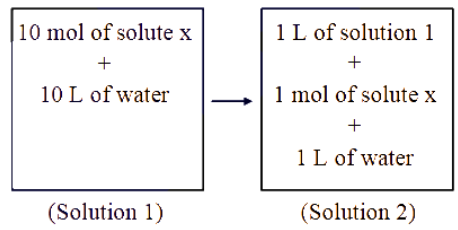
Statement I : H$$_2$$O molecules move from the chamber 1 to chamber 2.

Statement II : The osmotic pressure of a solution prepared by dissolving 50 mg of potassium sulphate (molar mass = 174 g/mol) in 2 L of water (at 27 °C) is 0.0107 bar. (Given: R = 0.083 dm$$^3$$ bar K$$^{-1}$$ mol$$^{-1}$$ and assume complete dissociation of electrolyte)

In the light of the above statements, choose the correct answer from the options given below :

Question 12

Solution A is prepared by dissolving 1 g of a protein (molar mass = 50000 g mol$$^{-1}$$) in 0.5 L of water at 300 K. Its osmotic pressure is $$x$$ bar. Solution B is made by dissolving 2 g of same protein in 1 L of water at 300 K. Osmotic pressure of solution B is $$y$$ bar. Entire solution of A is mixed with entire solution of B at same temperature. The osmotic pressure of resultant solution is $$z$$ bar. $$x$$, $$y$$ and $$z$$ respectively are :
($$R = 0.083$$ L bar mol$$^{-1}$$ K$$^{-1}$$)

Question 13

When 0.25 moles of a non-volatile, non-ionizable solute was dissolved in 1 mole of a solvent the vapor pressure of solution was $$x$$ % of vapor pressure of pure solvent. What is $$x$$ %?

Question 14

Which one of the following graphs accurately represents the plot of partial pressure of $$CS_{2}$$ vs its mole fraction in a mixture of acetone and $$CS_{2}$$ at constant temperature?

Question 15

Given below are two statements:

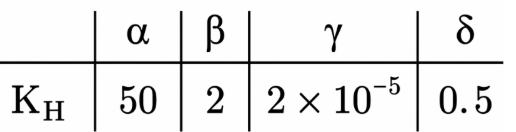
Statement I: The Henry's law constant $$K_{H}$$ is constant with respect to variations in solution's concentration over the range for which the solution is ideally dilute.

Statement II: $$K_{H}$$ does not differ for the same solute in different solvents.

In the light of the above statements, choose the correct answer from the options given below

Question 16

At 298 K, the mole percentage of $$N_{2}$$(g) in air is 80%. Water is in equilibrium with air at a pressure of 10 atm. What is the mole fraction of $$N_{2}$$(g) in water at 298 K?
($$K_{H}$$ for $$N_{2}$$ is $$6.5 \times 10^{7}$$ mm Hg)

Question 17

At T(K), 100 g of 98% $$H_{2}SO_{4}$$ (w /w) aqueous solution is mixed with 100 g of 49% $$H_{2}SO_{4}$$ (w /w) aqueous solution. What is the mole fraction of $$H_{2}SO_{4}$$ in the resultant solution?
(Given: Atomic mass H=1 u ; s=32 u ; 0 = 16 u).
(Assume that temperature after mixing remains constant)

Question 18

A solution is prepared by dissolving 0.3 g of a non-volatile non-electrolyte solute 'A' of molar mass 60 g $$mol^{-1}$$ and 0.9 g of a non-volatile non-electrolyte solute 'B' of molar mass 180 g $$mol^{-1}$$ in 100 mL $$H_{2}O$$ at 27°C. Osmotic pressure of the solution will be
[Given: R = 0.082 L atm $$K^{-1} mol^{-1}$$]

Question 19

At T(K), 2 moles of liquid A and 3 moles of liquid B are mixed. The vapour pressure of ideal solution fonned is 320 mm Hg. At this stage, one mole of A and one mole of B are added to the solution. The vapour pressure is now measmed as 328.6 mm Hg. The vapom pressure (in mm Hg) of A and B are respectively:

Question 20

Consider the following aqueous solutions.
I. 2.2 g Glucose in 125 ml of solution.
II. 1.9 g Calcium chloride in 250 ml of solution.
111. 9.0 g Urea in 500 ml of solution.
IV. 20.5 g Aluminium sulphate in 750 ml of solution.
The correct increasing order of boiling point of these solutions will be:
[Given : Molar mass in g $$mol^{-1}$$: H = 1, C=12, N= 14, 0=16, Cl =35.5, Ca=40, Al=27 and S=32]

Question 21

'W' g of a non-volatile electrolyte solid solute of molar mass 'M' g $$mol^{-1}$$ when dissolved in 100 mL water, decreases vapour pressure of water from 640 mm Hg to 600 mm Hg. If aqueous solution of the electrolyte boils at 375 K and $$K_{b}$$ for water is 0.52 K kg $$mol^{-1}$$, then the mole fraction of the electrolyte solute ($$x_{2}$$) in the solution can be expressed as
(Given : density of water= 1 g/mL and boiling point of water= 3 73 K)

Question 22

Elements P and Q form two types of non-volatile, non-ionizable compounds PQ and $$PQ_{2}$$. When 1g of PQ is dissolved in 50 g of solvent ''A', $$\Delta T_{b}$$was 1.176 K while when 1 g of $$PQ_{2}$$ is dissolved in 50g of solvent 'A'.$$\Delta T_{b}$$ was 0.689 K ($$K_{b}$$ of 'A' =5K kg $$mol^{-1}$$) The molar masses of elements P and Q (in g  $$mol^{-1}$$ )  respectively, are:

Question 23

Two liquids A and B form an ideal solution at temperature TK. At TK, the vapour pressures of pure A and B are 55 and 15 kN $$m^{-2}$$ respectively. What is the mole fraction of A in solution of A and B in equilibrium with a vapour in which the mole fraction of A is 0.8?

Question 24

A substance 'X' (1.5 g) dissolved in 150 g of a solvent 'Y'(molar mass=300 g $$mol^{-1}$$ ) led to an elevation of the boiling point by 0.5 K. The relative lowering in the vapour pressure of the solvent 'Y' is __________ $$\times 10^{-2}$$. (nearest integer)
[Given : $$K_{b}$$ of the solvent =5.0 K kg $$mol^{-1}$$]
Assume the solution to be dilute and no association or dissociation of X takes place in solution.

Question 25

20 g hemoglobin in a 1 L aqueous solution (A) at 300 K is separated from pure water by a semi-permeable membrane. At equilibrium, the height of solution in a tube dipped in solution (A) is found to be $$80.0 mm$$ higher than the tube dipped in water.
The molar mass of hemoglobin is ______ $$kg mol^{-1}$$. (Nearest integer)
(Given: $$g = 10 \, m \, s^{-2}$$, $$R = 8.3 \, kPa \, dm^{3} \, K^{-1} \, mol^{-1}$$, density of solution = $$1000 \, kg \, m^{-3}$$)

Question 26

The osmotic pressure of a living cell is 12 atm at 300 K. The strength of sodium chloride solution that is isotonic with the living cell at tltis temperature is __________ $$g L^{-1}$$.
(Nearest integer)
Given: R = 0.08 L atm $$K^{-1} mol^{-1}$$
Assume complete dissociation of NaCl
(Given : Molar mass of Na and Cl are 23 and 35.5 g $$mol^{-1}$$ respectively.)

Question 27

Two liquids A and B form an ideal solution. At 320 K, the vapour pressure of the solution, containing 3 mol of A and 1 mol of B is 500 mm Hg. At the same
temperature, if 1 mol of A is farther added to this solution, vapour pressure of the solution increases by 20 mm Hg. Vapour pressure (in mm Hg) of B in pure state is ____ . (Nearest integer)

Question 28

A non-volatile, non-electrolyte solid solute when dissolved in 40 g of a solvent, the vapour pressure of the solvent decreased from 760 mm Hg to 750 mm Hg. If the same solution boils at 320 K, then the number of moles of the solvent present in the solution is _____. (Nearest integer)
[Given: boiling point of the pure solvent = 319.5 K, $$K_b$$ of the solvent = 0.3 K kg mol$$^{-1}$$]

50,000+ JEE Students Trusted Our Score Calculator

Predict your JEE Main percentile, rank & performance in seconds