
Join Our JEE Preparation Group
Prep with like-minded aspirants; Get access to free daily tests and study material.
Sign in
Please select an account to continue using cracku.in
↓ →
Join Our JEE Preparation Group
Prep with like-minded aspirants; Get access to free daily tests and study material.
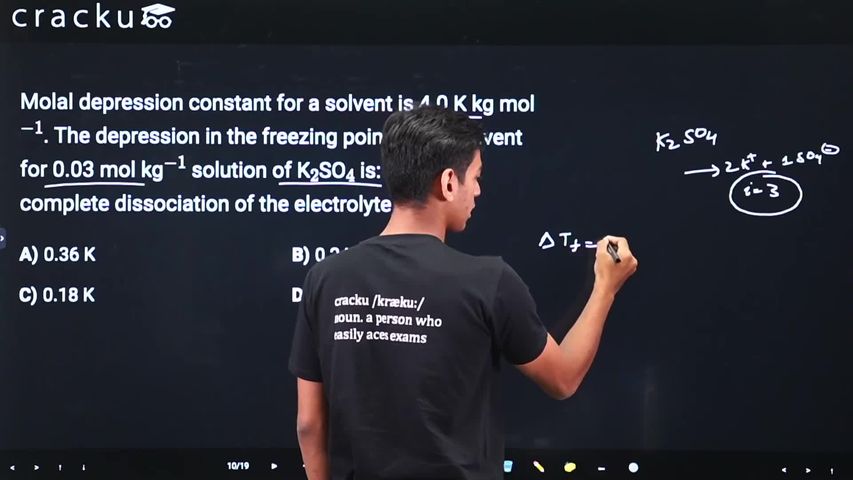
Molal depression constant for a solvent is 4.0 K kg mol$$^{-1}$$. The depression in the freezing point of the solvent for 0.03 mol kg$$^{-1}$$ solution of K$$_2$$SO$$_4$$ is: (Assume complete dissociation of the electrolyte)
We recall that the lowering of the freezing point for a solution is given by the relation of colligative properties. The formula is stated first:
$$\Delta T_f = i \, K_f \, m$$
where
$$\Delta T_f$$ = depression in freezing point (in kelvin),
$$i$$ = van’t Hoff factor (accounts for the number of particles produced by dissociation),
$$K_f$$ = molal depression constant of the solvent (in K kg mol−1),
$$m$$ = molality of the solution (in mol kg−1).
We are given that the solvent has $$K_f = 4.0\ \text{K kg mol}^{-1}$$ and the solution has a molality $$m = 0.03\ \text{mol kg}^{-1}$$.
Now, the solute is potassium sulfate, $$\text{K}_2\text{SO}_4$$. On complete dissociation, it produces two potassium ions and one sulfate ion:
$$\text{K}_2\text{SO}_4 \;\; \longrightarrow \;\; 2\,\text{K}^+ \;+\; \text{SO}_4^{2-}$$
Thus, the total number of ions formed per formula unit is
$$2 + 1 = 3$$
Hence, for complete dissociation, the van’t Hoff factor is
$$i = 3$$
Substituting everything into the freezing-point depression formula, we have
$$\Delta T_f = i \, K_f \, m = 3 \times 4.0\ \text{K kg mol}^{-1} \times 0.03\ \text{mol kg}^{-1}$$
Carrying out the multiplication step by step:
First multiply $$4.0$$ by $$0.03$$:
$$4.0 \times 0.03 = 0.12$$
Now multiply by the van’t Hoff factor $$3$$:
$$3 \times 0.12 = 0.36$$
So, we obtain
$$\Delta T_f = 0.36\ \text{K}$$
Hence, the correct answer is Option A.
Was this solution helpful?
Click on the Email ☝️ to Watch the Video Solution
Create a FREE account and get:
_1.webp)

Educational materials for JEE preparation

Ask our AI anything

AI can make mistakes. Please verify important information.
AI can make mistakes. Please verify important information.


