
Join Our JEE Preparation Group
Prep with like-minded aspirants; Get access to free daily tests and study material.
Sign in
Please select an account to continue using cracku.in
↓ →
Join Our JEE Preparation Group
Prep with like-minded aspirants; Get access to free daily tests and study material.
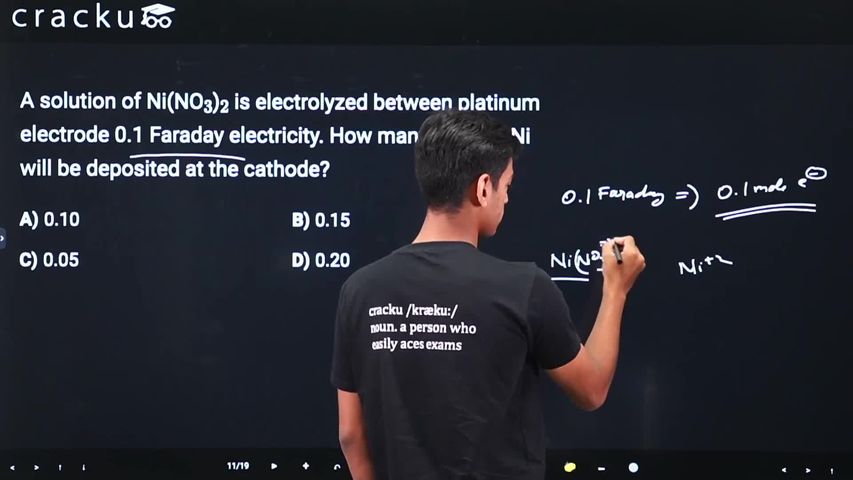
A solution of Ni(NO$$_3$$)$$_2$$ is electrolyzed between platinum electrode 0.1 Faraday electricity. How many mole of Ni will be deposited at the cathode?
First, we recall Faraday’s first law of electrolysis, which states that the amount of substance liberated or deposited at an electrode is directly proportional to the quantity of electricity passed through the electrolyte. Mathematically, the number of moles of electrons involved equals the number of Faradays of charge supplied:
$$\text{Moles of } e^- = \text{Faradays supplied}$$
We are told that $$0.1$$ Faraday of electricity is passed. Therefore, the moles of electrons that actually flow through the circuit are
$$n_{e^-}=0.1\text{ mol}$$
Now we look at the cathode reaction for nickel(II) ions. The ionic species present is $$\text{Ni}^{2+}$$ because the salt is $$\text{Ni(NO}_3)_2$$. At the cathode, reduction occurs, so the half-reaction is
$$\text{Ni}^{2+}+2e^- \;\longrightarrow\; \text{Ni(s)}$$
This equation shows clearly that two moles of electrons are required to deposit one mole of nickel metal. We translate this stoichiometric requirement into a proportionality:
$$2\ \text{mol } e^- \;\Longrightarrow\; 1\ \text{mol Ni}$$
To find the moles of nickel actually deposited, we set up the ratio using the number of electrons that have passed:
$$\text{Moles of Ni}=\dfrac{\text{Moles of } e^-}{2} =\dfrac{0.1}{2}$$
Carrying out the division gives
$$\text{Moles of Ni}=0.05\text{ mol}$$
Thus, the quantity of nickel metal formed on the cathode is precisely $$0.05$$ mole.
Hence, the correct answer is Option C.
Was this solution helpful?
Click on the Email ☝️ to Watch the Video Solution
Create a FREE account and get:
_1.webp)

Educational materials for JEE preparation

Ask our AI anything

AI can make mistakes. Please verify important information.
AI can make mistakes. Please verify important information.


