
Join Our JEE Preparation Group
Prep with like-minded aspirants; Get access to free daily tests and study material.
Sign in
Please select an account to continue using cracku.in
↓ →
Join Our JEE Preparation Group
Prep with like-minded aspirants; Get access to free daily tests and study material.
We recall that Earth’s atmosphere is divided into distinct layers on the basis of altitude. The commonly accepted sequence starting from the Earth’s surface is:
$$\text{Troposphere} \; < \text{Stratosphere} \; < \text{Mesosphere} \; < \text{Thermosphere}$$
These layers have approximate vertical extents that are widely memorised for elementary atmospheric science:
Troposphere: $$0\;\text{km} \text{ to } 10\;\text{km}$$
Stratosphere: $$10\;\text{km} \text{ to } 50\;\text{km}$$
Mesosphere: $$50\;\text{km} \text{ to } 80\;\text{km}$$
Thermosphere: $$80\;\text{km} \text{ upward (variable)}$$
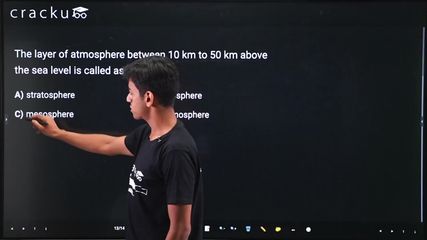
The question explicitly describes the layer lying between $$10\;\text{km}$$ and $$50\;\text{km}$$ above mean sea level. Consulting the altitude ranges stated above, we see that $$10\;\text{km} \le h \le 50\;\text{km}$$ corresponds exactly to the stratosphere.
None of the other given options match this altitude band: $$\begin{aligned} \text{Troposphere} &: 0\text{-}10\;\text{km} \quad (\text{too low}),\\ \text{Mesosphere} &: 50\text{-}80\;\text{km} \quad (\text{starts higher}),\\ \text{Thermosphere} &: \gt 80\;\text{km} \quad (\text{much higher}). \end{aligned}$$ So, by direct comparison, the only correct identification is the stratosphere.
Hence, the correct answer is Option A.
Was this solution helpful?
Click on the Email ☝️ to Watch the Video Solution
Create a FREE account and get:
_1.webp)

Educational materials for JEE preparation

Ask our AI anything

AI can make mistakes. Please verify important information.
AI can make mistakes. Please verify important information.


