
Join Our JEE Preparation Group
Prep with like-minded aspirants; Get access to free daily tests and study material.
Sign in
Please select an account to continue using cracku.in
↓ →
Join Our JEE Preparation Group
Prep with like-minded aspirants; Get access to free daily tests and study material.
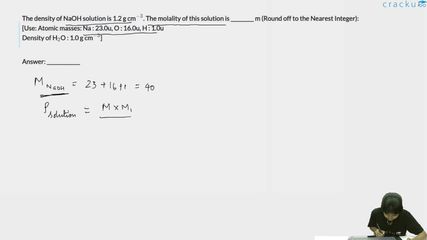
The density of NaOH solution is 1.2 g cm$$^{-3}$$. The molality of this solution is _________ m (Round off to the Nearest Integer):
[Use: Atomic masses: Na : 23.0u, O : 16.0u, H : 1.0u
Density of H$$_2$$O : 1.0 g cm$$^{-3}$$]
Correct Answer: 5
From Molarity ($$M$$) and Solvent Density ($$\rho_0$$):
$$\rho = \frac{M \cdot M_1}{1000} + \rho_0$$
Where:
= Density of the solution (g/mL)
= Density of the pure solvent (g/mL)
= Molarity of the solution (mol/L)
= Molar mass of the solute (g/mol)
Direct Molality ($$m$$) to Molarity ($$M$$) Relation:
Substitute the solution density formula into the standard relation to isolate the solvent density:
$$m = \frac{M}{\rho_0}$$
Note: This specific linear relationship ($$m = M/\rho_0$$) strictly holds true only for ideal solutions where the volumes of the solute and solvent are perfectly additive ($$V_{\text{solution}} = V_{\text{solvent}} + V_{\text{solute}}$$).
Solving for the NaOH Solution
To find the molality, we first need to use the given density of the solution to calculate the molarity ($$M$$), and then apply the direct relation.
1. Identify the Known Variables
2. Calculate Molarity ($$M$$)
Use the provided solution density formula:
$$\rho = \frac{M \cdot M_1}{1000} + \rho_0$$
Substitute the known values into the equation:
$$1.2 = \frac{M \cdot 40}{1000} + 1.0$$
Subtract 1.0 from both sides:
$$0.2 = \frac{40M}{1000}$$
$$0.2 = 0.04M$$
Solve for $$M$$:
$$M = \frac{0.2}{0.04}$$
$$M = 5 \text{ mol/L}$$
3. Calculate Molality ($$m$$)
Now, use the direct molality to molarity relation provided in your prompt:
$$m = \frac{M}{\rho_0}$$
Substitute the calculated molarity and the density of water:
$$m = \frac{5}{1.0}$$
$$m = 5 \text{ mol/kg}$$
Final Answer:
The molality of the NaOH solution is 5 m (mol/kg).
Was this solution helpful?
Click on the Email ☝️ to Watch the Video Solution
Create a FREE account and get:
_1.webp)

Educational materials for JEE preparation

Ask our AI anything

AI can make mistakes. Please verify important information.
AI can make mistakes. Please verify important information.
